Skill: Theme

Theme

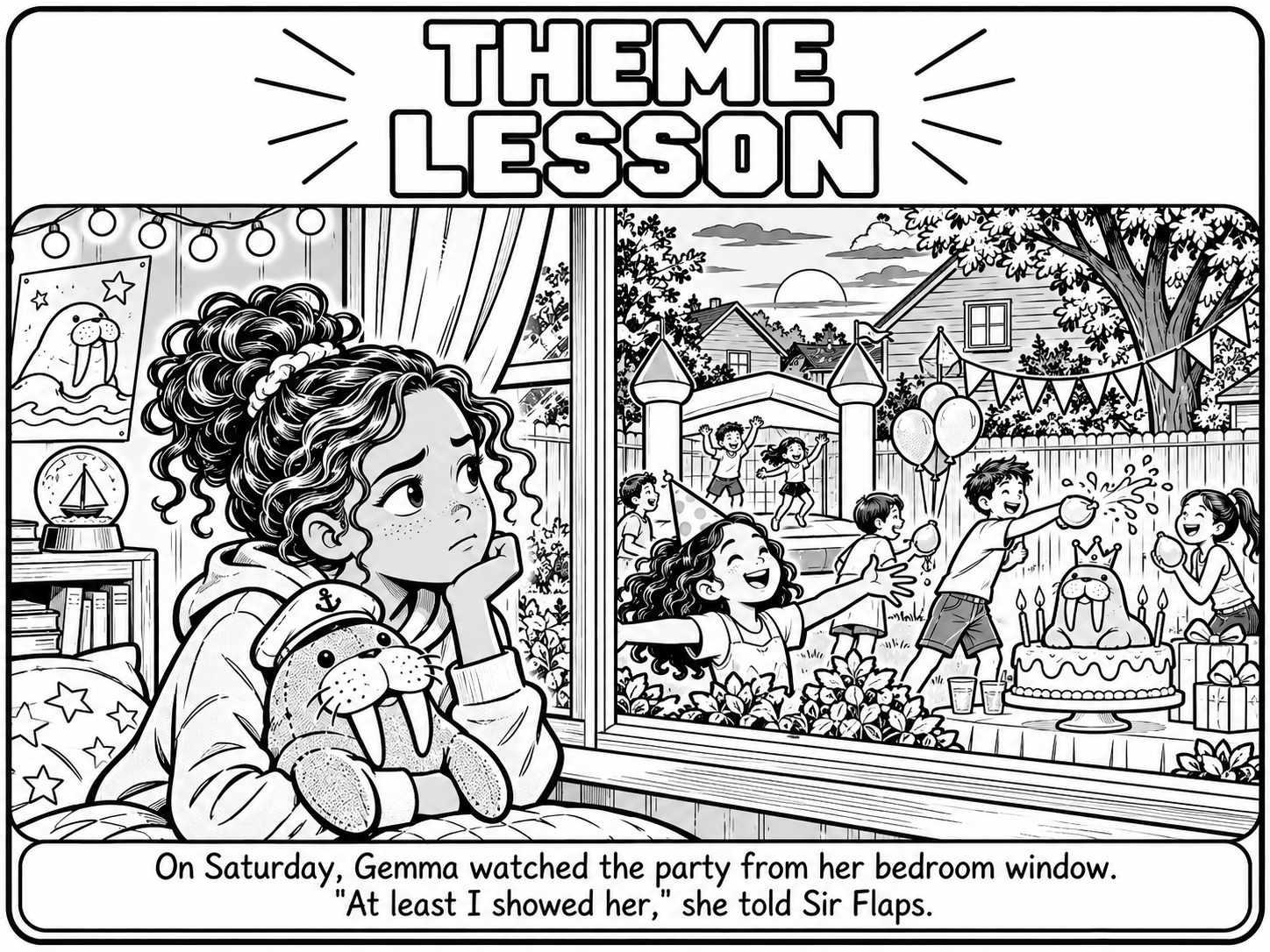
Theme is the lesson or message about life or human nature that a story teaches its readers. Authors rarely state a theme outright. Instead, readers infer it from what the characters choose, what happens because of those choices, and how the story ends. A theme is bigger than the story. It reaches beyond the story into real life.

Read the full Theme guide

Theme Topic vs. Theme Statement: Putting It into Words

  • Theme Topic: the subject a story explores, named in a word or two, like friendship, greed, or courage. A topic tells what a story is about, but a single word is not a theme.
  • Theme Statement: what the story says about its topic, written as a complete sentence. The topic greed, for example, might become "Greed can cost you more than it gets you." A strong theme statement doesn't reference the characters or plot of the story. Rather, it is a general statement that can apply to real world outside of the story.

The 4 C's: Where to Look for Theme Clues

  • Choices and Consequences: what the main character chooses and what happens as a result. Most themes grow out of a character's choices, good or bad.
  • Contrast: characters who respond differently to the same situation and end up in different places.
  • Change: what a character learns by the end of the story. When a character fails to learn the lesson, the reader often learns it instead.
  • Conflict: how the story's main problem is resolved, and which choices the ending rewards or punishes. (See Types of Conflict.)

Theme vs. Moral vs. Main Idea: Telling Them Apart

  • Theme: a lesson about life that readers infer from what happens in a story. The author shows it rather than stating it.
  • Moral: a lesson the story states outright, often in the last line of a fable, such as "Slow and steady wins the race."
  • Main Idea: what a nonfiction text, such as an article or a textbook chapter, is mostly about. Readers look for a theme in fiction and a main idea in nonfiction.

Interactive Lessons

Slide decks

Interactive Activities

Practice sets

Interactive Activity

Activity

Practice activities for this skill are coming soon. Check back as the collection grows.

  • Status: Coming soon
Theme activity preview

Standards & Objectives

Learning Objectives

  • Determine the theme of a story by analyzing characters' choices and their consequences, contrasts between characters, character change, and how the conflict is resolved.
  • Distinguish between a theme topic and a theme statement, and express a theme as a complete sentence that applies beyond the story.
  • Explain how a theme differs from a moral and a main idea.
  • Evaluate possible theme statements to separate a universal theme from story-specific statements, surface-level rules, and a character's mistaken conclusions.
  • Support a theme statement with specific evidence from the text and explain how key details convey the theme.

Standards Alignment

Common Core (CCSS)
CCSS.ELA-Literacy.CCRA.R.2Open

Determine central ideas or themes of a text and analyze their development; summarize the key supporting details and ideas.

Show standards (8)
Reading Literature (RL)
Key Ideas and Details
Grade 3
  • RL.3.2 Recount stories, including fables, folktales, and myths from diverse cultures; determine the central message, lesson, or moral and explain how it is conveyed through key details in the text.
Grade 4
  • RL.4.2 Determine a theme of a story, drama, or poem from details in the text; summarize the text.
Grade 5
  • RL.5.2 Determine a theme of a story, drama, or poem from details in the text, including how characters in a story or drama respond to challenges or how the speaker in a poem reflects upon a topic; summarize the text.
Grade 6
  • RL.6.2 Determine a theme or central idea of a text and how it is conveyed through particular details; provide a summary of the text distinct from personal opinions or judgments.
Grade 7
  • RL.7.2 Determine a theme or central idea of a text and analyze its development over the course of the text; provide an objective summary of the text.
Grade 8
  • RL.8.2 Determine a theme or central idea of a text and analyze its development over the course of the text, including its relationship to the characters, setting, and plot; provide an objective summary of the text.
Grades 9-10
  • RL.9-10.2 Determine a theme or central idea of a text and analyze in detail its development over the course of the text, including how it emerges and is shaped and refined by specific details; provide an objective summary of the text.
Grades 11-12
  • RL.11-12.2 Determine two or more themes or central ideas of a text and analyze their development over the course of the text, including how they interact and build on one another to produce a complex account; provide an objective summary of the text.

Copyright 2010. National Governors Association Center for Best Practices and Council of Chief State School Officers. All rights reserved.