Interactive Lesson
Adaptive Grades 3-12Auto-adapting difficulty. Content adjusts to student reading level in real time.
Interactive lessons for this skill are coming soon. Check back as the collection grows.
- Status: Coming soon

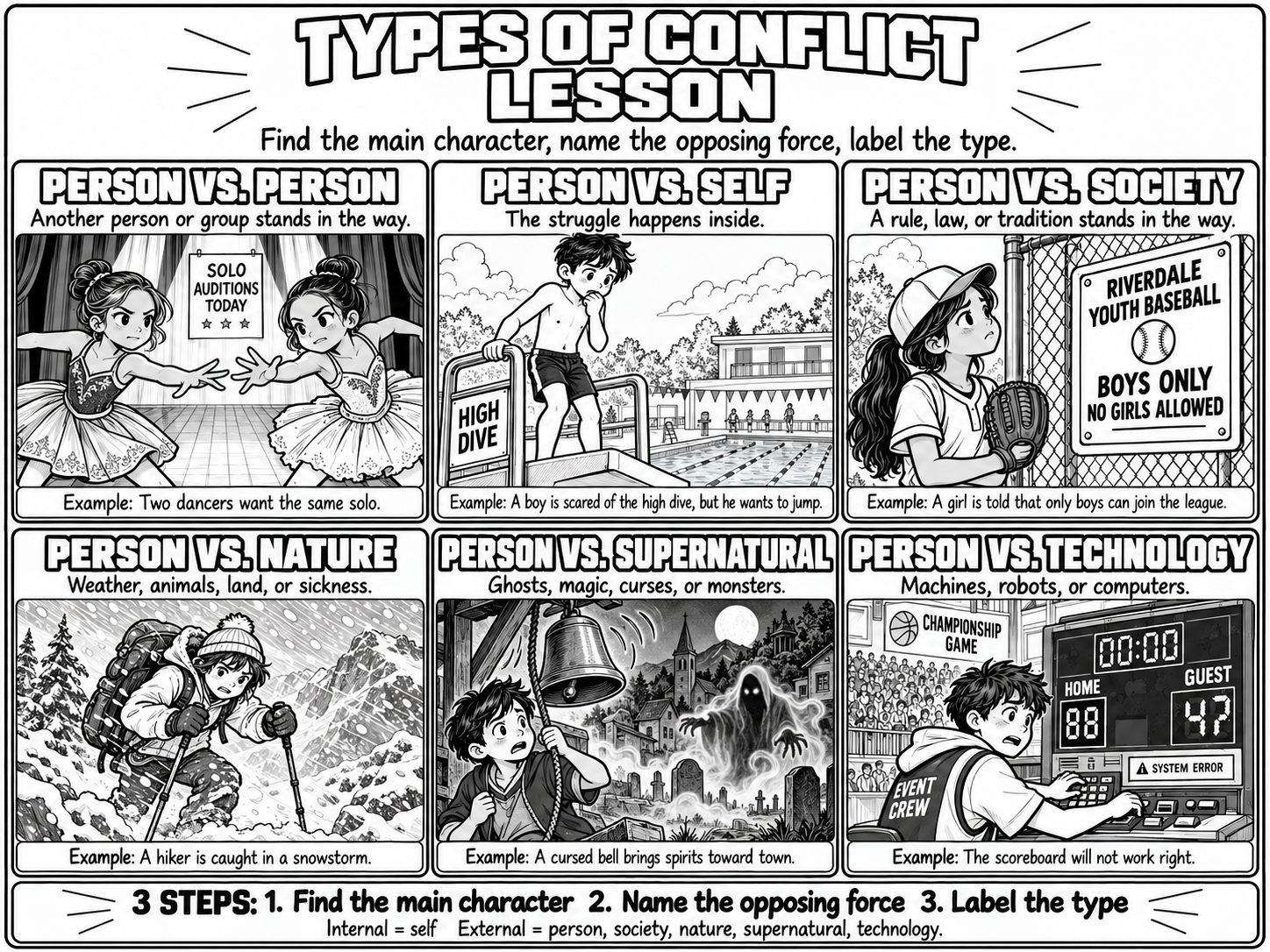
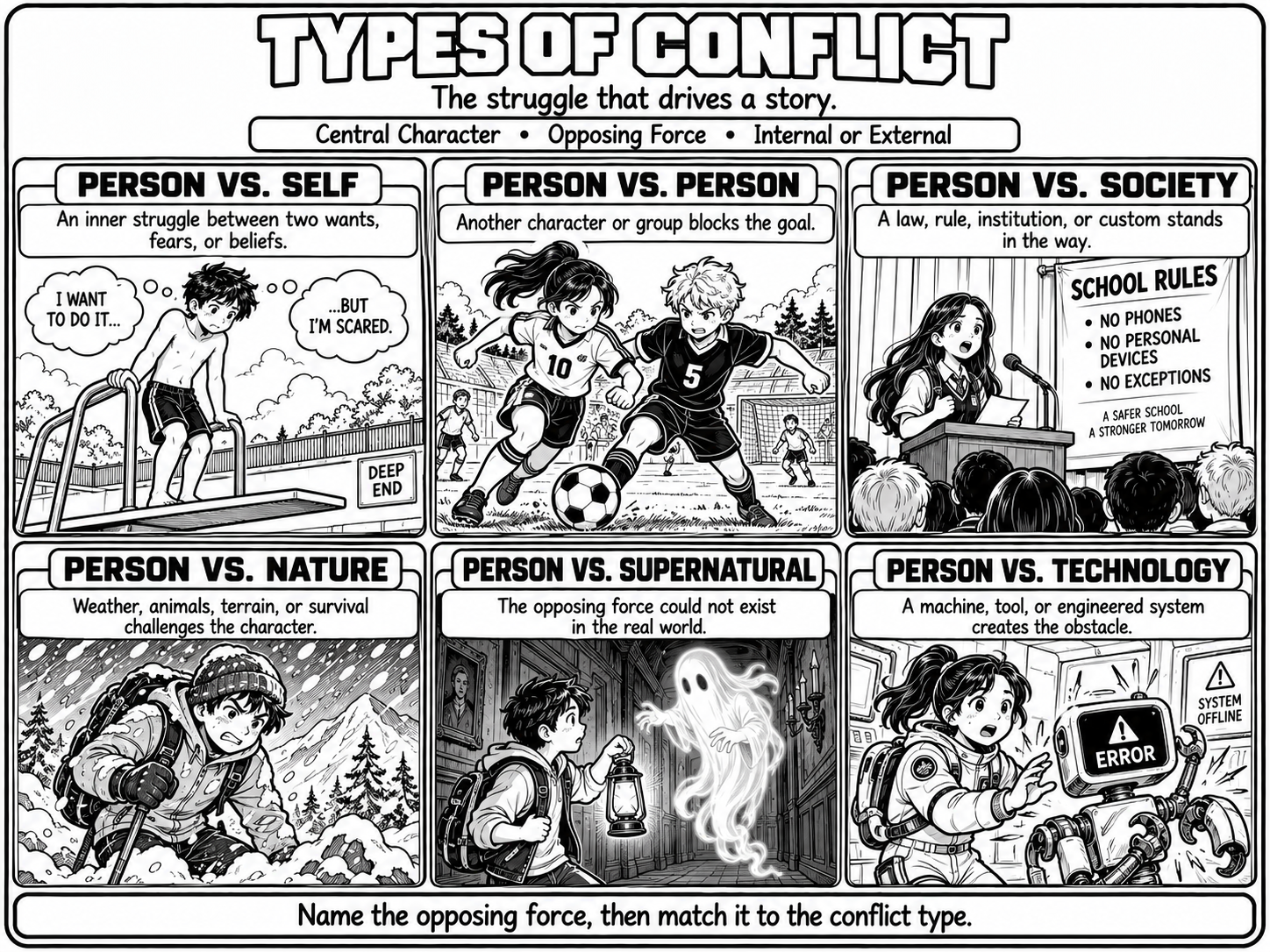
Conflict is the struggle that drives a story. On one side is the central character and whatever that character wants. On the other side is the opposing force, meaning whatever stands in the way. Here you will learn to name the force those characters are up against, because without one, nothing happens. A story with no conflict is just a list of events.
Any conflict can be named by asking three questions in order. Who is the central character? What is the opposing force? Is that force internal or external? The second question is the one that does the work. Naming the force is the whole analytical move. The label is just what you call that force once you have found it.
The steps work on any story, in any genre, at any length.
Once you have named the force, match it to one of six labels. In each label, person means the central character, even when that character is an animal or an imagined being. Only the first one on this list is internal.
The following resources will help students identify conflicts and types of conflicts in works of literature.
Auto-adapting difficulty. Content adjusts to student reading level in real time.
Interactive lessons for this skill are coming soon. Check back as the collection grows.
Practice activities for this skill are coming soon. Check back as the collection grows.
Analyze how and why individuals, events, or ideas develop and interact over the course of a text.
Read closely to determine what the text says explicitly and to make logical inferences from it; cite specific textual evidence when writing or speaking to support conclusions drawn from the text.
Copyright 2010. National Governors Association Center for Best Practices and Council of Chief State School Officers. All rights reserved.
Discussion