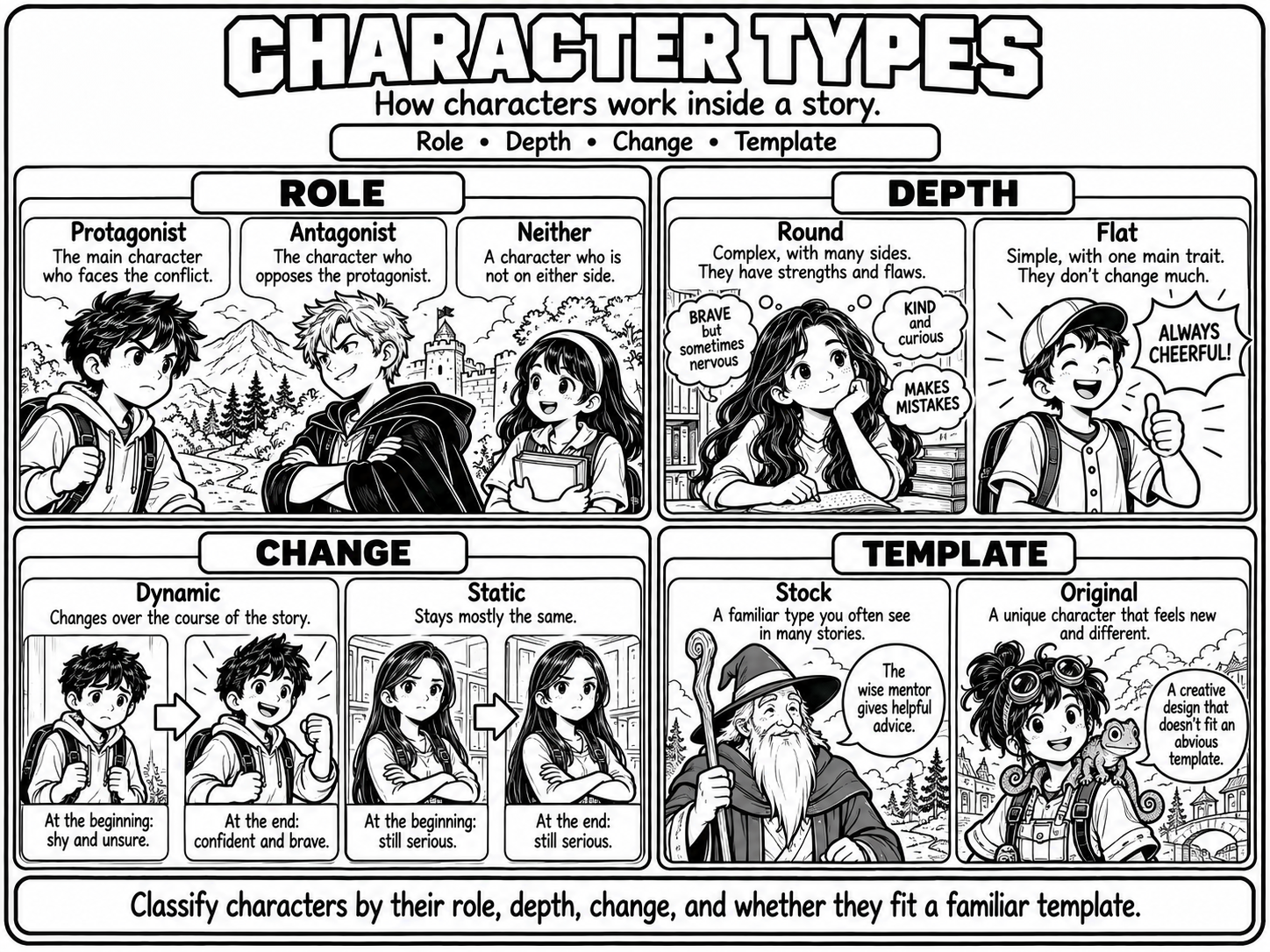
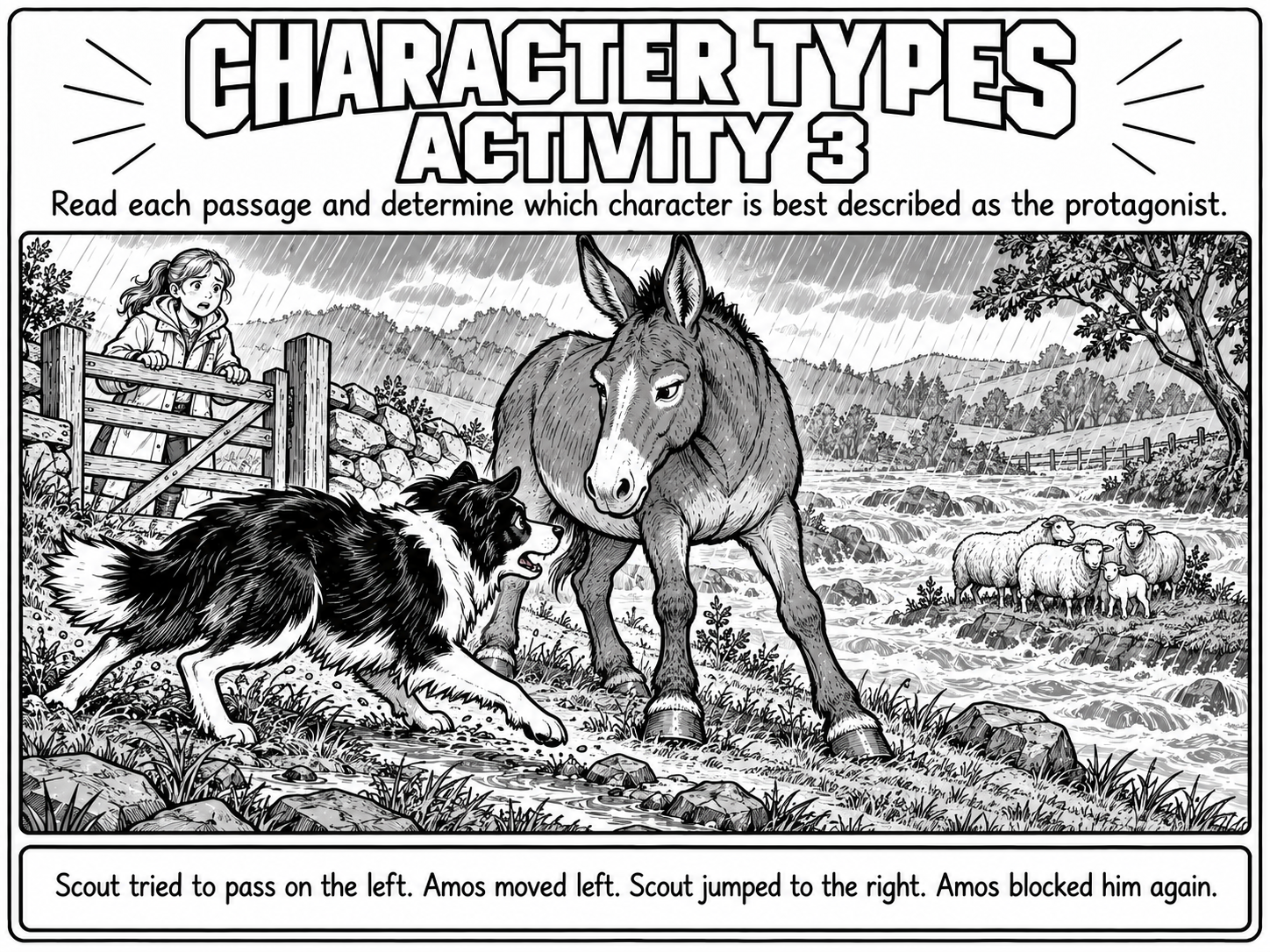
Character types describe how a character works inside a story. Every story runs on characters: the people, animals, or beings who face the conflict and carry the plot. In the last skill you learned how authors reveal what a character is like. Now you will learn how to classify what each character actually does once those traits are on the page.
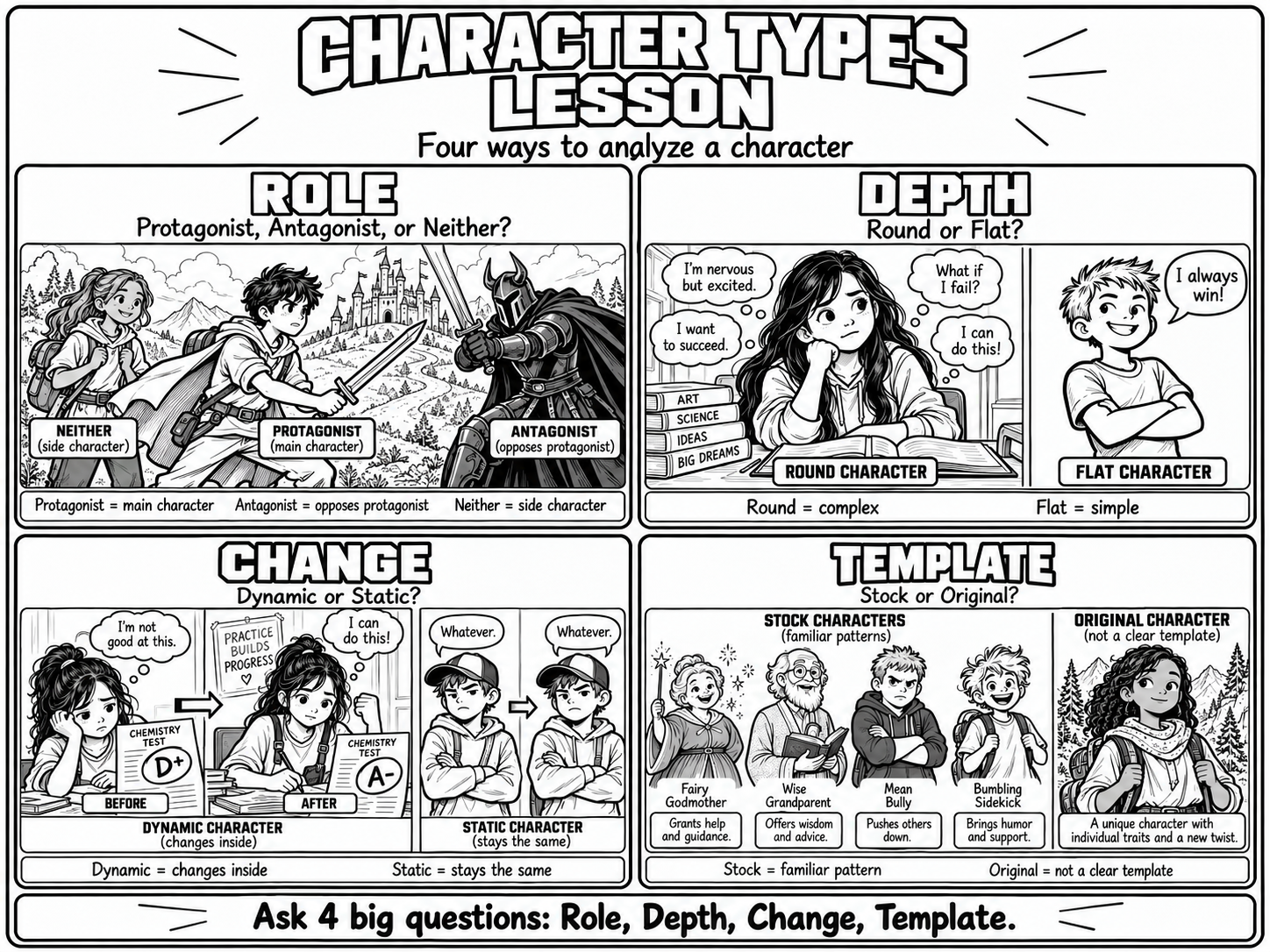
Any character can be analyzed by asking three questions, plus a bonus. What is their role in the conflict? How much depth do they have? Do they change? And, as a bonus, do they match a familiar template? These labels are independent: answering one does not answer the others.
Role: Protagonist, Antagonist, or Neither
Role is about the conflict, not about who is good or bad.
Protagonist: the central character the story follows. The main conflict is theirs to face, solve, or escape. A protagonist is not the same as a hero... they can be selfish, dishonest, or wrong. Antiheroes still count.
Antagonist: the character, group, or force that opposes the protagonist. An antagonist is not the same as a villain. A loving parent, a rival, nature, or the protagonist's own self-doubt can oppose without being evil.
Neither: most characters are neither. They fill out the story without owning the conflict or standing against it.
Depth: Round or Flat
Depth is about how fully a character is developed, not how much page time they get.
Round: a complex character with more than one side... mixed feelings, inner conflict, or contradictions. Round characters feel like real people.
Flat: a one-dimensional character built around a single trait or job. Flat is not an insult. Minor characters, comic relief, and many antagonists are flat by design.
Change: Dynamic or Static
Change is about who the character becomes by the end, and it has to be internal.
Dynamic: a character who undergoes a real inner change, such as a new belief, value, or understanding of themselves. Some event or realization forces the shift.
Static: a character who stays essentially the same. Static does not mean boring or badly written... a static character can act, struggle, and win while holding steady inside. Moving to a new town is a change in situation, not in character.
Bonus: Stock or Original
Stock characters match a template readers recognize on sight: the wise mentor, the bumbling sidekick, the evil overlord, the mean popular kid, the fairy godmother. Original characters fit no familiar template. Stock is about recognition, not depth, so an author can take a stock template and develop it into a round character, or set it up only to subvert it. The label is optional, used only when the template is clearly there.
The Reader's Job
For each character, work one question at a time: name the label and point to the evidence. The dimensions do not line up predictably. A protagonist can be flat, an antagonist can be round, and a stock character can be dynamic. The trap to avoid is confusing round (depth right now) with dynamic (change over time)... a character can be round and static, or flat and dynamic. Prove every label with a detail from the text, not a hunch.
Interactive Lessons
Slide decks
Character Types Lesson
AdaptiveGrades 3-12
Adaptive
Grades 3-12
Auto-adapting difficulty. Content adjusts to student reading level in real time.
Learn how to analyze the characters in a story. You will learn to classify a character three ways: by their role (protagonist, antagonist, or neither), their depth (round or flat), and their change over time (dynamic or static), plus a bonus label for characters who match a familiar template (stock). Available at three reading levels for grades 3 to 12.
Practice sets for this skill are on deck. Add activities in the content creator to populate this track.
Status: coming soon
Standards & Objectives
Learning Objectives
Identify a character's role (protagonist, antagonist, or neither), depth (round or flat), change (dynamic or static), and template (stock or original).
Analyze how a character's role in the conflict, their complexity, and their change over the course of a story reveal what kind of character they are.
Use textual evidence to support conclusions about a character's type.
Analyze how and why individuals, events, or ideas develop and interact over the course of a text.
Show standards (8)
Reading Literature (RL)
Key Ideas and Details
Grade 3
RL.3.3 Describe characters in a story (e.g., their traits, motivations, or feelings) and explain how their actions contribute to the sequence of events
Grade 4
RL.4.3 Describe in depth a character, setting, or event in a story or drama, drawing on specific details in the text (e.g., a character's thoughts, words, or actions).
Grade 5
RL.5.3 Compare and contrast two or more characters, settings, or events in a story or drama, drawing on specific details in the text (e.g., how characters interact).
Grade 6
RL.6.3 Describe how a particular story's or drama's plot unfolds in a series of episodes as well as how the characters respond or change as the plot moves toward a resolution.
Grade 7
RL.7.3 Analyze how particular elements of a story or drama interact (e.g., how setting shapes the characters or plot).
Grade 8
RL.8.3 Analyze how particular lines of dialogue or incidents in a story or drama propel the action, reveal aspects of a character, or provoke a decision.
Grades 9-10
RL.9-10.3 Analyze how complex characters (e.g., those with multiple or conflicting motivations) develop over the course of a text, interact with other characters, and advance the plot or develop the theme.
Grades 11-12
RL.11-12.3 Analyze the impact of the author's choices regarding how to develop and relate elements of a story or drama (e.g., where a story is set, how the action is ordered, how the characters are introduced and developed).
Copyright 2010. National Governors Association Center for Best Practices and Council of Chief State School Officers. All rights reserved.
Assign This Activity
Choose your defaults and generate a shareable assignment link.
Discussion