Poetry is a rich source of figurative language. Good poets pack worlds of meaning into tiny little lines. These lines evoke emotions, thoughts, and at times social change. One of the ways that poets perform these feats is with figurative language. This page contains a selection of poems that I find to be rich with figurative language.
Each poem includes review and discussion questions covering techniques like simile, metaphor, personification, hyperbole, and more. These poems are ready for classroom use and span a range of reading levels from elementary through high school.
What to Look For
When studying figurative language in poetry, students should look for places where the poet uses words in creative, non-literal ways. Here are the most common techniques found in the poems on this page:
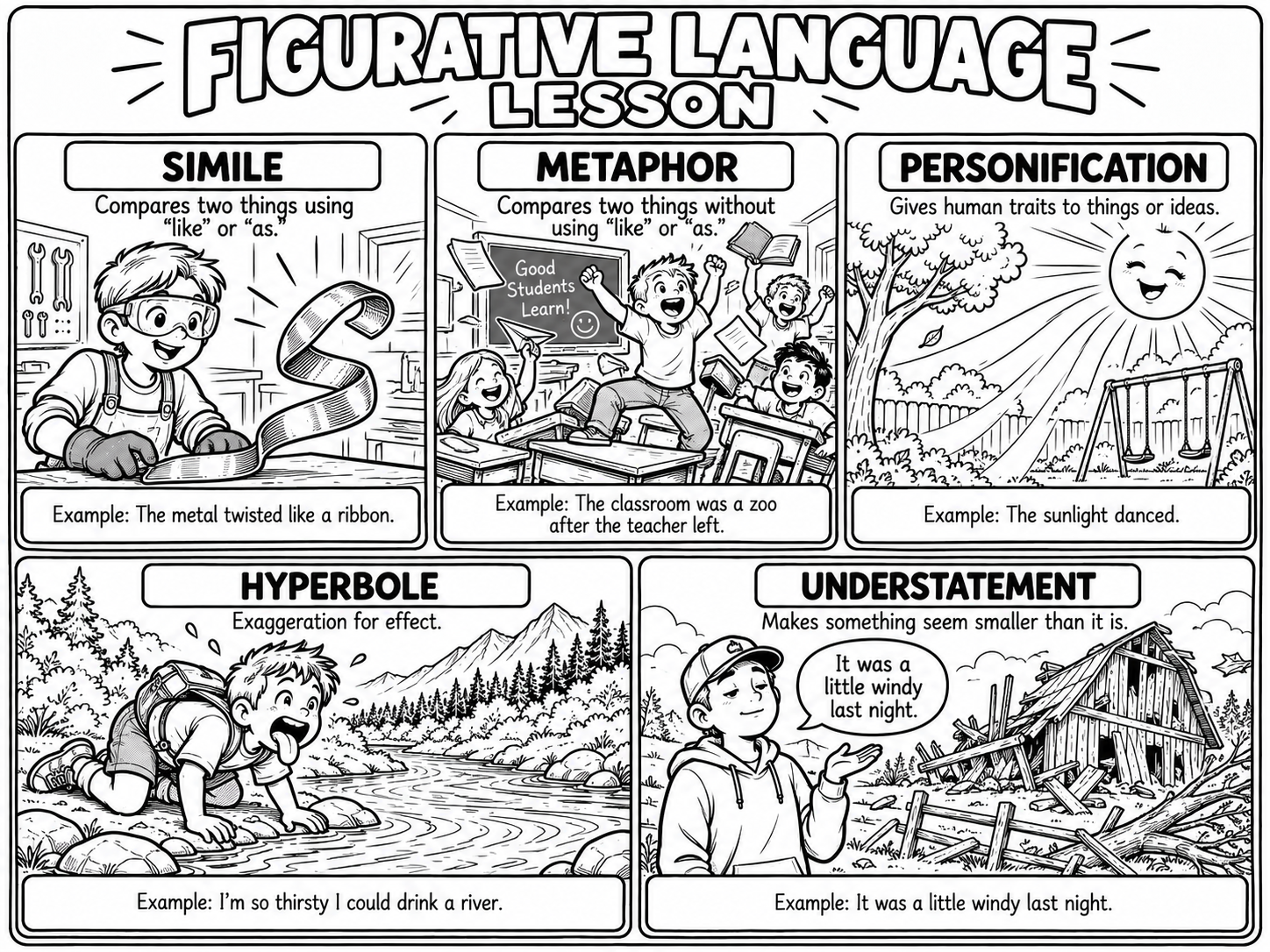
Simile: compares two things using "like" or "as." Example: "His sorrow goes / Like mountain snows."
Metaphor: compares two things directly without using "like" or "as." Example: "Life for me ain't been no crystal stair."
Personification: gives human traits or abilities to nonhuman things. Example: "The wind sings upon my lips."
Hyperbole: extreme exaggeration for effect. Example: "The dawn of a thousand dreams and thrills."
Alliteration: repeating the same starting sounds in nearby words. Example: "In the low blue lustre."
Imagery: writing that appeals to the five senses to create vivid mental pictures. Example: "Sunlight floods the shiny many-windowed place."
Simile vs. Metaphor: Both compare two things, but similes use "like" or "as" while metaphors state the comparison directly. This is one of the most common points of confusion for students, so keep an eye out for those signal words.
Quick Tips for Students
Read the poem more than once. The first read is for understanding; the second is for finding techniques.
Ask: what two things are being compared? If "like" or "as" connects them, it's a simile. If not, it's a metaphor.
Look for nonhuman things doing human actions — that's personification.
Watch for exaggeration that isn't meant to be taken literally — that's hyperbole.
Consider the effect: does the technique create humor, emphasis, imagery, or emotion?
Remember: a single line can contain more than one technique at the same time.
The Poems
Interactive Lessons
Slide decks
Figurative Language Lesson
AdaptiveGrades 3-12
Adaptive
Grades 3-12
Auto-adapting difficulty. Content adjusts to student reading level in real time.
This lesson explains simile, metaphor, personification, hyperbole, and understatement. Students learn these techniques and then practice identifying and distinguishing between them with a practice activity. This lesson is adaptable for grades 3-12.
Interpret words and phrases as they are used in a text, including determining technical, connotative, and figurative meanings, and analyze how specific word choices shape meaning or tone.
Demonstrate understanding of figurative language, word relationships, and nuances in word meanings.
Show standards (37)
Reading Literature (RL)
Craft and Structure
Grade 3
RL.3.4 Determine the meaning of words and phrases as they are used in a text, distinguishing literal from nonliteral language.
Grade 4
RL.4.4 Determine the meaning of words and phrases as they are used in a text, including those that allude to significant characters found in mythology (e.g., Herculean).
Grade 5
RL.5.4 Determine the meaning of words and phrases as they are used in a text, including figurative language such as metaphors and similes.
Grade 6
RL.6.4 Determine the meaning of words and phrases as they are used in a text, including figurative and connotative meanings; analyze the impact of a specific word choice on meaning and tone
Grade 7
RL.7.4 Determine the meaning of words and phrases as they are used in a text, including figurative and connotative meanings; analyze the impact of rhymes and other repetitions of sounds (e.g., alliteration) on a specific verse or stanza of a poem or section of a story or drama.
Grade 8
RL.8.4 Determine the meaning of words and phrases as they are used in a text, including figurative and connotative meanings; analyze the impact of specific word choices on meaning and tone, including analogies or allusions to other texts.
Grades 9-10
RL.9-10.4 Determine the meaning of words and phrases as they are used in the text, including figurative and connotative meanings; analyze the cumulative impact of specific word choices on meaning and tone (e.g., how the language evokes a sense of time and place; how it sets a formal or informal tone).
Language (L)
Vocabulary Acquisition and Use
Grade 3
L.3.5 Demonstrate understanding of figurative language, word relationships and nuances in word meanings.
L.3.5.a Distinguish the literal and nonliteral meanings of words and phrases in context (e.g., take steps).
L.3.5.b Identify real-life connections between words and their use (e.g., describe people who are friendly or helpful).
L.3.5.c Distinguish shades of meaning among related words that describe states of mind or degrees of certainty (e.g., knew, believed, suspected, heard, wondered).
Grade 4
L.4.5 Demonstrate understanding of figurative language, word relationships, and nuances in word meanings.
L.4.5.a Explain the meaning of simple similes and metaphors (e.g., as pretty as a picture) in context.
L.4.5.b Recognize and explain the meaning of common idioms, adages, and proverbs.
L.4.5.c Demonstrate understanding of words by relating them to their opposites (antonyms) and to words with similar but not identical meanings (synonyms).
Grade 5
L.5.5 Demonstrate understanding of figurative language, word relationships, and nuances in word meanings.
L.5.5.a Interpret figurative language, including similes and metaphors, in context.
L.5.5.b Recognize and explain the meaning of common idioms, adages, and proverbs.
L.5.5.c Use the relationship between particular words (e.g., synonyms, antonyms, homographs) to better understand each of the words.
Grade 6
L.6.5 Demonstrate understanding of figurative language, word relationships, and nuances in word meanings.
L.6.5.a Interpret figures of speech (e.g., personification) in context.
L.6.5.b Use the relationship between particular words (e.g., cause/effect, part/whole, item/category) to better understand each of the words.
L.6.5.c Distinguish among the connotations (associations) of words with similar denotations (definitions) (e.g., stingy, scrimping, economical, unwasteful, thrifty).
Grade 7
L.7.5 Demonstrate understanding of figurative language, word relationships, and nuances in word meanings.
L.7.5.a Interpret figures of speech (e.g., literary, biblical, and mythological allusions) in context.
L.7.5.b Use the relationship between particular words (e.g., synonym/antonym, analogy) to better understand each of the words.
L.7.5.c Distinguish among the connotations (associations) of words with similar denotations (definitions) (e.g., refined, respectful, polite, diplomatic, condescending).
Grade 8
L.8.5 Demonstrate understanding of figurative language, word relationships, and nuances in word meanings.
L.8.5.a Interpret figures of speech (e.g. verbal irony, puns) in context.
L.8.5.b Use the relationship between particular words to better understand each of the words.
L.8.5.c Distinguish among the connotations (associations) of words with similar denotations (definitions) (e.g., bullheaded, willful, firm, persistent, resolute).
Grades 9-10
L.9-10.5 Demonstrate understanding of figurative language, word relationships, and nuances in word meanings.
L.9-10.5.a Interpret figures of speech (e.g., euphemism, oxymoron) in context and analyze their role in the text.
L.9-10.5.b Analyze nuances in the meaning of words with similar denotations.
Grades 11-12
L.11-12.5 Demonstrate understanding of figurative language, word relationships, and nuances in word meanings.
L.11-12.5.a Interpret figures of speech (e.g., hyperbole, paradox) in context and analyze their role in the text.
L.11-12.5.b Analyze nuances in the meaning of words with similar denotations.
Copyright 2010. National Governors Association Center for Best Practices and Council of Chief State School Officers. All rights reserved.