Skill: Characterizations

Characterizations

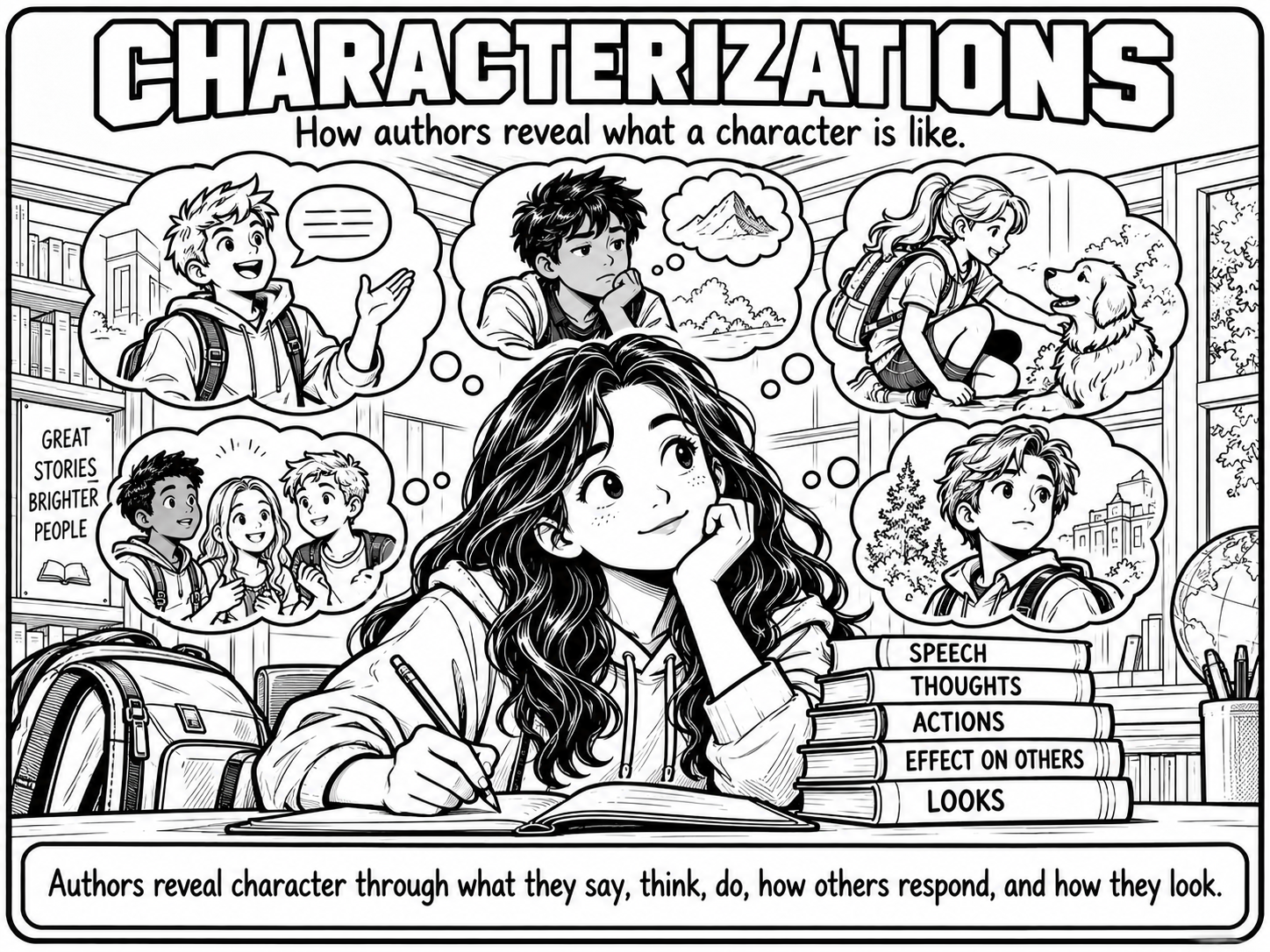
An outline of a character showing an overview of INDIRECT and DIRECT characterizations.

Characterization is how an author reveals what a character is like. Every story runs on characters: the people, animals, or beings who drive the plot, face the conflict, and bring the story to life. Strong readers pay attention to how those characters are revealed: what traits they have, and how the author lets us in on them.

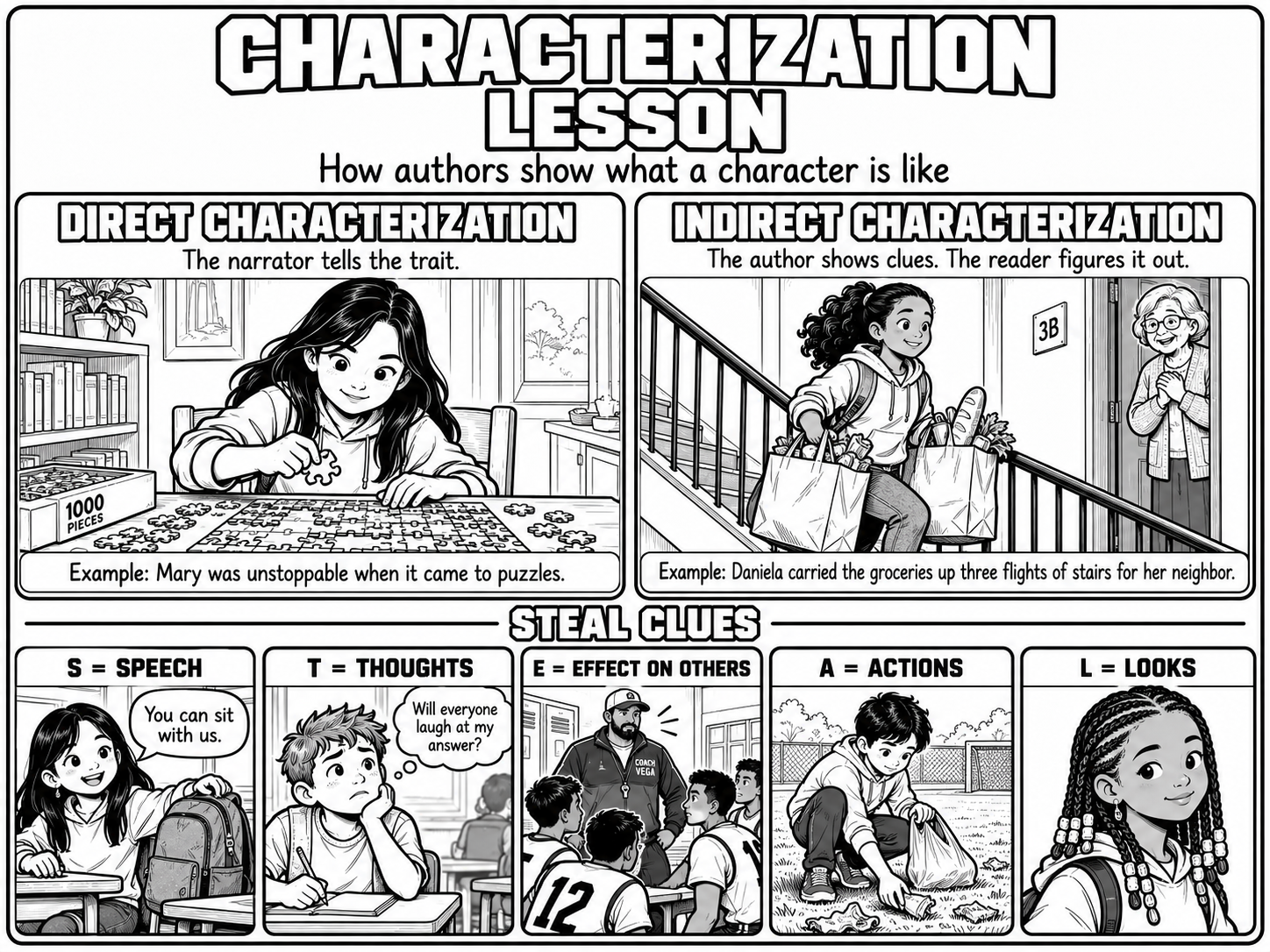
Authors reveal character in one of two ways. They can tell us a trait outright, or they can show us clues and let us figure it out.

Direct vs. Indirect Characterization: How Authors Reveal Character

  • Direct Characterization: the narrator states a trait outright. If a story says, "Maya was brave, kind, and curious," that's direct characterization. The trait is handed to the reader; there's nothing to infer. The vocabulary anchor here is explicit: clearly stated.
  • Indirect Characterization: the author reveals traits through clues that readers piece together. Nobody states the trait; you infer it from the evidence. The vocabulary anchor here is implicit: implied, not directly stated.

STEAL: The Five Clues of Indirect Characterization

When an author characterizes indirectly, the clues fall into five categories. The mnemonic is STEAL:

  • S = Speech: what the character says. "I'll handle it. I always do," can reveal confidence or exhaustion.
  • T = Thoughts: what goes on in the character's head, revealed by the narrator. Leo wondered if anyone would even notice if he left hints at insecurity.
  • E = Effect on others: how other characters react to or talk about this character. If the room goes quiet when she walks in, that tells you something.
  • A = Actions: what the character does. Giving away your lunch to the new kid shows generosity. Actions are the workhorse clue; most passages lean on them.
  • L = Looks: how the character appears, when the detail is doing real work. "Her hair was never a strand out of place" characterizes; "she had brown hair" is just a detail.

The Reader's Job

For direct characterization, you read it and accept it. For indirect characterization, you do the work: spot the evidence, name the most precise trait it supports, and point to the exact clue. One trap to watch: a trait word inside dialogue is not direct characterization. "I'm so brave," Mark said, hiding behind the couch, is Speech. His hiding tells the real story.

Interactive Lessons

Slide decks

Interactive Activities

Practice sets

Interactive Activity

Activity

Practice sets for this skill are on deck. Add activities in the content creator to populate this track.

  • Status: coming soon
Characterizations activity preview

Standards & Objectives

Learning Objectives

  • Identify direct and indirect characterization in a text.
  • Analyze how authors use speech, thoughts, others' reactions, actions, and appearance to reveal character.
  • Use textual evidence to support conclusions about a character's traits.

Standards Alignment

Common Core (CCSS)
CCSS.ELA-Literacy.CCRA.R.3Open

Analyze how and why individuals, events, or ideas develop and interact over the course of a text.

Show standards (9)
Reading Literature (RL)
Key Ideas and Details
Grade 2
  • RL.2.3 Describe how characters in a story respond to major events and challenges.
Grade 3
  • RL.3.3 Describe characters in a story (e.g., their traits, motivations, or feelings) and explain how their actions contribute to the sequence of events
Grade 4
  • RL.4.3 Describe in depth a character, setting, or event in a story or drama, drawing on specific details in the text (e.g., a character's thoughts, words, or actions).
Grade 5
  • RL.5.3 Compare and contrast two or more characters, settings, or events in a story or drama, drawing on specific details in the text (e.g., how characters interact).
Grade 6
  • RL.6.3 Describe how a particular story's or drama's plot unfolds in a series of episodes as well as how the characters respond or change as the plot moves toward a resolution.
Grade 7
  • RL.7.3 Analyze how particular elements of a story or drama interact (e.g., how setting shapes the characters or plot).
Grade 8
  • RL.8.3 Analyze how particular lines of dialogue or incidents in a story or drama propel the action, reveal aspects of a character, or provoke a decision.
Grades 9-10
  • RL.9-10.3 Analyze how complex characters (e.g., those with multiple or conflicting motivations) develop over the course of a text, interact with other characters, and advance the plot or develop the theme.
Grades 11-12
  • RL.11-12.3 Analyze the impact of the author's choices regarding how to develop and relate elements of a story or drama (e.g., where a story is set, how the action is ordered, how the characters are introduced and developed).

Copyright 2010. National Governors Association Center for Best Practices and Council of Chief State School Officers. All rights reserved.