Skill: Point of View

Point of View

A floating eye in the sky looking down at multiple characters walking through a town with dotted lines showing the eye can see into their thoughts.

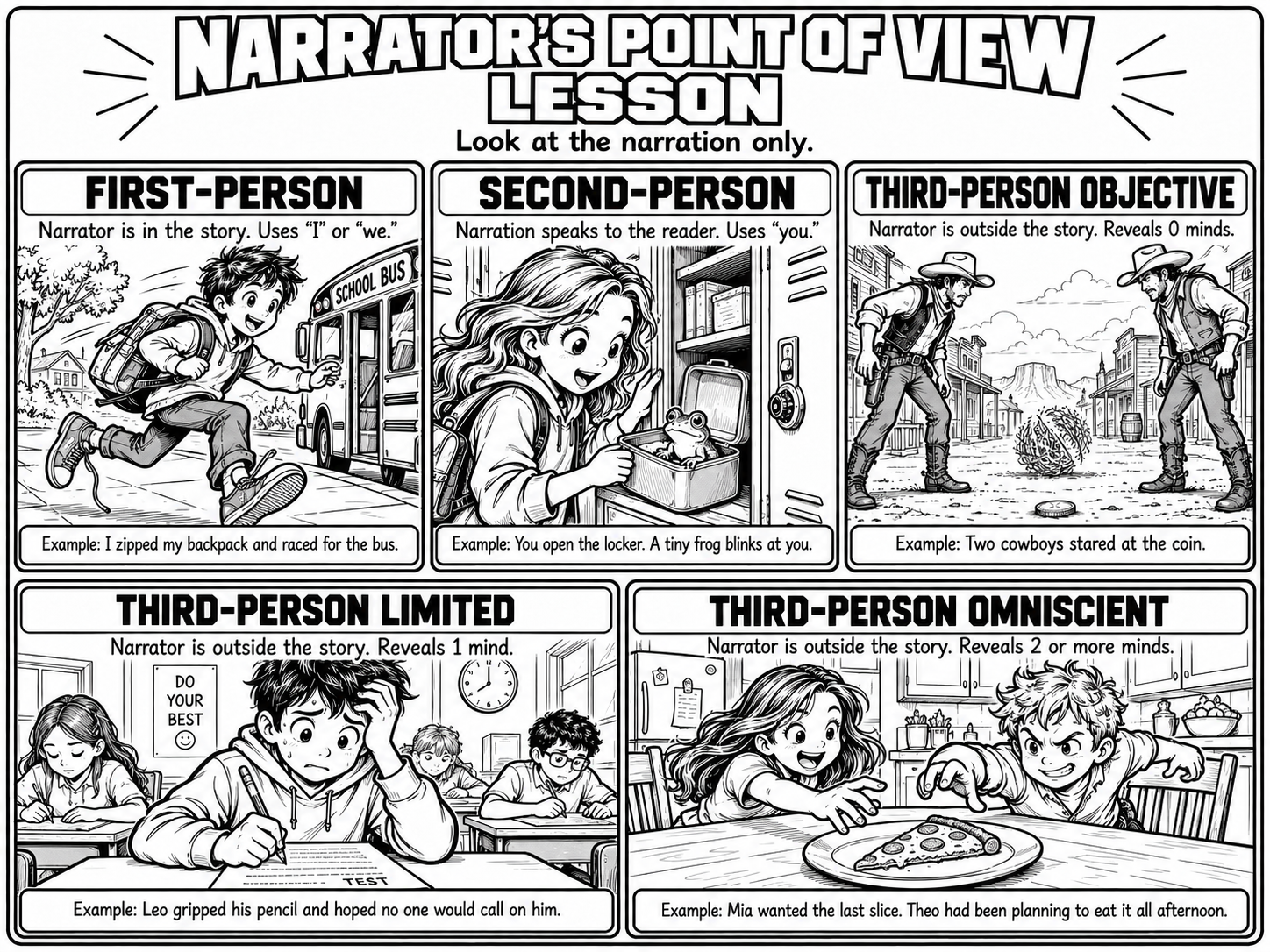
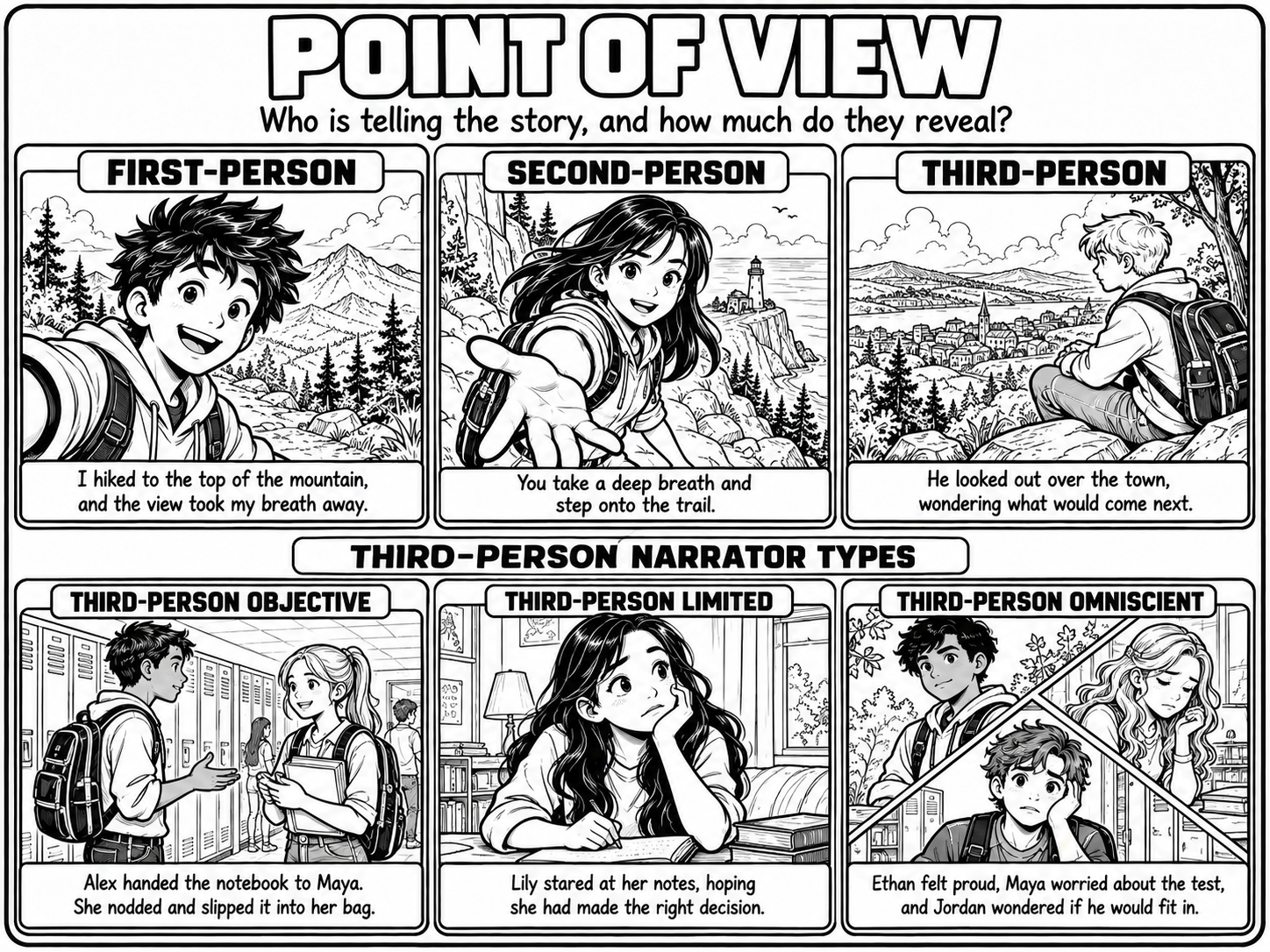
Point of view is the perspective from which a story is told. It is determined by the narrator's relationship to the events and characters, and it is identified through the pronouns the narrator uses and how much access the narrator has to the characters' thoughts and feelings.

Narrative Person: Who Is Telling the Story

  • First-Person: the narrator is a character in the story, telling events firsthand using pronouns like I, me, my, and we. The narrator may be the protagonist or a supporting character.
  • Second-Person: the narrator addresses the reader directly as you, placing the reader inside the action. This mode is rare in fiction but common in directions, instructions, and Choose Your Own Adventure books.
  • Third-Person: the narrator stands outside the story and refers to characters using pronouns like he, she, they, and them. How much the narrator knows about characters' inner thoughts determines the specific mode.

Narrative Access: How Much the Third-Person Narrator Reveals

  • Third-Person Objective: the narrator reports only what can be observed from the outside — characters' actions and dialogue — without revealing any character's thoughts or feelings.
  • Third-Person Limited: the narrator reveals the inner thoughts and feelings of one character. Other characters' inner lives remain hidden from the reader.
  • Third-Person Omniscient: the narrator is all-knowing and reveals the thoughts and feelings of multiple characters. (Omni = all, scient = knowing.)

Interactive Lessons

Slide decks

Interactive Activities

Practice sets

Standards & Objectives

Learning Objectives

  • Identify the point of view of a text based on the narrator's pronoun use and access to characters' thoughts and feelings.
  • Distinguish between first-person, second-person, and third-person narration using key textual clues.
  • Explain the defining characteristics of the three modes of third-person narration (objective, limited, and omniscient) and how they differ from one another.
  • Support point of view classifications with specific evidence from the text.

Standards Alignment

Common Core (CCSS)
CCSS.ELA-Literacy.CCRA.R.6Open

Assess how point of view or purpose shapes the content and style of a text.

Show standards (22)
Reading Literature (RL)
Craft and Structure
Grade K
  • RL.K.6 With prompting and support, name the author and illustrator of a story and define the role of each in telling the story.
Grade 1
  • RL.1.6 Identify who is telling the story at various points in a text.
Grade 2
  • RL.2.6 Acknowledge differences in the points of view of characters, including by speaking in a different voice for each character when reading dialogue aloud.
Grade 3
  • RL.3.6 Distinguish their own point of view from that of the narrator or those of the characters.
Grade 4
  • RL.4.6 Compare and contrast the point of view from which different stories are narrated, including the difference between first- and third-person narrations.
Grade 5
  • RL.5.6 Describe how a narrator's or speaker's point of view influences how events are described.
Grade 6
  • RL.6.6 Explain how an author develops the point of view of the narrator or speaker in a text.
Grade 7
  • RL.7.6 Analyze how an author develops and contrasts the points of view of different characters or narrators in a text.
Grade 8
  • RL.8.6 Analyze how differences in the points of view of the characters and the audience or reader (e.g., created through the use of dramatic irony) create such effects as suspense or humor.
Grades 9-10
  • RL.9-10.6 Analyze a particular point of view or cultural experience reflected in a work of literature from outside the United States, drawing on a wide reading of world literature.
Grades 11-12
  • RL.11-12.6 Analyze a case in which grasping a point of view requires distinguishing what is directly stated in a text from what is really meant (e.g., satire, sarcasm, irony, or understatement).
Reading Informational Text (RI)
Craft and Structure
Grade K
  • RI.K.6 Name the author and illustrator of a text and define the role of each in presenting the ideas or information in a text.
Grade 1
  • RI.1.6 Distinguish between information provided by pictures or other illustrations and information provided by the words in a text.
Grade 2
  • RI.2.6 Identify the main purpose of a text, including what the author wants to answer, explain, or describe.
Grade 3
  • RI.3.6 Distinguish their own point of view from that of the author of a text.
Grade 4
  • RI.4.6 Compare and contrast a firsthand and secondhand account of the same event or topic; describe the differences in focus and the information provided.
Grade 5
  • RI.5.6 Analyze multiple accounts of the same event or topic, noting important similarities and differences in the point of view they represent.
Grade 6
  • RI.6.6 Determine an author's point of view or purpose in a text and explain how it is conveyed in the text.
Grade 7
  • RI.7.6 Determine an author's point of view or purpose in a text and analyze how the author distinguishes his or her position from that of others.
Grade 8
  • RI.8.6 Determine an author's point of view or purpose in a text and analyze how the author acknowledges and responds to conflicting evidence or viewpoints.
Grades 9-10
  • RI.9-10.6 Determine an author's point of view or purpose in a text and analyze how an author uses rhetoric to advance that point of view or purpose.
Grades 11-12
  • RI.11-12.6 Determine an author's point of view or purpose in a text in which the rhetoric is particularly effective, analyzing how style and content contribute to the power, persuasiveness or beauty of the text.

Copyright 2010. National Governors Association Center for Best Practices and Council of Chief State School Officers. All rights reserved.