Category: Text Analysis

Text Analysis

An open book with gears and puzzle pieces inside its pages, representing the mechanical process of understanding how text is built and organized

Text analysis is the process of examining a text closely to understand how it is built, what it communicates, and why the author made specific choices. Strong readers don't just understand what a text says — they understand how and why it says it.

What Students Will Learn

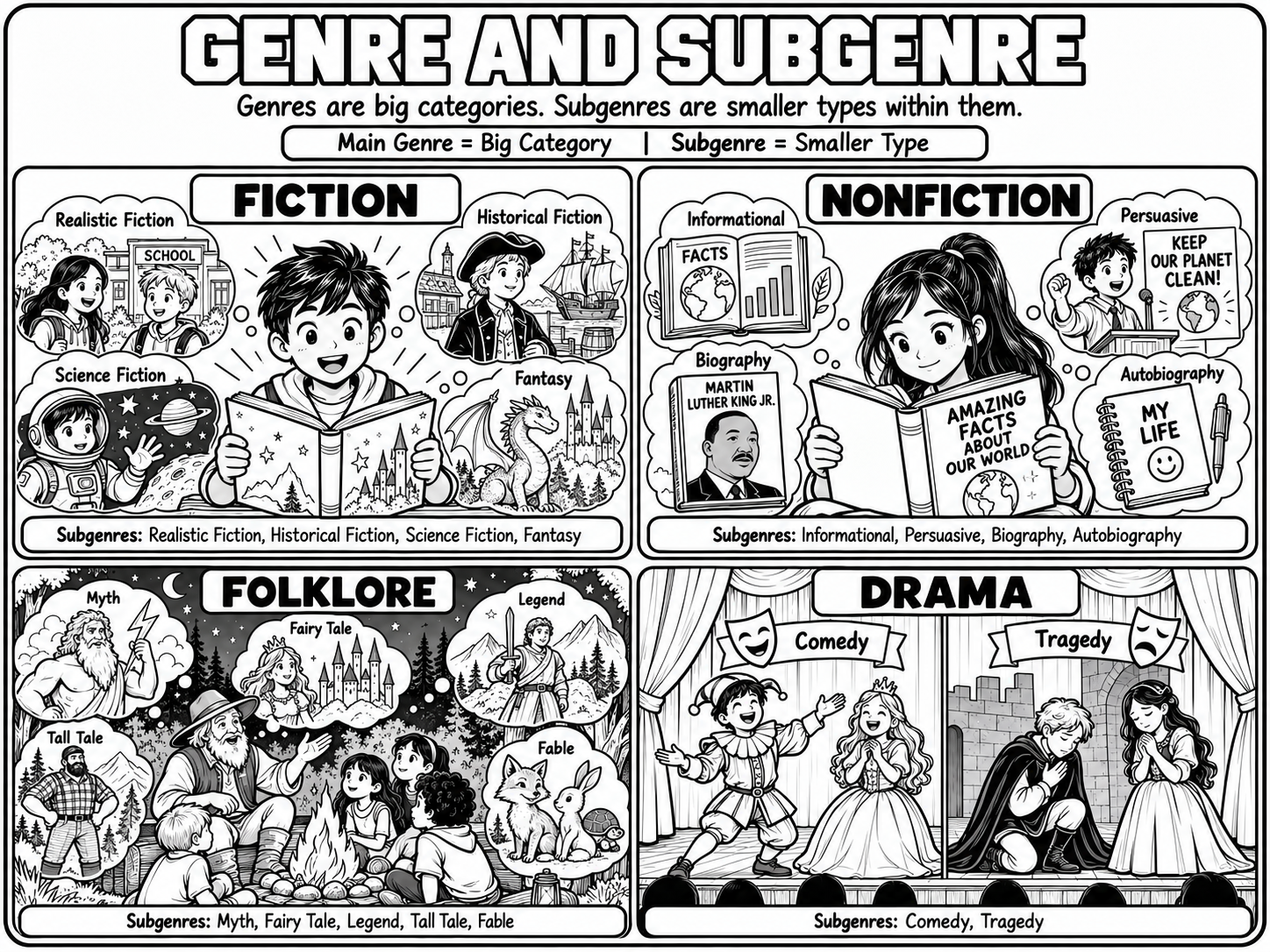
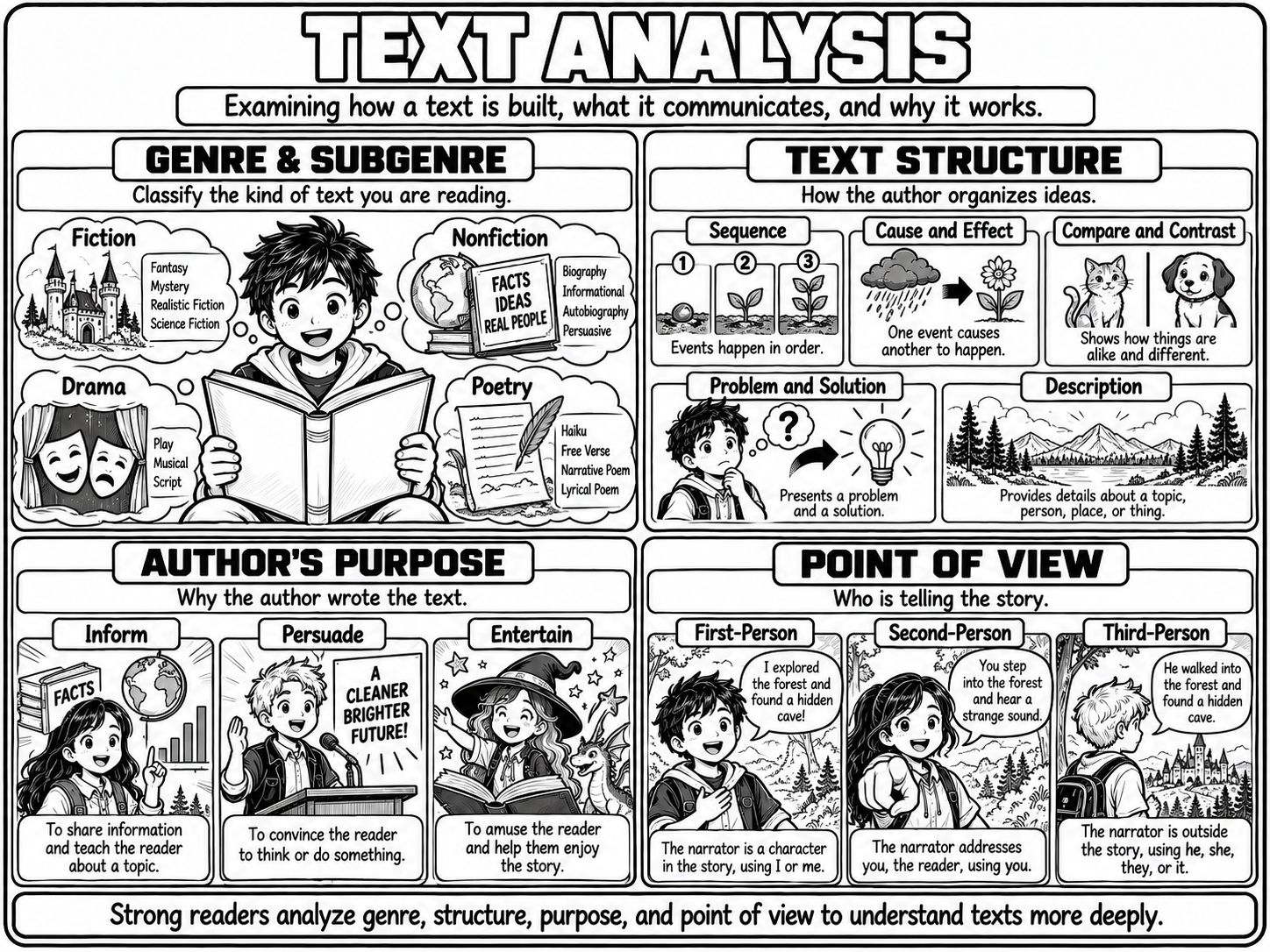
  • Genre & Subgenre: how to classify texts into major genres — fiction, nonfiction, and folklore — and identify specific subgenres using key textual clues.
  • Text Structure: how authors organize information using patterns such as cause and effect, compare and contrast, chronological order, problem and solution, and description.
  • Author's Purpose: how to determine why an author wrote a text — to inform, persuade, entertain, or explain — and how that purpose shapes the content.
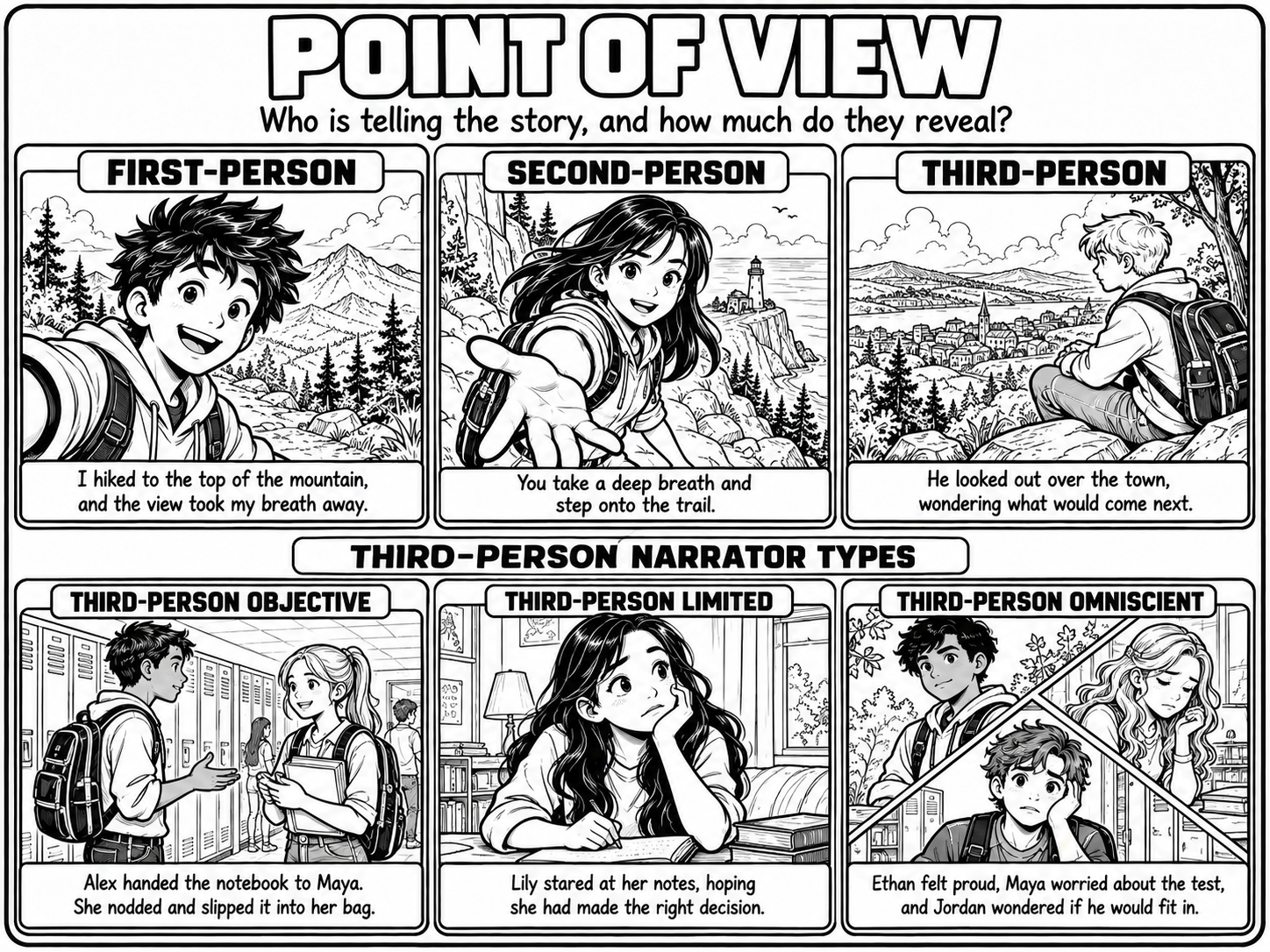
  • Point of View: how to identify the narrator's perspective — first person, second person, or third person — and understand how it affects the way a story is told.

Skills

Skill hubs

Standards & Objectives

Learning Objectives

  • Identify how a text is structured, categorized, and narrated.
  • Analyze the choices an author makes in organizing and presenting a text.
  • Use textual evidence to support conclusions about a text's genre, structure, purpose, and point of view.

Standards Alignment

Common Core (CCSS)
CCSS.ELA-Literacy.CCRA.R.5Open

Analyze the structure of texts, including how specific sentences, paragraphs, and larger portions of the text (e.g., a section, chapter, scene, or stanza) relate to each other and the whole.

CCSS.ELA-Literacy.CCRA.R.9Open

Analyze how two or more texts address similar themes or topics in order to build knowledge or to compare the approaches the authors take.

CCSS.ELA-Literacy.CCRA.R.5Open

Analyze the structure of texts, including how specific sentences, paragraphs, and larger portions of the text (e.g., a section, chapter, scene, or stanza) relate to each other and the whole.

CCSS.ELA-Literacy.CCRA.R.6Open

Assess how point of view or purpose shapes the content and style of a text.

Show standards (42)
Reading Literature (RL)
Craft and Structure
Grade 3
  • RL.3.5 Refer to parts of stories, dramas, and poems when writing or speaking about a text, using terms such as chapter, scene, and stanza; describe how each successive part builds on earlier sections.
  • RL.3.6 Distinguish their own point of view from that of the narrator or those of the characters.
Grade 4
  • RL.4.5 Explain major differences between poems, drama, and prose, and refer to the structural elements of poems (e.g., verse, rhythm, meter) and drama (e.g., casts of characters, settings, descriptions, dialogue, stage directions) when writing or speaking about a text.
  • RL.4.6 Compare and contrast the point of view from which different stories are narrated, including the difference between first- and third-person narrations.
Grade 5
  • RL.5.5 Explain how a series of chapters, scenes, or stanzas fits together to provide the overall structure of a particular story, drama, or poem.
  • RL.5.6 Describe how a narrator's or speaker's point of view influences how events are described.
Grade 6
  • RL.6.5 Analyze how a particular sentence, chapter, scene, or stanza fits into the overall structure of a text and contributes to the development of the theme, setting, or plot.
  • RL.6.6 Explain how an author develops the point of view of the narrator or speaker in a text.
Grade 7
  • RL.7.5 Analyze how a drama's or poem's form or structure (e.g., soliloquy, sonnet) contributes to its meaning
  • RL.7.6 Analyze how an author develops and contrasts the points of view of different characters or narrators in a text.
Grade 8
  • RL.8.5 Compare and contrast the structure of two or more texts and analyze how the differing structure of each text contributes to its meaning and style.
  • RL.8.6 Analyze how differences in the points of view of the characters and the audience or reader (e.g., created through the use of dramatic irony) create such effects as suspense or humor.
Grades 9-10
  • RL.9-10.6 Analyze a particular point of view or cultural experience reflected in a work of literature from outside the United States, drawing on a wide reading of world literature.
Grades 11-12
  • RL.11-12.6 Analyze a case in which grasping a point of view requires distinguishing what is directly stated in a text from what is really meant (e.g., satire, sarcasm, irony, or understatement).
Integration of Knowledge and Ideas
Grade 3
  • RL.3.9 Compare and contrast the themes, settings, and plots of stories written by the same author about the same or similar characters (e.g., in books from a series)
Grade 4
  • RL.4.9 Compare and contrast the treatment of similar themes and topics (e.g., opposition of good and evil) and patterns of events (e.g., the quest) in stories, myths, and traditional literature from different cultures.
Grade 5
  • RL.5.9 Compare and contrast stories in the same genre (e.g., mysteries and adventure stories) on their approaches to similar themes and topics.
Grade 6
  • RL.6.9 Compare and contrast texts in different forms or genres (e.g., stories and poems; historical novels and fantasy stories) in terms of their approaches to similar themes and topics.
Grade 7
  • RL.7.9 Compare and contrast a fictional portrayal of a time, place, or character and a historical account of the same period as a means of understanding how authors of fiction use or alter history.
Grade 8
  • RL.8.9 Analyze how a modern work of fiction draws on themes, patterns of events, or character types from myths, traditional stories, or religious works such as the Bible, including describing how the material is rendered new.
Reading Informational Text (RI)
Craft and Structure
Grade 3
  • RI.3.5 Use text features and search tools (e.g., key words, sidebars, hyperlinks) to locate information relevant to a given topic efficiently.
  • RI.3.6 Distinguish their own point of view from that of the author of a text.
Grade 4
  • RI.4.5 Describe the overall structure (e.g., chronology, comparison, cause/effect, problem/solution) of events, ideas, concepts, or information in a text or part of a text.
  • RI.4.6 Compare and contrast a firsthand and secondhand account of the same event or topic; describe the differences in focus and the information provided.
Grade 5
  • RI.5.5 Compare and contrast the overall structure (e.g., chronology, comparison, cause/effect, problem/solution) of events, ideas, concepts, or information in two or more texts.
  • RI.5.6 Analyze multiple accounts of the same event or topic, noting important similarities and differences in the point of view they represent.
Grade 6
  • RI.6.5 Analyze how a particular sentence, paragraph, chapter, or section fits into the overall structure of a text and contributes to the development of the ideas.
  • RI.6.6 Determine an author's point of view or purpose in a text and explain how it is conveyed in the text.
Grade 7
  • RI.7.5 Analyze the structure an author uses to organize a text, including how the major sections contribute to the whole and to the development of the ideas.
  • RI.7.6 Determine an author's point of view or purpose in a text and analyze how the author distinguishes his or her position from that of others.
Grade 8
  • RI.8.5 Analyze in detail the structure of a specific paragraph in a text, including the role of particular sentences in developing and refining a key concept.
  • RI.8.6 Determine an author's point of view or purpose in a text and analyze how the author acknowledges and responds to conflicting evidence or viewpoints.
Grades 9-10
  • RI.9-10.5 Analyze in detail how an author's ideas or claims are developed and refined by particular sentences, paragraphs, or larger portions of a text (e.g., a section or chapter).
  • RI.9-10.6 Determine an author's point of view or purpose in a text and analyze how an author uses rhetoric to advance that point of view or purpose.
Grades 11-12
  • RI.11-12.5 Analyze and evaluate the effectiveness of the structure an author uses in his or her exposition or argument, including whether the structure makes points clear, convincing, and engaging.
  • RI.11-12.6 Determine an author's point of view or purpose in a text in which the rhetoric is particularly effective, analyzing how style and content contribute to the power, persuasiveness or beauty of the text.
Integration of Knowledge and Ideas
Grade 3
  • RI.3.9 Compare and contrast the most important points and key details presented in two texts on the same topic.
Grade 4
  • RI.4.9 Integrate information from two texts on the same topic in order to write or speak about the subject knowledgeably.
Grade 5
  • RI.5.9 Integrate information from several texts on the same topic in order to write or speak about the subject knowledgeably.
Grade 6
  • RI.6.9 Compare and contrast one author's presentation of events with that of another (e.g., a memoir written by and a biography on the same person).
Grade 7
  • RI.7.9 Analyze how two or more authors writing about the same topic shape their presentations of key information by emphasizing different evidence or advancing different interpretations of facts.
Grade 8
  • RI.8.9 Analyze a case in which two or more texts provide conflicting information on the same topic and identify where the texts disagree on matters of fact or interpretation.

Copyright 2010. National Governors Association Center for Best Practices and Council of Chief State School Officers. All rights reserved.