Category: Elements of Fiction

Elements of Fiction

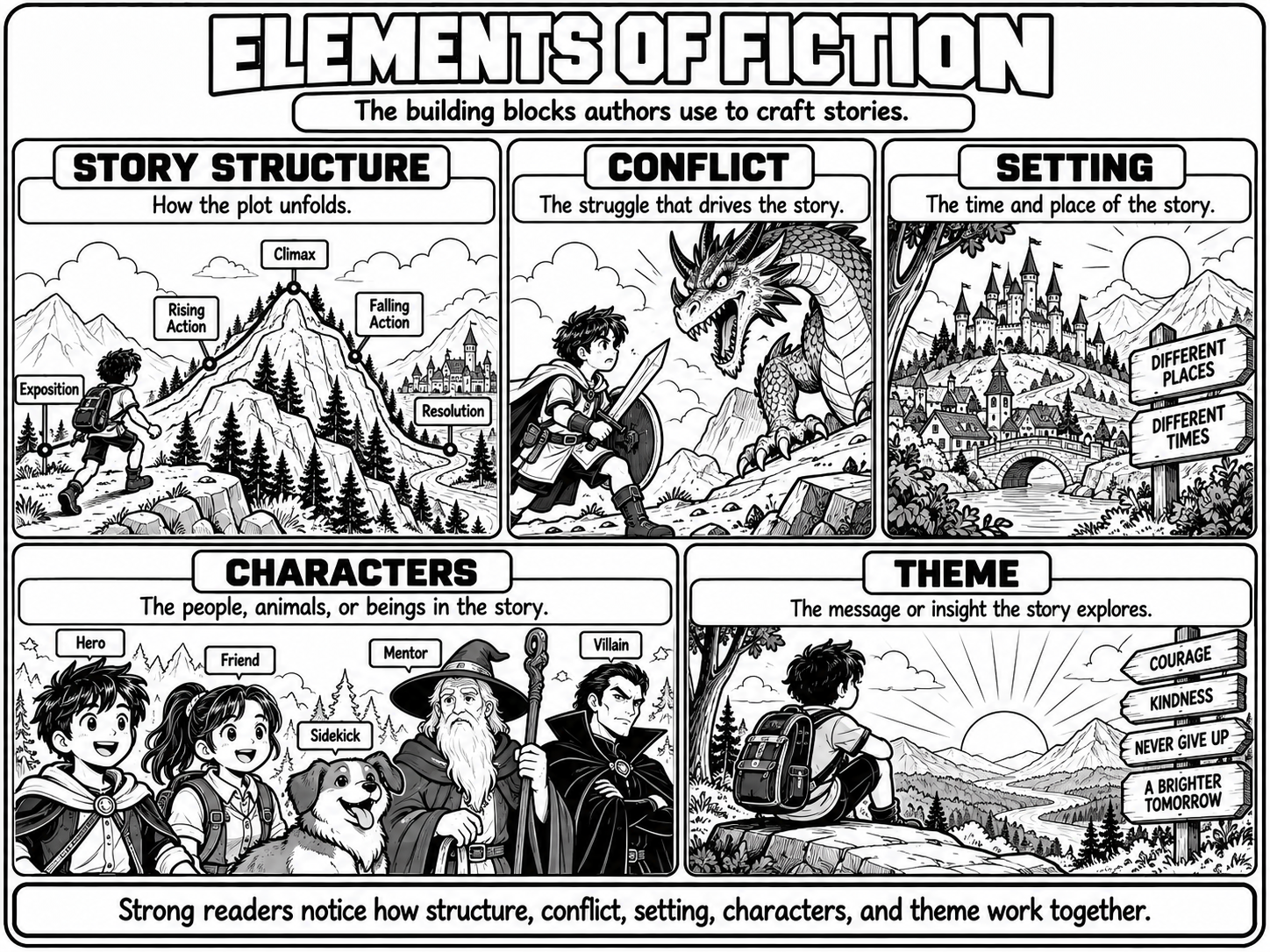
A coloring book style image showing the elements of fiction: characterization, conflict, setting, story structure, and theme.

Elements of fiction are the building blocks authors use to craft stories. Strong readers recognize these elements and understand how they work together to create meaning, tension, and impact.

What Students Will Learn

  • Story Structure: how plots unfold through exposition, rising action, climax, falling action, and resolution.
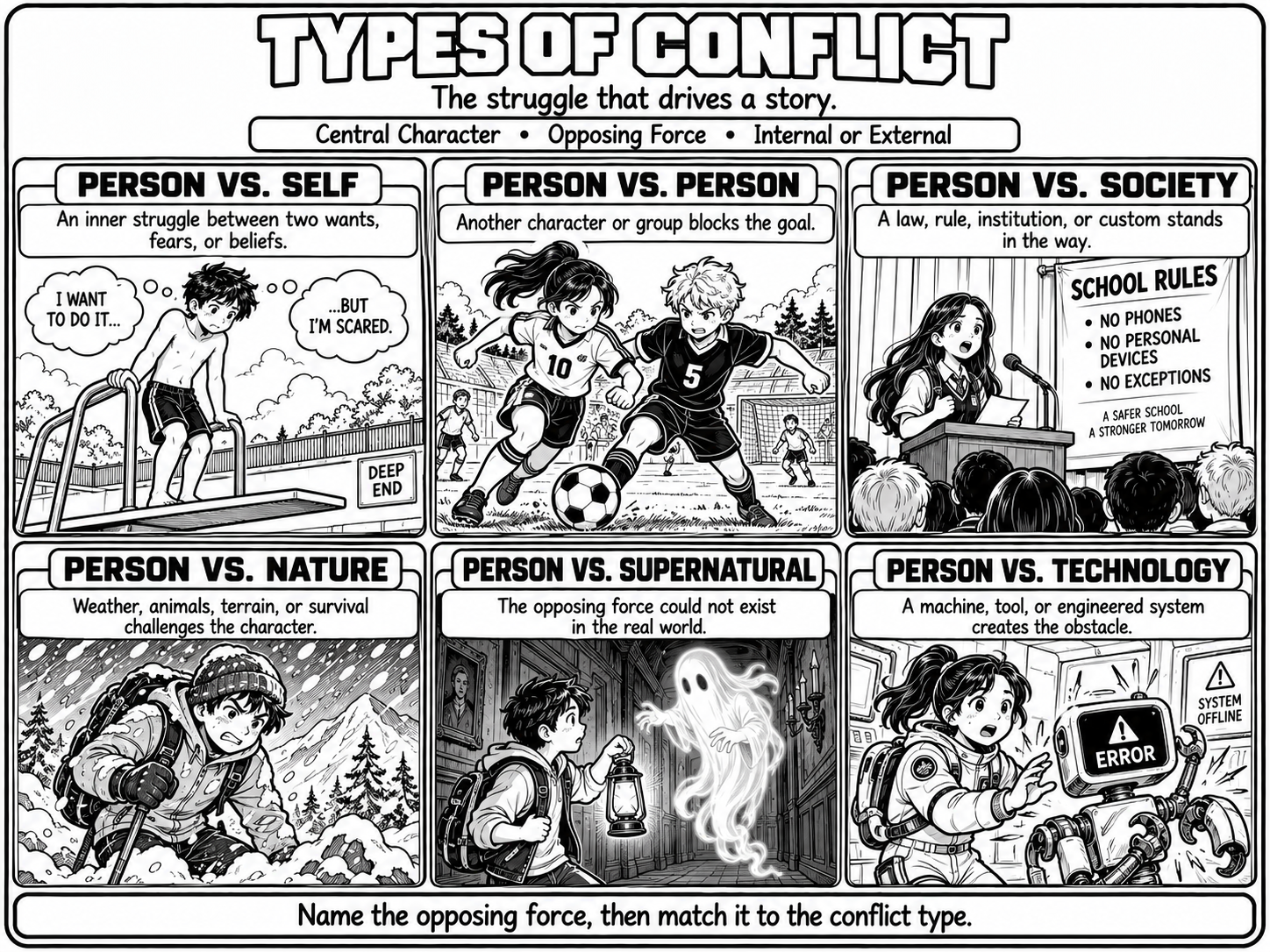
  • Conflict: how to identify the central struggle that drives a story, including character vs. character, character vs. self, character vs. nature, and character vs. society.
  • Setting: how time and place shape a story's mood, characters, and events.
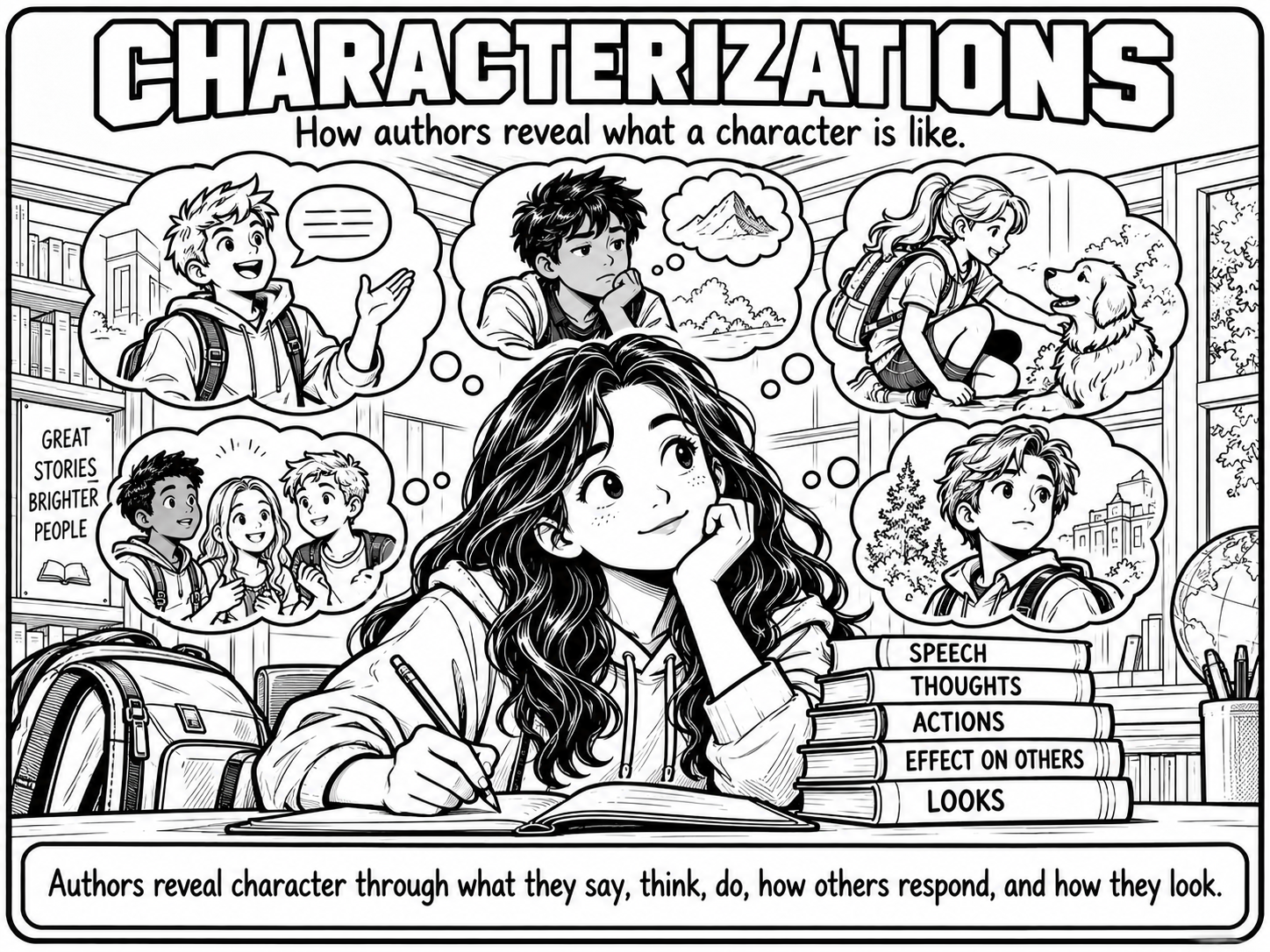
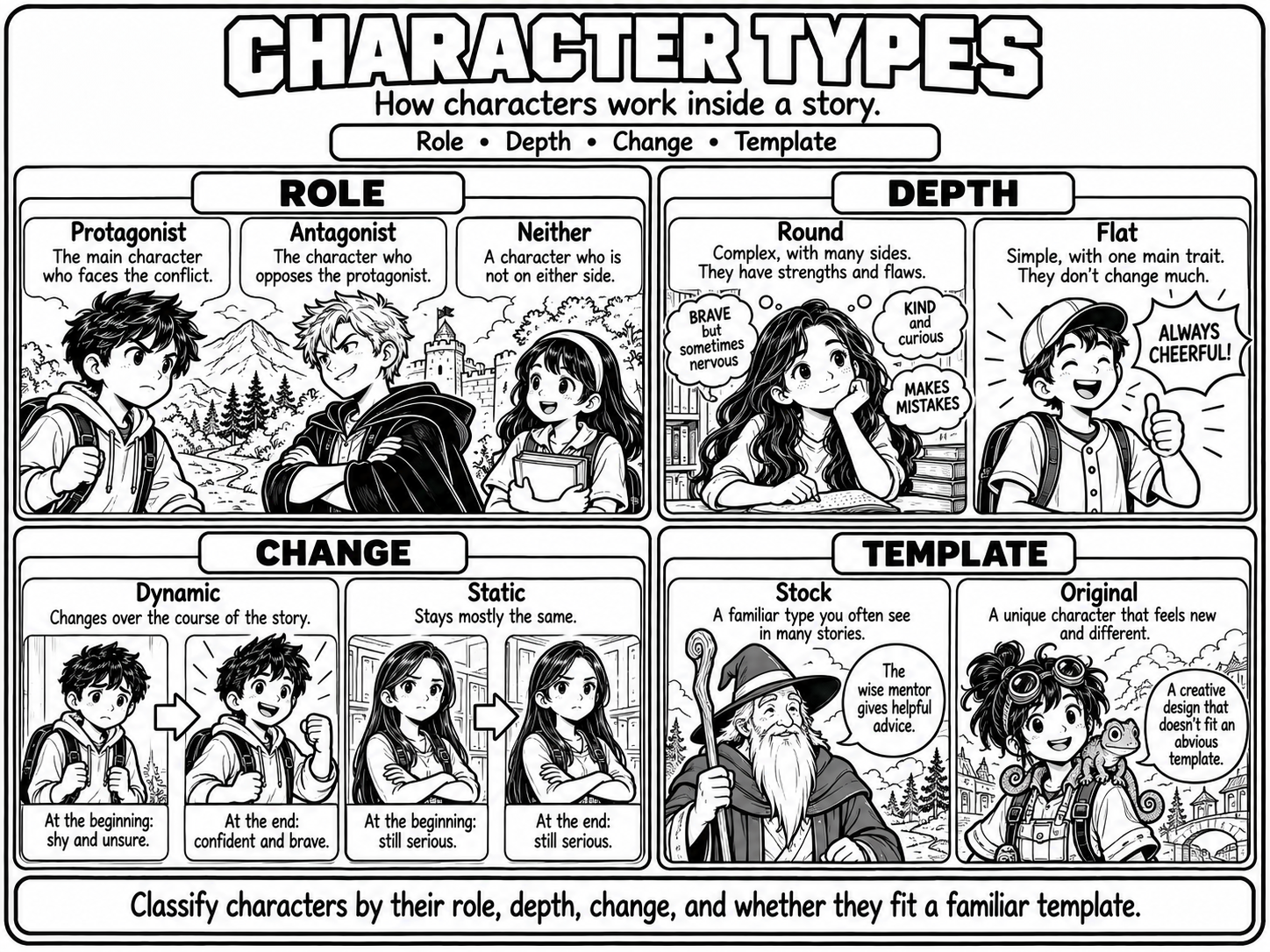
  • Characters: how authors build and reveal the entities who populate a story, including direct and indirect characterization and different character types.
  • Theme: how to identify the central message or insight a story explores, and how the other elements work together to develop it.

Skills

Skill hubs

Standards & Objectives

Learning Objectives

  • Identify the key elements that make up a work of fiction, including structure, conflict, setting, characters, and theme.
  • Analyze how authors develop and connect these elements to create meaning.
  • Use textual evidence to support conclusions about a story's structure, conflict, setting, characterization, and theme.

Standards Alignment

Common Core (CCSS)
CCSS.ELA-Literacy.CCRA.R.5Open

Analyze the structure of texts, including how specific sentences, paragraphs, and larger portions of the text (e.g., a section, chapter, scene, or stanza) relate to each other and the whole.

CCSS.ELA-Literacy.CCRA.R.3Open

Analyze how and why individuals, events, or ideas develop and interact over the course of a text.

CCSS.ELA-Literacy.CCRA.R.2Open

Determine central ideas or themes of a text and analyze their development; summarize the key supporting details and ideas.

Show standards (27)
Reading Literature (RL)
Key Ideas and Details
Grade 2
  • RL.2.2 Recount stories, including fables and folktales from diverse cultures, and determine their central message, lesson, or moral.
  • RL.2.3 Describe how characters in a story respond to major events and challenges.
Grade 3
  • RL.3.2 Recount stories, including fables, folktales, and myths from diverse cultures; determine the central message, lesson, or moral and explain how it is conveyed through key details in the text.
  • RL.3.3 Describe characters in a story (e.g., their traits, motivations, or feelings) and explain how their actions contribute to the sequence of events
Grade 4
  • RL.4.2 Determine a theme of a story, drama, or poem from details in the text; summarize the text.
  • RL.4.3 Describe in depth a character, setting, or event in a story or drama, drawing on specific details in the text (e.g., a character's thoughts, words, or actions).
Grade 5
  • RL.5.2 Determine a theme of a story, drama, or poem from details in the text, including how characters in a story or drama respond to challenges or how the speaker in a poem reflects upon a topic; summarize the text.
  • RL.5.3 Compare and contrast two or more characters, settings, or events in a story or drama, drawing on specific details in the text (e.g., how characters interact).
Grade 6
  • RL.6.2 Determine a theme or central idea of a text and how it is conveyed through particular details; provide a summary of the text distinct from personal opinions or judgments.
  • RL.6.3 Describe how a particular story's or drama's plot unfolds in a series of episodes as well as how the characters respond or change as the plot moves toward a resolution.
Grade 7
  • RL.7.2 Determine a theme or central idea of a text and analyze its development over the course of the text; provide an objective summary of the text.
  • RL.7.3 Analyze how particular elements of a story or drama interact (e.g., how setting shapes the characters or plot).
Grade 8
  • RL.8.2 Determine a theme or central idea of a text and analyze its development over the course of the text, including its relationship to the characters, setting, and plot; provide an objective summary of the text.
  • RL.8.3 Analyze how particular lines of dialogue or incidents in a story or drama propel the action, reveal aspects of a character, or provoke a decision.
Grades 9-10
  • RL.9-10.2 Determine a theme or central idea of a text and analyze in detail its development over the course of the text, including how it emerges and is shaped and refined by specific details; provide an objective summary of the text.
  • RL.9-10.3 Analyze how complex characters (e.g., those with multiple or conflicting motivations) develop over the course of a text, interact with other characters, and advance the plot or develop the theme.
Grades 11-12
  • RL.11-12.2 Determine two or more themes or central ideas of a text and analyze their development over the course of the text, including how they interact and build on one another to produce a complex account; provide an objective summary of the text.
  • RL.11-12.3 Analyze the impact of the author's choices regarding how to develop and relate elements of a story or drama (e.g., where a story is set, how the action is ordered, how the characters are introduced and developed).
Craft and Structure
Grade 2
  • RL.2.5 Describe the overall structure of a story, including describing how the beginning introduces the story and the ending concludes the action.
Grade 3
  • RL.3.5 Refer to parts of stories, dramas, and poems when writing or speaking about a text, using terms such as chapter, scene, and stanza; describe how each successive part builds on earlier sections.
Grade 4
  • RL.4.5 Explain major differences between poems, drama, and prose, and refer to the structural elements of poems (e.g., verse, rhythm, meter) and drama (e.g., casts of characters, settings, descriptions, dialogue, stage directions) when writing or speaking about a text.
Grade 5
  • RL.5.5 Explain how a series of chapters, scenes, or stanzas fits together to provide the overall structure of a particular story, drama, or poem.
Grade 6
  • RL.6.5 Analyze how a particular sentence, chapter, scene, or stanza fits into the overall structure of a text and contributes to the development of the theme, setting, or plot.
Grade 7
  • RL.7.5 Analyze how a drama's or poem's form or structure (e.g., soliloquy, sonnet) contributes to its meaning
Grade 8
  • RL.8.5 Compare and contrast the structure of two or more texts and analyze how the differing structure of each text contributes to its meaning and style.
Grades 9-10
  • RL.9-10.5 Analyze how an author's choices concerning how to structure a text, order events within it (e.g., parallel plots), and manipulate time (e.g., pacing, flashbacks) create such effects as mystery, tension, or surprise.
Grades 11-12
  • RL.11-12.5 Analyze how an author's choices concerning how to structure specific parts of a text (e.g., the choice of where to begin or end a story, the choice to provide a comedic or tragic resolution) contribute to its overall structure and meaning as well as its aesthetic impact.

Copyright 2010. National Governors Association Center for Best Practices and Council of Chief State School Officers. All rights reserved.