Category: Literary Devices

Literary Devices

A stack of books as the foundation with various literary tools emerging from the top book including a symbolic heart for theme, intersecting paths for plot structure, character silhouettes, and decorative swirls representing figurative language.

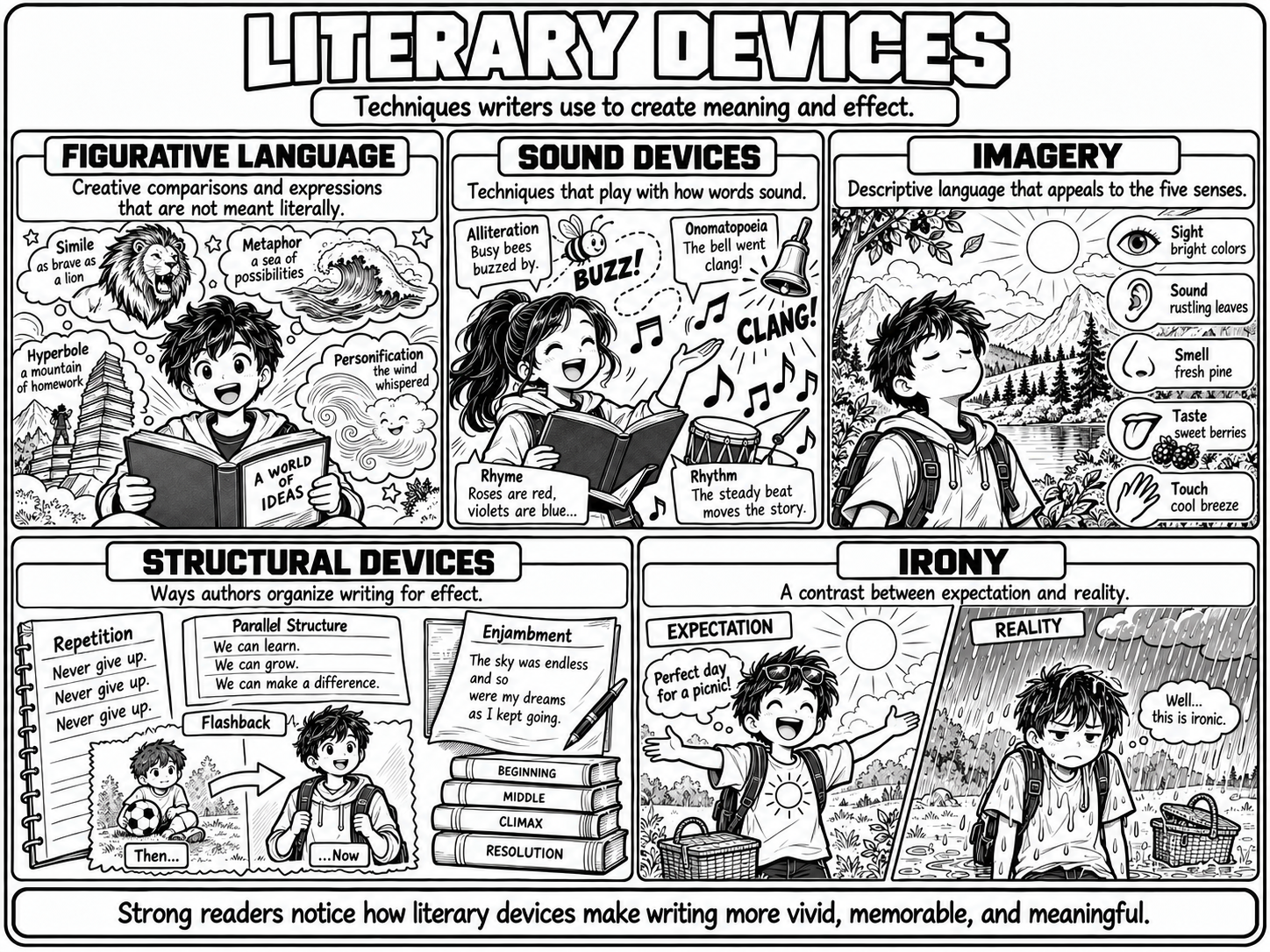
Literary devices are techniques writers use to create special effects, add meaning, or make their writing more engaging. These tools help authors express ideas in creative and memorable ways.

Categories of Literary Devices

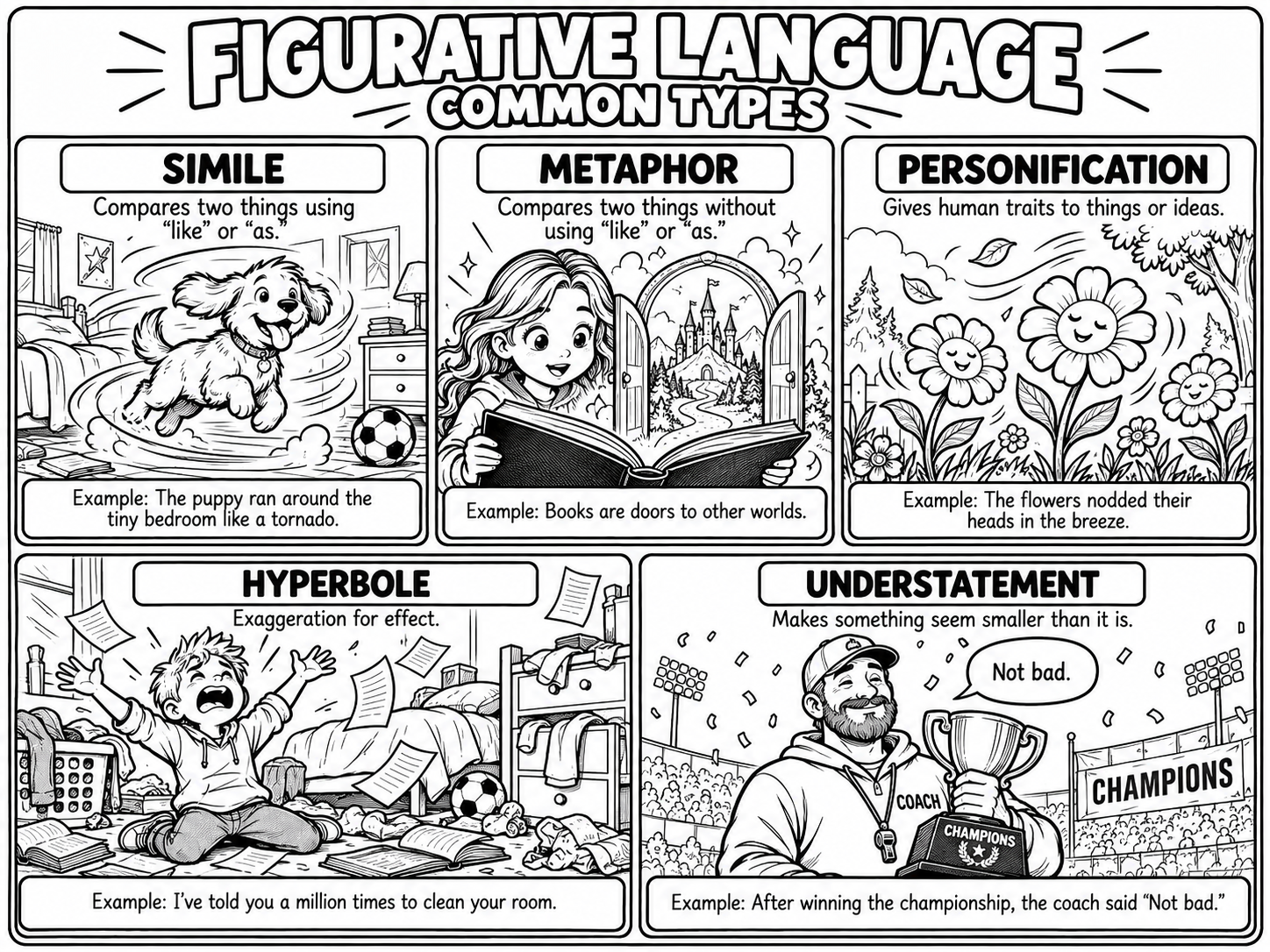
  • Figurative Language: creative comparisons and expressions that aren't meant literally, such as similes, metaphors, personification, hyperbole, and idioms.
  • Sound Devices: techniques that play with how words sound, such as alliteration, onomatopoeia, rhyme, and rhythm.
  • Imagery: descriptive language that appeals to the five senses, helping readers see, hear, feel, smell, or taste what the writer describes.
  • Structural Devices: ways of organizing text for effect, such as repetition, parallelism, enjambment, and flashback.
  • Irony: when there's a contrast between expectation and reality, including verbal, situational, and dramatic irony.

Skills

Skill hubs

Standards & Objectives

Learning Objectives

  • Identify and distinguish between common literary devices in prose and poetry.
  • Interpret the meaning of figurative language in context.
  • Explain how literary devices contribute to meaning, mood, and style.
  • Analyze an author's purpose for using specific literary devices.

Standards Alignment

Common Core (CCSS)
CCSS.ELA-Literacy.CCRA.R.4Open

Interpret words and phrases as they are used in a text, including determining technical, connotative, and figurative meanings, and analyze how specific word choices shape meaning or tone.

CCSS.ELA-Literacy.CCRA.L.5Open

Demonstrate understanding of figurative language, word relationships, and nuances in word meanings.

Show standards (37)
Reading Literature (RL)
Craft and Structure
Grade 3
  • RL.3.4 Determine the meaning of words and phrases as they are used in a text, distinguishing literal from nonliteral language.
Grade 4
  • RL.4.4 Determine the meaning of words and phrases as they are used in a text, including those that allude to significant characters found in mythology (e.g., Herculean).
Grade 5
  • RL.5.4 Determine the meaning of words and phrases as they are used in a text, including figurative language such as metaphors and similes.
Grade 6
  • RL.6.4 Determine the meaning of words and phrases as they are used in a text, including figurative and connotative meanings; analyze the impact of a specific word choice on meaning and tone
Grade 7
  • RL.7.4 Determine the meaning of words and phrases as they are used in a text, including figurative and connotative meanings; analyze the impact of rhymes and other repetitions of sounds (e.g., alliteration) on a specific verse or stanza of a poem or section of a story or drama.
Grade 8
  • RL.8.4 Determine the meaning of words and phrases as they are used in a text, including figurative and connotative meanings; analyze the impact of specific word choices on meaning and tone, including analogies or allusions to other texts.
Grades 9-10
  • RL.9-10.4 Determine the meaning of words and phrases as they are used in the text, including figurative and connotative meanings; analyze the cumulative impact of specific word choices on meaning and tone (e.g., how the language evokes a sense of time and place; how it sets a formal or informal tone).
Language (L)
Vocabulary Acquisition and Use
Grade 3
  • L.3.5 Demonstrate understanding of figurative language, word relationships and nuances in word meanings.
  • L.3.5.a Distinguish the literal and nonliteral meanings of words and phrases in context (e.g., take steps).
  • L.3.5.b Identify real-life connections between words and their use (e.g., describe people who are friendly or helpful).
  • L.3.5.c Distinguish shades of meaning among related words that describe states of mind or degrees of certainty (e.g., knew, believed, suspected, heard, wondered).
Grade 4
  • L.4.5 Demonstrate understanding of figurative language, word relationships, and nuances in word meanings.
  • L.4.5.a Explain the meaning of simple similes and metaphors (e.g., as pretty as a picture) in context.
  • L.4.5.b Recognize and explain the meaning of common idioms, adages, and proverbs.
  • L.4.5.c Demonstrate understanding of words by relating them to their opposites (antonyms) and to words with similar but not identical meanings (synonyms).
Grade 5
  • L.5.5 Demonstrate understanding of figurative language, word relationships, and nuances in word meanings.
  • L.5.5.a Interpret figurative language, including similes and metaphors, in context.
  • L.5.5.b Recognize and explain the meaning of common idioms, adages, and proverbs.
  • L.5.5.c Use the relationship between particular words (e.g., synonyms, antonyms, homographs) to better understand each of the words.
Grade 6
  • L.6.5 Demonstrate understanding of figurative language, word relationships, and nuances in word meanings.
  • L.6.5.a Interpret figures of speech (e.g., personification) in context.
  • L.6.5.b Use the relationship between particular words (e.g., cause/effect, part/whole, item/category) to better understand each of the words.
  • L.6.5.c Distinguish among the connotations (associations) of words with similar denotations (definitions) (e.g., stingy, scrimping, economical, unwasteful, thrifty).
Grade 7
  • L.7.5 Demonstrate understanding of figurative language, word relationships, and nuances in word meanings.
  • L.7.5.a Interpret figures of speech (e.g., literary, biblical, and mythological allusions) in context.
  • L.7.5.b Use the relationship between particular words (e.g., synonym/antonym, analogy) to better understand each of the words.
  • L.7.5.c Distinguish among the connotations (associations) of words with similar denotations (definitions) (e.g., refined, respectful, polite, diplomatic, condescending).
Grade 8
  • L.8.5 Demonstrate understanding of figurative language, word relationships, and nuances in word meanings.
  • L.8.5.a Interpret figures of speech (e.g. verbal irony, puns) in context.
  • L.8.5.b Use the relationship between particular words to better understand each of the words.
  • L.8.5.c Distinguish among the connotations (associations) of words with similar denotations (definitions) (e.g., bullheaded, willful, firm, persistent, resolute).
Grades 9-10
  • L.9-10.5 Demonstrate understanding of figurative language, word relationships, and nuances in word meanings.
  • L.9-10.5.a Interpret figures of speech (e.g., euphemism, oxymoron) in context and analyze their role in the text.
  • L.9-10.5.b Analyze nuances in the meaning of words with similar denotations.
Grades 11-12
  • L.11-12.5 Demonstrate understanding of figurative language, word relationships, and nuances in word meanings.
  • L.11-12.5.a Interpret figures of speech (e.g., hyperbole, paradox) in context and analyze their role in the text.
  • L.11-12.5.b Analyze nuances in the meaning of words with similar denotations.

Copyright 2010. National Governors Association Center for Best Practices and Council of Chief State School Officers. All rights reserved.