Learn how to identify the conflict in a story. You will learn to find the central character, name the opposing force that stands in the way, and sort that force as internal (person vs. self) or external (person vs. person, society, nature, supernatural, or technology). Available at three reading levels for grades 3 to 12.
Reading LevelChoose where to begin. The lesson adjusts as you go.
Tap to change. You can also toggle these during the lesson.
0/21
Ad 728x90
What Is a Conflict?
The struggle at the center of the story
Every story runs on conflict.
No conflict means no tension.
Side one: the central character, also called the protagonist.
Side two: the opposing force, also called the antagonist.
Stories often carry more than one conflict.
How to Name a Conflict
Three steps that work on any story…
Step 1: Who is the central character?
Step 2: What is the opposing force?
Step 3: Which type of force is that?
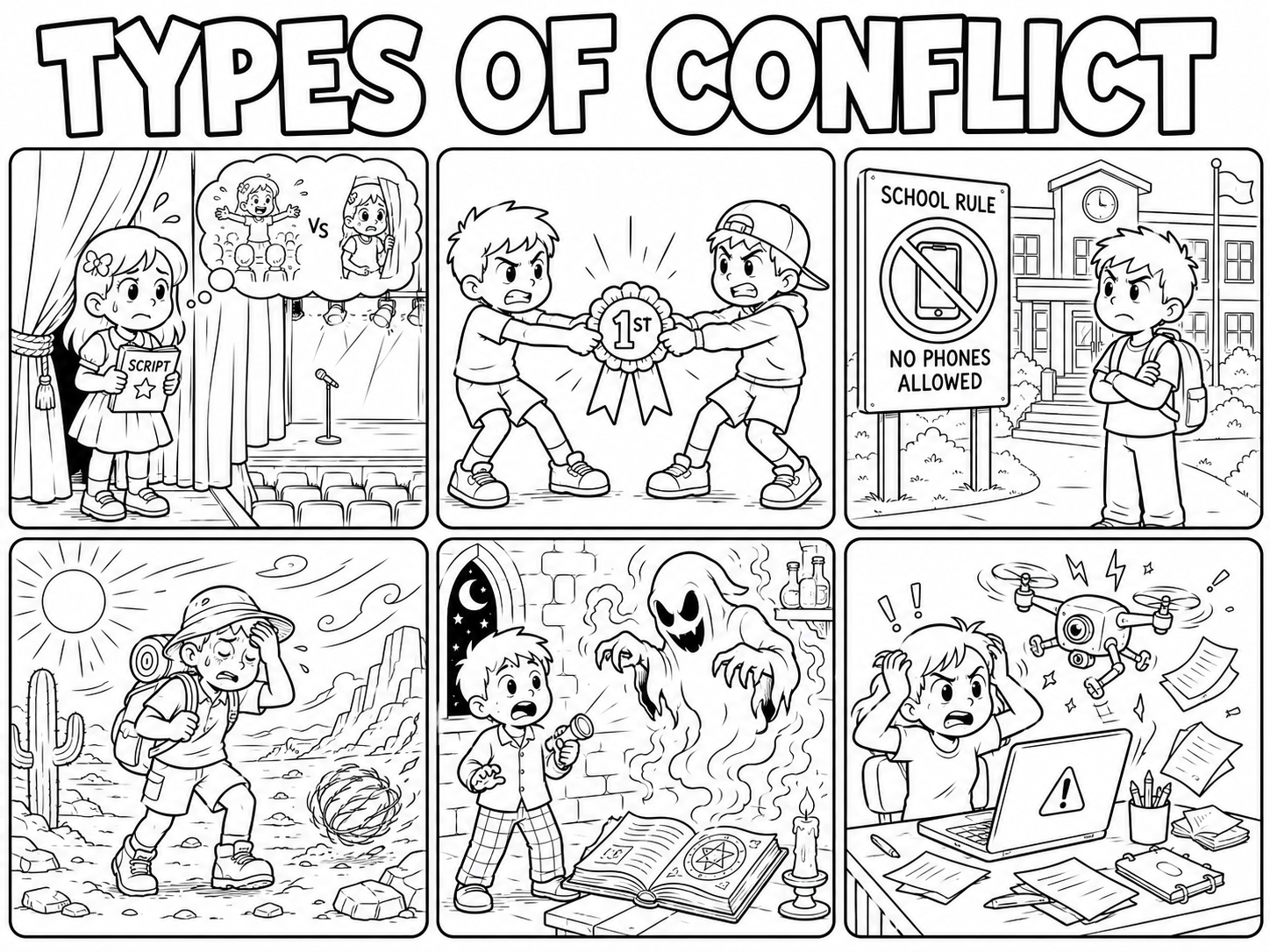
Six Types of Conflict: An Overview
PERSON = CENTRAL CHARACTER
Person vs. Person = another character or group
Person vs. Self = something inside the character
Person vs. Society = a law, rule, institution, or tradition
Person vs. Nature = weather, animals, terrain, illness, or scarcity
Person vs. Supernatural = ghosts, magic, curses, or monsters
Person vs. Technology = machines, devices, robots, or computers
Let's look at each one...
Person vs. Person
Another character stands in the way
Examples
Two swimmers from the same team fight for the last spot at the state meet.
A girl runs against her best friend for team captain.
Person vs. Self
The struggle happens inside
Examples
A student finds the answer key and has to decide what to do.
A runner has to decide whether to quit the team she no longer loves.
Having feelings is NOT the same as an internal conflict.
Person vs. Society
A rule, a law, or a tradition stands in the main character's way
Examples
A student tries to change the school's 30-year-old dress code.
A girl is told that only boys are allowed to join the baseball league.
CAREFUL: One person can be the face of a system without being the system.
Person vs. Nature
The natural world challenges the main character
Examples
A sailor goes overboard and has to swim toward a distant island.
A new farmer cannot get anything to grow in the tough old soil.
Nature is NOT just weather.
Person vs. Supernatural
Something from outside our world challenges the main character
Examples
A girl finds a magic door in her attic that only opens at midnight.
A family learns that the house they bought does not want them to live inside of it.
Ghosts, magic, monsters, curses, and gods all belong here.
Person vs. Technology
The protagonist faces a machine, robot, computer, or other technology
Examples
A pilot fights an autopilot that will not release control.
Grandpa cannot make his new phone stop calling strangers.
Ask yourself: is the machine an opponent or just a tool?
BE CAREFUL!
Common Mistakes...
1: The opposing force is NOT always a person.
2: A group of people is not the same as society.
3: Feelings alone do not make it Person vs. Self.
4: A machine in the story is not always the opponent.
Let's Look at One Together...
The rule had been sitting in the student handbook for thirty years: no eighth grader could run for class president. Nina read it twice, then read it a third time in case she had missed a word. When she asked Ms. Hall about it, the office secretary shrugged and pointed at the page as if the page had settled the matter. So Nina brought a clipboard to lunch and collected signatures. She got ninety-one. In December she stood in front of five school board members she had never met, with her hands shaking, and asked them to strike one sentence from a book most students had never opened. In February, they did.
1: Who is the protagonist?
2: What force opposes the protagonist?
3: Label the opposing force.
Now you're ready to practice!
Review
Practice Review
Tanisha has spent the summer training for the only open place on the city youth BMX team. Her former practice partner, Marcus, wants it just as badly, and he knows her routine from start to finish. When Marcus rides first, he uses Tanisha's signature move and loudly claims that she copied it from him. With one final run left, Tanisha must outthink Marcus and prove that she belongs on the team.
Choose one answer, then add your follow-up response.
Learn Why
Tanisha is challenged by Marcus, who is a person. So, the type of conflict in this story is person vs. person.
Follow-up Response
Who is the protagonist? Who or what is the opposing force? Explain how that force challenges the protagonist.
June sells handmade friendship bracelets on Main Street and every dollar goes into her telescope fund. One afternoon, Officer Pratt stops at her table, buys two bracelets for his daughters, and then delivers June some bad news. He explains that a town rule says nobody under sixteen can hold a seller's permit. He is as friendly as can be while he takes down her sign but claims that he has to enforce the rule. June signs up for five minutes at the next town meeting. Can one young person get a whole town to change its rules?
Choose one answer, then add your follow-up response.
Learn Why
June is challenged by the town's rule not Officer Pratt, who is just enforcing the rule. So, the type of conflict in this story is best labeled as person vs. society.
Follow-up Response
Who is the protagonist? Who or what is the opposing force? Explain how that force challenges the protagonist.
After a basketball game, Evan finds an unmarked envelope stuffed with cash beneath the bleachers. It is almost exactly what he needs for a class trip his family has already said they cannot afford. No one sees him find it and there is no name on the envelope. As Evan imagines boarding the bus with his friends, he also imagines the person who lost the money and a part of him feels for that person. Of course another part of him wants to participate in the class trip. Will he attempt to return the money or use it for the trip?
Choose one answer, then add your follow-up response.
Learn Why
Evan is challenged by his own desire and guilt. He badly wants to keep the money and go on the class trip, but he also knows that someone else suffered from losing that money and that he should give it back. So, the type of conflict in this story is best labeled as person vs. self.
Follow-up Response
Who is the protagonist? Who or what is the opposing force? Explain how that force challenges the protagonist.
Marlowe lives with her father at a lighthouse on a dangerous stretch of coast. During a violent night storm, a window shatters, the warning lamp goes dark, and her father injures his leg on the stairs. Now the lighthouse has gone dark. A passenger ship is already moving toward the hidden rocks, but Marlowe is the only person able to climb the tower. With wind forcing open the doors and rain flooding the steps, can she relight the lamp before the ship reaches shore?
Choose one answer, then add your follow-up response.
Learn Why
Marlowe is challenged by the weather. The storm has extinguished the guiding light on the rocky shore and Marlowe is the only one who can restore it. In order to do this she will need to battle the elements. So, the type of conflict in this story is best labeled as person vs. nature.
Follow-up Response
Who is the protagonist? Who or what is the opposing force? Explain how that force challenges the protagonist.
Ingrid is an apprentice in her uncle's bell shop in a mountain village. One day she repairs a cracked bell found beneath an abandoned chapel. Every night at midnight, the bell rings once even though no rope is attached. Each toll draws another shadow from the graveyard, and the figures move closer to the village each night. Ingrid discovers that the thirteenth toll will allow the spirits to remain forever. Can she break the bell's curse before its final toll?
Choose one answer, then add your follow-up response.
Learn Why
Ingrid is challenged by spirits and a cursed bell. Since these are things that are beyond our natural world, the type of conflict in this story is best labeled as person vs. supernatural.
Follow-up Response
Who is the protagonist? Who or what is the opposing force? Explain how that force challenges the protagonist.
Eli, a young frontier mail rider, is attempting to deliver a deed. This important document proves that the families of Red Mesa own their land. Outlaw leader Lexie Diamond wants the document destroyed. She wants to claim the valley for herself. Lexie blocks the main road, sends riders after Eli, and waits for him at the abandoned station where every trail meets. Can Eli outthink Lexie, evade her gang, and deliver the deed before the land hearing begins at sunrise?
Choose one answer, then add your follow-up response.
Learn Why
Eli is challenged by a group of individuals but they are not operating within the rules of society. So, the conflict in this story is best labeled as person vs. person.
Follow-up Response
Who is the protagonist? Who or what is the opposing force? Explain how that force challenges the protagonist.
Tasha is the manager for the school basketball team and she runs the scoreboard at the championship game. Tonight, the scoreboard seems to have a mind of its own. It awards points that nobody scored. It freezes the clock then leaps it forward thirty seconds. The buzzer blasts in the middle of free throws. While both crowds groan, Tasha battles back. She resets the board, checks every cable, and punches in the fix codes from the back of the manual. The machine responds to every fix with a brand new glitch. Can Tasha hold the biggest game of the year together until the final buzzer?
Choose one answer, then add your follow-up response.
Learn Why
Tasha is challenged by the scoreboard, which seems to behave on its own and is threatening to ruin the big game. She does all she can to overcome these challenges. So the conflict in this story is best labeled as person vs. technology.
Follow-up Response
Who is the protagonist? Who or what is the opposing force? Explain how that force challenges the protagonist.
Mae has spent three years helping to turn an empty city lot into a small community orchard. Just before the first big apple harvest, she discovers hundreds of beetles feeding on the leaves. The insects spread from tree to tree faster than the volunteers can remove them. They threaten the youngest trees first but even mature trees are not safe. With the harvest and the orchard itself at risk, Mae experiments with traps, barriers, and careful pruning. Can she stop the infestation before the entire grove is lost?
Choose one answer, then add your follow-up response.
Learn Why
Mae is challenged by invasive beetles, which threaten her orchard and its harvest. Since beetles are a part of the natural world, the conflict in this story is best labeled as person vs. nature.
Follow-up Response
Who is the protagonist? Who or what is the opposing force? Explain how that force challenges the protagonist.
At the school art show, Ken recognizes the picture that wins first prize. His best friend, Amari, copied it almost exactly from an old art book that Ken once lent her but no one else seems to notice. Ken wants to protect a friend who has stood by him for years, yet he knows another student deserves the award. Then the teacher announces that the results will become final the next morning. Now Ken has one night to decide between loyalty and integrity, silence or honesty. Will Ken stay quiet or tell the truth?
Choose one answer, then add your follow-up response.
Learn Why
Ken is challenged by an internal struggle. He must decide whether to be honest or loyal. Although Amari has created this situation, she is not actually opposing Ken. So the type of conflict in this story is best labeled as person vs. self, NOT person vs. person.
Follow-up Response
Who is the protagonist? Who or what is the opposing force? Explain how that force challenges the protagonist.
The year is 1902 and Emil was born left-handed. His left-hand letters march across the page, neat and proud. But according to the school code in the county, all children must write with the right hand, so Emil's schoolwork comes out wobbly and smeared. Miss Fern is a caring and concerned teacher, but even she taps Emil's desk and makes him switch the pencil. Emil has decided to challenge this unfair policy. Can one boy push back against the way things have always been done?
Choose one answer, then add your follow-up response.
Learn Why
Emil is challenged by a rule or policy. The issue is not with the teacher, who doesn't directly oppose him. The issue is with a school code that Emil tries to change. So, the conflict in this story is best labeled as person vs. society.
Follow-up Response
Who is the protagonist? Who or what is the opposing force? Explain how that force challenges the protagonist.