

The Long Way
Scout loved the moment before Mary blew her whistle. He would crouch low in the grass and watch the sheep. His paws would dig into the dirt. His whole body would be ready.
Then the whistle would sound, and Scout would fly.
He raced across the pasture, turned the sheep, and drove them through the gate. Most days, he finished before Mary could lift the whistle to her lips a second time.
"Fastest dog on the farm," Mary would say as she scratched behind his ears.
Scout always held his head a little higher after that.
Speed was Scout's favorite thing about himself. It was also how he judged everyone else. That was why Amos annoyed him.
Amos was an old gray mule with a white nose and worn hooves. He never ran. He never even seemed to hurry. If Scout reached a gate first, he had to wait while Amos came along one slow step at a time.
Mary trusted the old mule. "Amos knows every trail on this farm," she often said. "He remembers where the ground stays firm after rain."
Scout did not see what was so special about that. Any trail could be crossed quickly if you were fast enough.
Then the rain came.
It rained for three days. Water filled the ditches. The creek rose over its rocks and rushed through the lower pasture. On the fourth morning, part of a fence fell into the mud.
Six ewes and Pip, the smallest lamb, were trapped in the low meadow. The flooded creek stood between them and the barn. Their frightened cries carried through the rain.
Mary had to hold the rest of the flock away from the broken fence. She opened the gate to the north lane and pointed toward the hill.
"Bring them home, Scout," she said. Then she touched Amos on the neck. "Take the ridge. Amos knows the way."
Amos turned toward the long trail that climbed over the hill.
Scout heard Pip cry again. The ridge trail curved away from the meadow. The path beside the creek went straight toward it.
Scout could reach the sheep before Amos reached the first turn.
He dashed downhill.
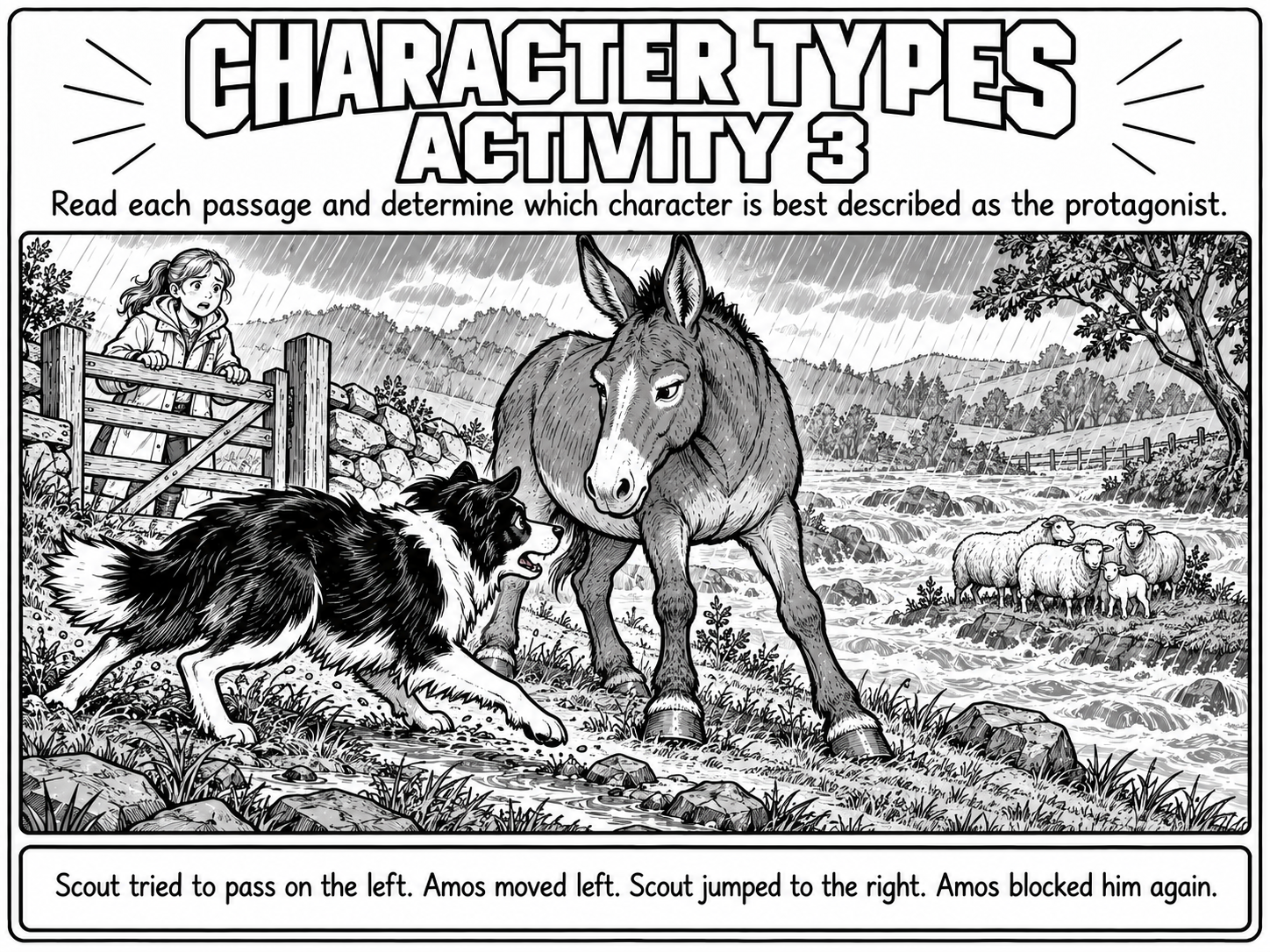
Amos stepped sideways and blocked him.
Scout tried to pass on the left. Amos moved left. Scout jumped to the right. Amos blocked him again.
Scout barked sharply. The sheep needed help, and this slow old mule was standing in his way.
Amos did not move. The creek roared below them.
Scout spotted a narrow gap beside him. He shot through it and raced toward the water.
Two steps later, the ground broke beneath his paws.
Mud slid toward the creek. Scout fell onto his chest and began slipping with it. His front paws splashed into the cold brown water. He clawed at the bank, but the mud kept pulling him down.
Then a broad gray shoulder pressed beside him.
Amos had followed. He planted all four hooves in the mud and leaned against the bank. Scout pushed against Amos's front leg and pulled himself onto solid ground.
Scout stood shaking. Mud covered his legs and belly. He did not look at Amos.
The old mule simply turned around and started up the ridge trail again.
The sheep cried from the meadow. Scout wanted to race ahead, but the broken bank showed what his speed had almost cost him.
This time Scout followed Amos.
The ridge trail was long. It twisted through old apple trees and climbed over wet stones. Scout had to slow down to stay behind the mule.
From high on the hill, Scout looked down at the path beside the creek. Most of it had disappeared beneath the rushing water. The bank where he had planned to run was falling away piece by piece.
Amos had not chosen the ridge because he was slow or lost. He had chosen it because he knew.
At last, they reached the low meadow from the far side. The sheep were packed together near the rising water.
Scout rushed forward to circle them.
The frightened ewes bolted. Two of them ran straight toward the creek.
Scout stopped.
Amos stepped between the sheep and the water. He planted his hooves and stood still. He did not chase the ewes. He did not kick or bray. He simply gave them nowhere dangerous to go.
The sheep turned away from him.
Scout understood. Running faster would only frighten them more.
He lowered his body and moved slowly along the outside of the flock. He took one careful step, paused, and took another. The sheep began moving toward the ridge trail.
At a narrow washout, Pip froze. The little lamb cried and refused to move. His mother turned back for him. The water continued rising behind them.
The old Scout would have charged forward.
Instead, Scout backed away. He curved around Pip slowly and left the trail open in front of him. Amos waited farther ahead, quiet and steady.
Pip took one step. Then he took another. Soon he was following his mother up the trail.
Amos led the flock over the ridge. Scout worked behind them, keeping the sheep together without crowding them. His legs hurt from holding back, but every sheep stayed on the safe path.
By the time they reached the barn, water had covered the low meadow.
Mary closed the gate and counted the sheep. Every ewe was there. Pip pressed safely against his mother.
Mary knelt and wrapped her arms around Scout. Then she gave Amos an apple from her coat pocket.
"Good work," she said. "Fast feet helped, Scout. But Amos knew where to put them."
Scout looked at the old mule. For the first time, Amos did not look slow.
He looked certain.
The next morning, the sun returned. Mary opened the pasture gate, and Scout raced through it from habit. After a few steps, he stopped and looked back.
Amos was still walking through the gate.
Scout returned to him. When the old mule started down the fence line, Scout walked beside him and matched his pace.
The long way no longer felt like wasted time.