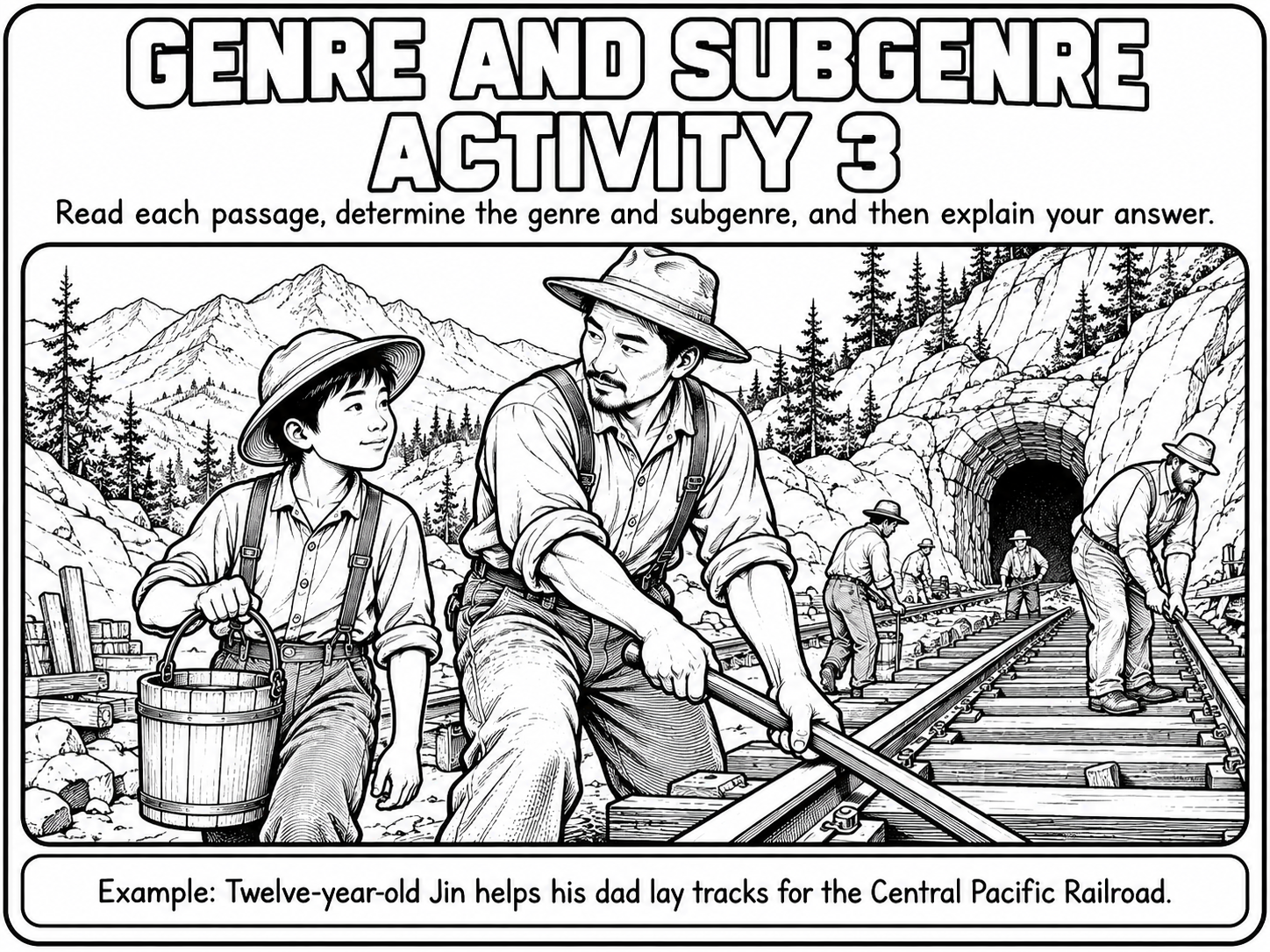
Genre and Subgenre Activity 3
Interactive ActivityGrades 6-8

Genre and Subgenre Activity 3

Skill: Genre and Subgenre

Read the descriptions of the texts. Look for details that reveal the genre. Select the genre and
subgenre and then explain your answer.

Reading LevelChoose where to begin. The activity adjusts as you go.

Genre and Subgenre Activity 3

Genre and Subgenre Activity 3

Read the descriptions of the texts. Look for details that reveal the genre. Select the genre and
subgenre and then explain your answer.

Ad 728x90
Preview Level

Level B - Proficient

Read each passage, determine the genre and subgenre, and then explain your answer.
Dust and Dynamite by Carmen Solano
It is 1867, and the race to build a railroad across America is on. Twelve-year-old Jin works alongside his father laying track for the Central Pacific Railroad in the Sierra Nevada mountains. The work is hard and dangerous. The men use dynamite to blast through rock. When Jin's father gets hurt in a tunnel accident, Jin must decide whether to keep working or find help in a town that doesn't welcome outsiders. Can one boy make a difference when the odds are stacked against him?
What genre is this passage?
How do you know? Explain your answer.
Recess Isn't a Reward, It's a Right by Dante Simmons
Have you ever had recess taken away as a punishment? Dante Simmons thinks that's wrong. In this essay, he argues that all students need recess every day. He gives reasons why running and playing helps kids pay attention in class. He also says that taking recess away is not a fair punishment. Dante wants readers to talk to their teachers and principals about making recess a rule that can't be taken away. Are you with him?
What genre is this passage?
How do you know? Explain your answer.
Why the Canyons Answer Back adapted by Niko Dalen
Long ago, the desert had no canyons and no echoes. The Wind God Teren raced across the open land, shouting his name so loudly that even birds fell from the sky in surprise. The Earth Goddess Suma begged him to be quiet, but Teren only laughed and cried out again, splitting the stone below with the force of his voice. Angry at his pride, Suma pressed the broken earth downward into deep winding canyons. From that day on, Teren's voice remained trapped among the stone walls, and that is why people's words still come back to them when they call into the canyon.
What genre is this passage?
How do you know? Explain your answer.
Flour on the Floor: How I Became a Baker by Rosa Munoz
In this book, Rosa Munoz shares the true story of her life in her own words. Rosa grew up watching her grandmother bake bread every morning in a tiny kitchen. She writes about her first disasters: burned crusts, flat cakes, and dough that stuck to everything. "I ruined so many batches that I could have opened a museum of mistakes," she admits. Rosa describes how she saved money, took risks, and eventually opened a small bakery that became famous in her city. Her story is an honest, personal look at what it takes to turn a passion into a career.
What genre is this passage?
How do you know? Explain your answer.
The Last Lighthouse Keeper by Nadia Holt
It is the year 2302 and the surface world has been abandoned. People now live in underwater cities connected by high-speed submarine tunnels. Twelve-year-old Wren is one of the last people still living above the waves. She lives in a lighthouse that nobody seems to need. Her only friend is a malfunctioning repair robot she calls Gull. When Wren's outdated radio equipment picks up a distress signal from somewhere on the coast, she faces a choice: ignore it and stay safe or investigate. Who could be sending this message, and why?
What genre is this passage?
How do you know? Explain your answer.
The Firefly and the Lantern retold by Mae Tanaka
A Firefly spent every evening drifting through the dark woods, carrying her own small glow. A brass Lantern on a nearby porch watched her and laughed. "Why do you bother?" the Lantern called out. "My flame is a hundred times brighter than yours. Everyone looks at me." The Firefly said nothing and kept flying. One stormy night, the wind blew hard and snuffed out the Lantern's flame. The porch sat in total darkness. But the Firefly kept glowing, steady and calm, lighting her own small path through the rain. By morning, the Lantern's glass was cold and empty. The Firefly was still shining. The moral of the story is that a light that comes from within can never be blown out.
What genre is this passage?
How do you know? Explain your answer.
Romeo and Juliet by William Shakespeare
This is a play about two teenagers from rival families. They fall in love at first sight. Then they secretly marry. Unfortunately, a chain of misunderstandings and violence leads to both of their deaths.
What genre is this passage?
How do you know? Explain your answer.
The Weather Map by Corin Vale
Milo finds a rolled-up map under the sink in his apartment basement. When he opens it, a glowing path appears on the floor. The path leads to a hidden city where fish swim through the air and stairs move by themselves. Milo meets a rain-keeper, a magical being who tells Milo that someone has stolen tomorrow's weather. Now Milo's world is in danger. Can Milo use the magic map to bring the rain back before his whole world dries up?
What genre is this passage?
How do you know? Explain your answer.
The Weaver and the Frozen Prince retold by Katya Volkov
Once upon a time, a jealous witch cast a curse on a young prince, turning him into a statue of solid ice in the heart of a dark forest. Knights and scholars tried to break the enchantment, but nothing worked. A poor weaver girl named Lira heard the story and decided to try. She carried only her loom and a ball of golden thread. Along the way, a talking fox appeared and warned her that only a blanket woven from starlight could break the witch's spell. For three nights, Lira climbed the tallest hill and caught threads of light from the sky. She wove them into a shimmering blanket and laid it over the frozen prince. The ice cracked, the curse shattered, and the prince opened his eyes. Together, they returned to the kingdom and lived happily ever after.
What genre is this passage?
How do you know? Explain your answer.
King Arthur and the Lady of the Lake retold by Eleanor Graves
Many people believe that King Arthur was a real king who ruled Britain long ago. They say he was the greatest king the land had ever known. According to the stories, Arthur was already a powerful leader when a hand rose from the surface of a still, glassy lake, holding a shimmering sword. The Lady of the Lake gave Arthur this sword. It was called Excalibur. The Lady of the Lake told him it would protect him in every battle. Arthur accepted it, and legends say the sword helped him win impossible victories against armies twice the size of his own. Some people tell these stories about King Arthur seriously, as though every detail were fact. But most historians agree that the details have been stretched over hundreds of years of retelling. Still, some say the Lady of the Lake is out there, waiting for Arthur's successor.
What genre is this passage?
How do you know? Explain your answer.
The Permission Slip by Erin Cole
Jae has spent weeks preparing for the district debate trip, and his teacher says he has a real shot at bringing home a medal. Then he finds the permission slip, still buried in the bottom of his backpack and still missing his mother's signature. His mom has been working double shifts, and every time Jae means to ask her, something gets in the way. The deadline is tomorrow morning. If he misses it, another student will take his place. When his friend Marco shrugs and says, "Just sign it yourself," the solution sounds simple—but not harmless. Will Jae protect his chance to go, or protect the truth?
What genre is this passage?
How do you know? Explain your answer.
Wangari Maathai: Roots of Change by Sara N. Cole
Sara N. Cole tells the true story of Wangari Maathai's life. Wangari was born in Kenya. As a child, Wangari enjoyed the forests and fresh water near her home, but as she grew older, she noticed that many trees had disappeared. Instead of only talking about the problem, she organized women to plant new trees and restore damaged land. Many powerful people tried to stop her, but she persisted. Her work grew into a much larger movement that inspired people around the world. Wangari Maathai's life shows how one person's courage and persistence can lead to lasting change.
What genre is this passage?
How do you know? Explain your answer.
All About Bridges by Frank Sherman
How do bridges hold up cars, trucks, and even trains without falling down? This book explains how engineers design bridges that can carry heavy loads. It teaches readers about different types of bridges, like beam bridges and suspension bridges. It also has pictures showing how cables and arches help spread the weight. If you have ever wondered how people build across rivers and valleys, this book has the answers.
What genre is this passage?
How do you know? Explain your answer.
Spinning the Globe: The Nellie Bly Story by Diane Prescott
This book tells the true story of Nellie Bly, one of the bravest reporters in history. Nellie faced many dangers to make the world a better place. She went undercover in a mental hospital to show how badly patients were treated. She also raced around the world in just 72 days, beating the record from a famous book. Diane Prescott shares Nellie's real-life adventures, from her childhood to her greatest achievements. This is the story of a woman who refused to keep quiet.
What genre is this passage?
How do you know? Explain your answer.
Keep the Library Open After School by Naomi Bell
Naomi Bell thinks the town library should stay open for two extra hours after school. In her essay, she says students need free use of computers, printers, books for research, and quiet spots during the peak homework time. She also mentions that many parents can't pick up their kids right after school. So, the library is a safe spot to wait and study. She ends by asking people to sign her petition and come to the next town council meeting. That way, leaders can hear from the students who really need the library.
What genre is this passage?
How do you know? Explain your answer.
A Midsummer Night's Dream by William Shakespeare
In this hilarious play, four young lovers wander around a forest. Mischievous fairies cast spells that make everyone fall in love with the wrong person. There is a night of confusion, jealousy, and mistaken identity. The audience finds this quite humorous. And then everything is sorted out just in time for some wedding celebrations.
What genre is this passage?
How do you know? Explain your answer.
Mighty Maggie and the Blizzard Express retold by Cole Bannister
Folks in the frontier town of Silver Switch will tell you that Mighty Maggie was tougher than winter itself. One year a train got buried in snow before it could reach town. Maggie stomped across the drifts, braided the storm cloud into one long rope, and tied it around the steam engine. Then she leaned forward and pulled the whole train into the station before the passengers' hot cocoa got cold. By supper, the tracks were clear and the snow was piled so high that folks used it for sledding till spring.
What genre is this passage?
How do you know? Explain your answer.
The Dreaming Machine by Kira West
Zara lives on a floating city above the clouds. Her robot tutor, Axiom, has taught her everything since she was five. But lately Axiom has been pausing mid-sentence, tilting his head, and describing things he's never seen: blue grass, falling rain, a door that won't open. Robots aren't supposed to dream. So what's happening? Zara's mother, a lead engineer, wants to reset Axiom's core system. But Zara believes erasing whatever is growing inside Axiom would be like erasing a person. Zara must decide whether she should protect the machine that raised her, or follow the rules that keep the city safe.
What genre is this passage?
How do you know? Explain your answer.
The Beaver and the Drum retold by June Vale
A Beaver was hard at work repairing a weak spot in his dam when a Woodpecker landed nearby and began drumming proudly on a hollow log. "Hear how the forest listens to me," Woodpecker said. Beaver liked the sound. He noticed Woodpecker getting a lot of attention. Beaver wanted to get the attention of the forest creatures too. So he laid down his sticks and spent the rest of the afternoon pounding on the log beside his friend. That night a heavy rain swelled the stream. The water burst through the dam where Beaver had left his work unfinished. By morning, Beaver's home was gone. The moral of the story is that applause will not keep out the rain.
What genre is this passage?
How do you know? Explain your answer.
Summer in the Repair Shop by Luis Ortega
In this book, Luis Ortega tells the true story of his own life. Luis writes about spending one summer in his grandfather's garage, learning how to repair broken bicycles. "My hands were always black with grease," Luis says, "but I loved making old bikes work again." At first he was nervous about fixing anything by himself. By the end of the summer, he had repaired a bike on his own and rode it all the way across town.
What genre is this passage?
How do you know? Explain your answer.