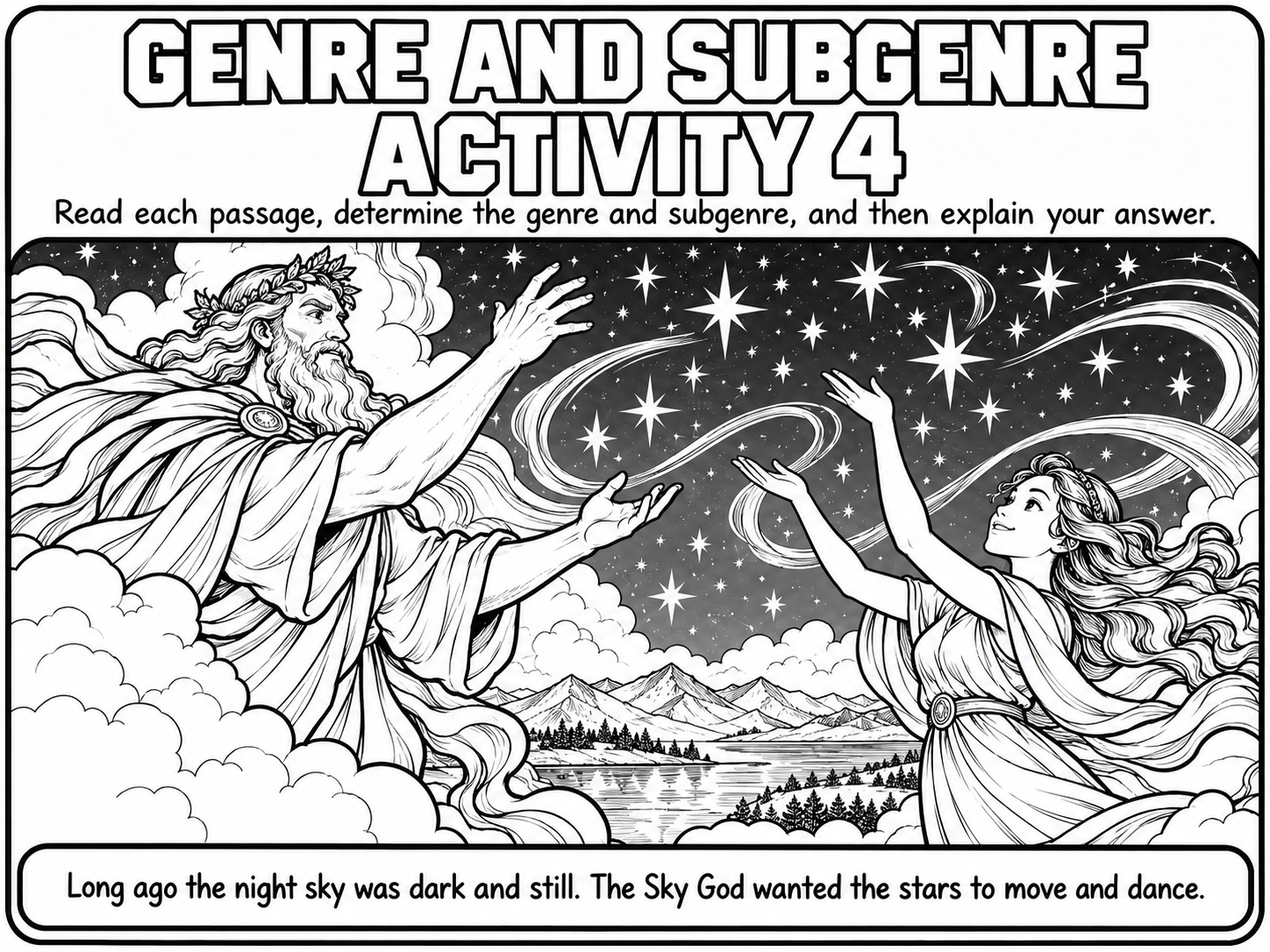
Genre and Subgenre Activity 4
Interactive ActivityGrades 9-12

Genre and Subgenre Activity 4

Skill: Genre and Subgenre

Read the descriptions of the texts. Look for details that reveal the genre. Select the genre and
subgenre and then explain your answer.

Reading LevelChoose where to begin. The activity adjusts as you go.

Genre and Subgenre Activity 4

Genre and Subgenre Activity 4

Read the descriptions of the texts. Look for details that reveal the genre. Select the genre and
subgenre and then explain your answer.

Ad 728x90
Preview Level

Level B - Proficient

Read each passage, determine the genre and subgenre, and then explain your answer.
How the Stars Learned to Dance adapted by Amina Okubo
Long ago the night sky was dark and silent. The Sky God wanted the stars to move and dance so the world would not feel lonely. He called on the Wind Goddess for help. Together they spun and twirled until the stars began to sparkle and dance across the sky. That is why we see stars twinkling and moving at night.
What genre is this passage?
How do you know? Explain your answer.
Turn the Empty Lot Into a Community Garden by Tessa Hill
In her essay, Tessa Hill says the empty lot on Maple Street should be turned into a community garden. Right now, the lot sits behind a fence and fills up with trash. Tessa thinks a garden would help her town. It would grow fresh food, give students a place to learn about science, and make the neighborhood nicer. She ends by asking readers to sign a petition and speak up at the next town meeting.
What genre is this passage?
How do you know? Explain your answer.
The Nikola Tesla Story by Diane Hargrove
Diane Hargrove shares the true story of Nikola Tesla, a truly gifted inventor. As a young boy in a small village in what is now Croatia, Tesla loved watching lightning storms. He came to the United States with just four cents. Hargrove talks about Tesla's tough friendship with Thomas Edison and his important work on a type of power called alternating current. She also explains the personal issues that stopped Tesla from getting the praise he earned. Hargrove tells the story of a brilliant man whose thoughts were always ahead of his time.
What genre is this passage?
How do you know? Explain your answer.
The Ghost in the String by Liam O'Malley
Twelve-year-old Leo never expected his inheritance to be a wooden yo-yo. However, this isn't a normal toy. The moment he throws it, the yo-yo performs impossible tricks: spinning for minutes, walking up walls, and hovering in mid-air. Leo's excitement turns to chills when he realizes the yo-yo is trying to communicate. A ghostly figure of a boy from the past begins to appear in the bedroom mirror whenever the yo-yo is in motion. Can Leo help the spirit find peace, or is he now trapped in a dangerous magical game?
What genre is this passage?
How do you know? Explain your answer.
The Usual Identity by Carly Vaughn
The year is 2085, and every person in the city has been genetically engineered to look exactly the same. Everyone has gray eyes and brown hair in the name of "perfect harmony." The birth of a girl named Elara with striking red hair and vivid green eyes causes panic. The leaders call her a dangerous flaw in the system, and the scientists fear their technology has made a mistake. Will Elara be allowed to stay, or are her differences too much for the world to handle?
What genre is this passage?
How do you know? Explain your answer.
The Hatchet and the Cherry Tree retold by Walton Webber
Most people are familiar with the story of young George Washington and his father's prized cherry tree. Walton Webber retells this story that is part of the oral tradition. George received a small hatchet as a gift and, in his excitement, damaged a tree in the family garden. When confronted by his father, George did not lie, as he easily could have. Instead, he famously declared, "I can't tell a lie. I chopped down your cherry tree." While historians believe this event was likely invented by an early author to celebrate Washington's honesty, the story is still told seriously as if it were a part of his real history.
What genre is this passage?
How do you know? Explain your answer.
Squirrel Launcher 3000: Official Player's Guide by GameGuides Press
Do you want to win at Squirrel Launcher 3000? This manual provides a complete breakdown of the mechanics in the hit game. Readers will learn to build catapults using waffles and rubber chicken tension bands. The guide also explains the patterns of the Acorn King boss and provides a walkthrough for the final level. Use this book to master the physics of the game and break your old high score.
What genre is this passage?
How do you know? Explain your answer.
Paul Bunyan's Big Walk retold by Buck Harmony
Paul Bunyan was the biggest and greatest lumberjack in American history. One day he had a craving for crab legs. So he decided to walk from one side of America to the other. Everywhere he went, he left his mark. As he dragged his enormous axe behind him through the desert, the blade carved out the massive Grand Canyon. When he got thirsty in the north, he spit out a giant mouthful of water and created the five Great Lakes. These weren't so great to Paul. His giant campfire left behind the black soil of the Midwest. Paul Bunyan's big walk accidentally made some of the most famous places in America. But by the time he reached the other side of the country, Paul decided that he wanted pancakes after all.
What genre is this passage?
How do you know? Explain your answer.
The Double Date Disaster by Elma Lawler
This is a funny play about two couples, the Millers and the Grays. They plan a joint vacation and decide to test each other's loyalty with a series of "fake" emergencies. Soon, everyone is so confused that they start believing their own fake stories! The audience follows the comic mix-ups until the third act when an ambulance arrives and even a mortician! After all the chaos and silly situations are resolved, the play ends with a big wedding where both couples get married.
What genre is this passage?
How do you know? Explain your answer.
The Rose and the Prince retold by Helena Bridges
Once upon a time, in a land far away, a beautiful young woman named Belle traded her freedom to save her father from a mysterious Beast. Belle soon discovered that the Beast's castle was filled with enchanted objects and a magical rose. The rose was part of a curse placed on the prince many years ago by a powerful enchantress. Only by learning to love another could the prince break the spell and return to his human form. After many adventures, Belle and the Prince broke the curse and lived happily ever after.
What genre is this passage?
How do you know? Explain your answer.
The Donkey in the Lion's Skin retold by Nora Finch
One day a donkey discovered a lion's skin left behind by hunters. He pulled it over himself and strutted through the woods. The other animals took one look and fled in terror. The donkey enjoyed feeling powerful for the first time. He was feeling so strong that he decided to roar like a lion. But when he did, all that came out was a loud "Hee-haw!" The animals then realized who it was and began to laugh. The moral of the story is that you cannot hide who you really are for long.
What genre is this passage?
How do you know? Explain your answer.
Twenty Years Late by Pham Linh
Hoa is digging up the backyard to start a vegetable garden when her shovel strikes something solid. She unearths a rusted lunchbox, sealed with old duct tape. Inside are letters, instant photos, ticket stubs, and a thin school yearbook from twenty years ago. Three kids had buried it as a time capsule, promising in a letter to come back and dig it up. They never did. Hoa decides she will find them and return the box herself. She uses the yearbook to track down a name and an address in the next town. She writes a careful letter and mails it. Now she just has to wait. Are these strangers still out there? Will any of them want to be reminded of who they were two decades ago?
What genre is this passage?
How do you know? Explain your answer.
Narrative of the Life of Frederick Douglass by Frederick Douglass
Frederick Douglass wrote this book in 1845 to share his true life story with the world. He describes the brutal conditions he faced while enslaved in Maryland. He explains how he learned to read in secret, believing that knowledge was the path to freedom. He also recounts the day he finally escaped to the North. Because he wrote the story himself, we see his life through his own eyes.
What genre is this passage?
How do you know? Explain your answer.
Why Toast Always Lands Butter-Side Down by Mike Winters
Mike Winters takes a scientific look at the most common kitchen mishaps. He explains the physics of falling toast. Gravity and the height of a normal table cause the toast to do a half-flip in the air. That is why it usually lands butter-side down. Readers will also learn why onions make us cry and why some cereals float in clumps. Winters shows how real science can explain even the messiest moments at the dinner table.
What genre is this passage?
How do you know? Explain your answer.
Let Us Play by Tori Gates
Tori believes that the study hall rules are outdated and should be changed. She argues that students who finish their schoolwork early should be allowed to play games. She explains that these games sharpen thinking skills and provide a mental break after a long day of classes. Tori concludes by urging her classmates to talk to the principal and request this change.
What genre is this passage?
How do you know? Explain your answer.
The Pit Boy by Brant Gable
Kade has lived on the streets of New Halex City since he was six years old. The city is a maze of neon signs, flying cars, and giant metal towers that block out the sun. To survive, Kade fights robots in underground arenas where kids battle scrap-metal machines for food and credits. He is small, but he is fast, and he knows the weak spots on every model. One night, a retired mech pilot named Rho watches Kade take down a robot twice his size. Rho offers Kade a deal: train with him, learn to pilot a real mech, and fight in the city's professional league. But the league is dangerous, and the people who run it do not lose easily. Will Kade trust a stranger and trade the streets for a seat in a mech fighter?
What genre is this passage?
How do you know? Explain your answer.
Why the Crickets Sing at Night retold by Sam Abbott
Long ago, when the world was still new, the nights were completely silent. The wind slept, the birds slept, and not a single sound rose from the grass. A small brown cricket named Tev was lonely in the silence. Every night he watched the moon climb across the sky, and every night he wished he could sing her a song. But his small voice was too quiet to reach her. One evening, Tev climbed to the highest blade of grass he could find and called out to Ulima, the goddess of the night. Ulima heard him. She was moved by the loneliness of such a small creature, and she gave Tev a gift: two thin wings that would make music whenever he rubbed them together. From that night on, Tev sang for the moon, and his song spread to every cricket in every field. And that is why crickets chirp every night when the sun goes down.
What genre is this passage?
How do you know? Explain your answer.
The Last Round by Dale Hopper
Eli has been getting bullied since the start of seventh grade. Three older boys take his lunch money, knock his books out of his hands, and corner him by his locker. Eli does not tell his parents. He does not tell his teachers. He just keeps his head down and waits for the next thing to go wrong. Then he meets Mr. Pike, the old man who lives two doors down. Mr. Pike used to wrestle on the regional circuit back in the seventies, and his garage is full of trophies, faded posters, and a sweaty old practice mat. Mr. Pike does not promise to turn Eli into a fighter. He promises to teach Eli how to stand up, how to think clearly under pressure, and how to stop running from a problem he can finally face. As the weeks pass, Eli starts to change, but will it be enough to make a difference?
What genre is this passage?
How do you know? Explain your answer.
Othello by William Shakespeare
This play is about a brave general named Othello. Othello is in love with a kind woman named Desdemona, and they get married in secret. But one of Othello's officers, named Iago, is jealous and angry. Iago tells lies to Othello and tricks him into believing that Desdemona has been unfaithful. Othello starts to believe the lies, even though they are not true. By the end of the play, Iago's lies have destroyed everyone. Othello and Desdemona both die, and Iago's evil plan is finally uncovered.
What genre is this passage?
How do you know? Explain your answer.
The Fox Without a Tail retold by Rob Barnes
A clever young Fox stepped into a hunter's trap one morning and barely escaped with his life. He pulled himself free, but his tail was left behind in the iron jaws. At first, the Fox was simply grateful to be alive. But as the days went on, he grew embarrassed every time another fox stared at the empty space where his tail used to be. So he called a great meeting of every fox in the forest. "Brothers and sisters!" he announced. "I have learned the truth. Tails are heavy, useless things. They drag in the mud and serve no purpose. We must all be rid of them!" An older fox at the back of the crowd narrowed her eyes. "You speak with great passion," she said calmly, "but I notice you only began hating tails after you lost yours." The other foxes burst out laughing and went back to their dens. The moral of the story is that people often want others to share in their own misfortunes.
What genre is this passage?
How do you know? Explain your answer.