

What are Character Types?
How characters function in a story
- Every story has characters.
- Not every character does the same job.
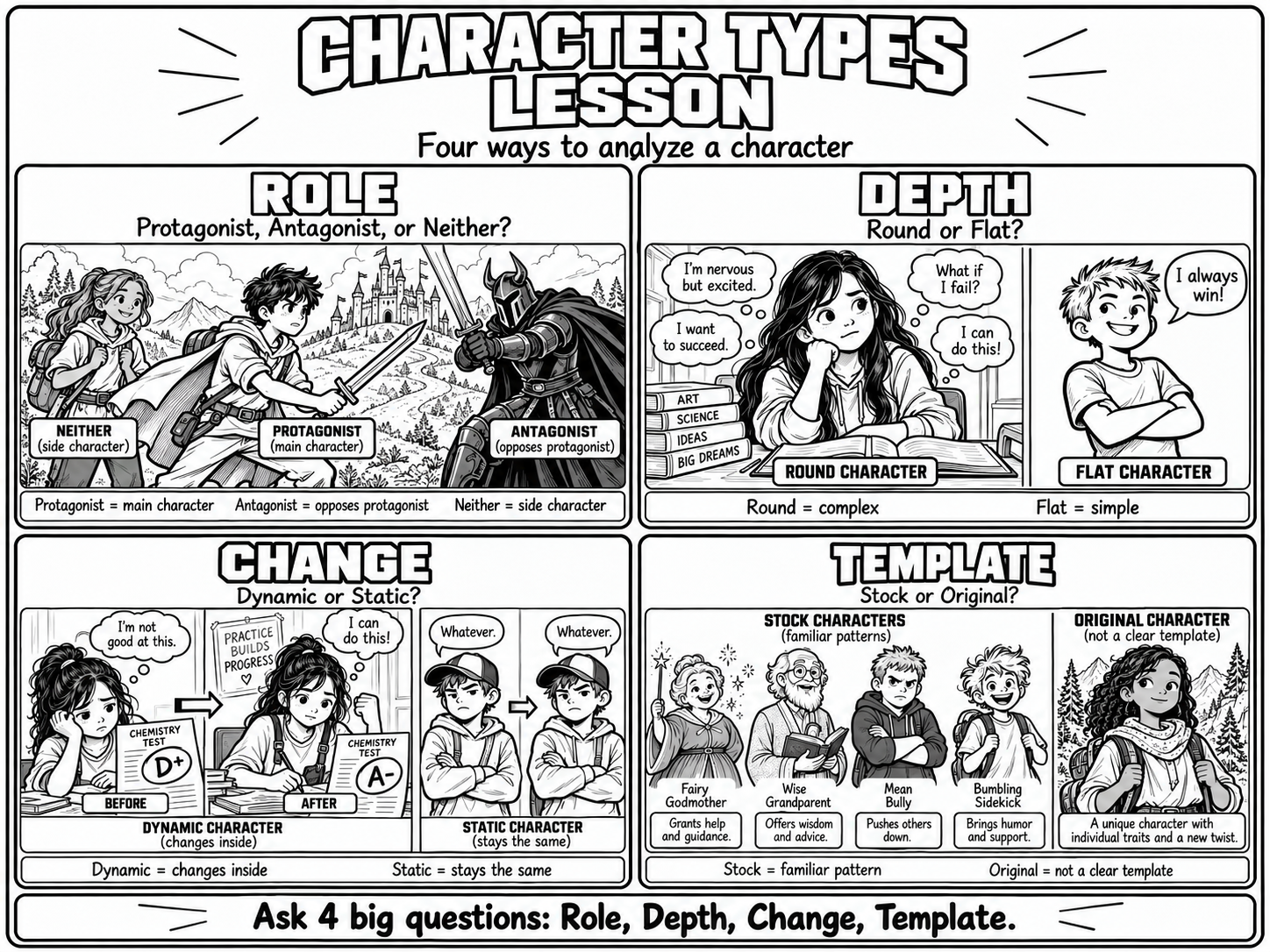
- Character types = role, depth, change
- Let's learn the vocabulary.
Skill: Character Types
Learn how to analyze the characters in a story. You will learn to classify a character three ways: by their role (protagonist, antagonist, or neither), their depth (round or flat), and their change over time (dynamic or static), plus a bonus label for characters who match a familiar template (stock). Available at three reading levels for grades 3 to 12.
Tap to change. You can also toggle these during the lesson.
Anders lived for the setup. He loved the half second before a prank landed, when nobody knew yet what was coming. A rubber snake in Theo's backpack. A fake spider on the bus. A whoopee cushion under the substitute's chair. If there was a way to make someone jump, Anders had already thought of it.
His best friend Theo was used to it. When the rubber snake fell out of his bag, he just sighed and handed it back. "Nice one," he said, the way he said it every time. Theo never got mad. He figured that was just Anders.
Everyone figured that was just Anders. Last month he had told the whole bus that Mr. Delgado's house down the street was haunted, and for a week three kids refused to walk past it. His older sister Greta had stopped believing a single word out of his mouth. When he ran into the kitchen yelling that her shoe had a spider on it, she did not even look up. "Sure it does," she said flatly, and kept scrolling on her phone. She was done being fooled.
That was the thing about Anders. He joked so much that nobody could tell anymore when he was serious. There was no serious. There was just Anders, grinning, waiting for you to fall for it.
One evening their dad was making dinner. He had a pan going on the stove and stepped into the other room to answer the phone. Anders wandered in for a snack and saw it: a dish towel had slipped against the hot burner, and a thin line of flame was climbing up the cloth toward the cabinets.
"Fire!" Anders shouted. "There is a real fire, in the kitchen, right now!"
From the couch, Greta did not even turn around. "Nice try, Anders."
"I am not joking! Dad! Dad, come here, now!"
"You are always not joking," Greta said.
The flame was spreading. Anders felt something he never felt during a prank, a cold drop in his stomach. He ran to the other room, grabbed his dad's arm, and pulled. "It is real. I promise it is real. Please."
Maybe it was his face. Something in it made his dad move. He followed Anders into the kitchen, saw the burning towel, and snapped into action. He shut off the burner, smothered the flame with a lid, and in a few seconds it was out. A smear of soot climbed the wall. The kitchen smelled like smoke, but nobody was hurt.
Greta appeared in the doorway, pale now. She had just realized how close they all came to dealing with a burning kitchen.
Their dad let out a long breath. "Good thing you got me when you did," he said quietly.
Anders nodded, but he was still stuck on the scary part. It was not the fire. It was the seconds before anyone moved, when "Fire!" from his mouth meant nothing because it was just another word from the boy who joked. His pranks had been funny, of course, but he had made himself into someone people could not trust, even when it mattered most.
He did not decide to stop being funny. He was still going to be funny. That was who he was. But he decided there had to be a difference between Anders playing around and Anders meaning it, so that the next time something was real, someone would move on the first word.
A few days later, Anders told Greta there was a llama loose in the backyard. She did not even glance up. "Fake."
"Yeah, that one is fake," he admitted, grinning. Then his voice dropped, flat and clear. "But the stove is still on. For real."
Greta narrowed her eyes at him, weighing it. Something in how he said it was different. She got up, checked, and turned the burner off. Then she pointed at him. "Do not make me regret believing you."
She was still the same Greta, still ready to call his bluff. The difference was that this time, when it counted, he had made sure she could tell.
Lesson Report
Would you like to return to question 1 and retry your review before final submission, or submit your current answers as-is?
This usually takes about 90 seconds. DO NOT CLOSE THIS WINDOW UNTIL THIS IS COMPLETE OR YOU MAY LOSE YOUR WORK.