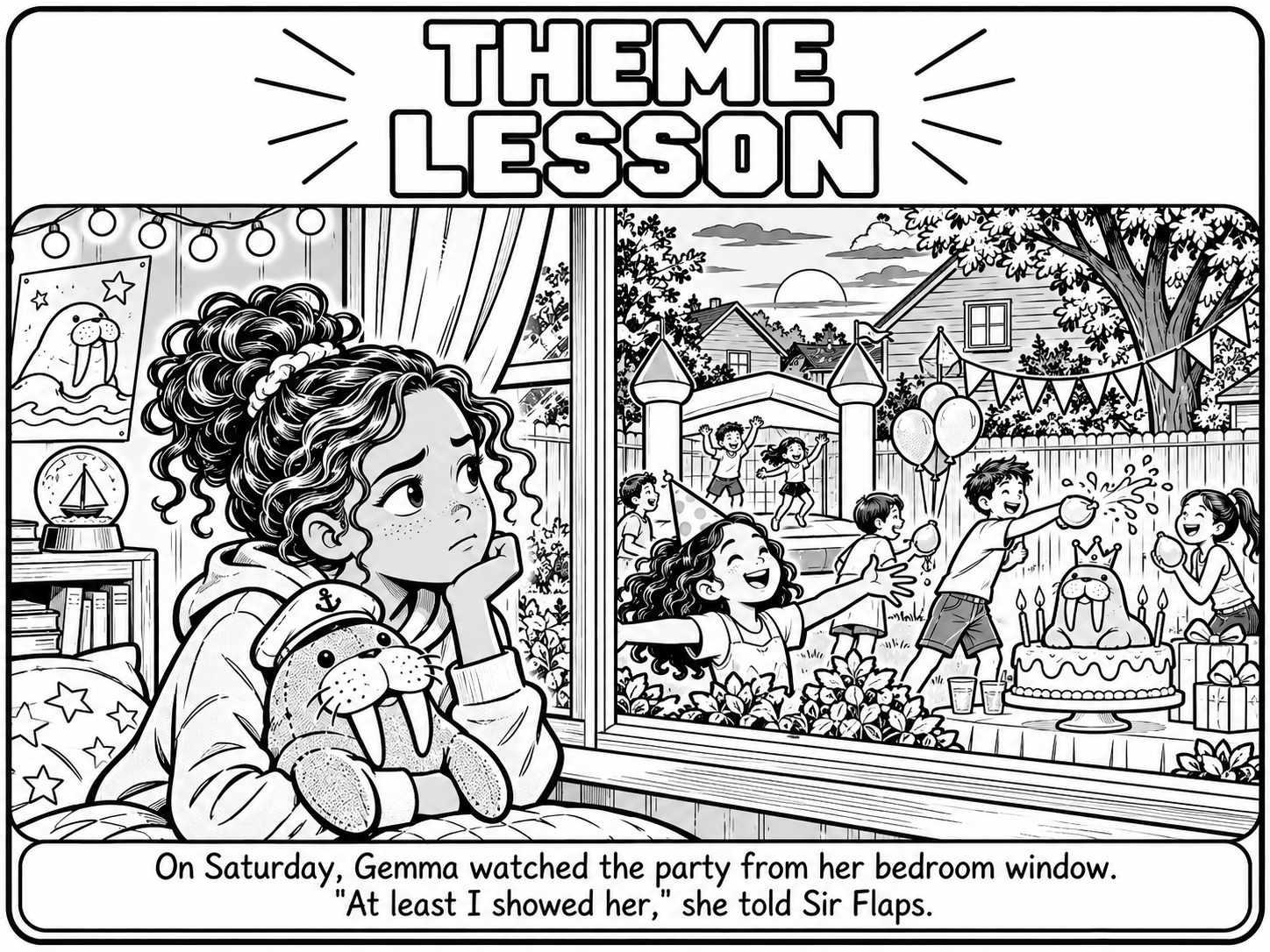
Theme is the lesson or message about life or human nature that a story teaches its readers. Authors rarely state a theme outright. Instead, readers infer it from what the characters choose, what happens because of those choices, and how the story ends. A theme is bigger than the story. It reaches beyond the story into real life.
Read the full Theme guide
Theme Topic vs. Theme Statement: Putting It into Words
Theme Topic: the subject a story explores, named in a word or two, like friendship, greed, or courage. A topic tells what a story is about, but a single word is not a theme.
Theme Statement: what the story says about its topic, written as a complete sentence. The topic greed, for example, might become "Greed can cost you more than it gets you." A strong theme statement doesn't reference the characters or plot of the story. Rather, it is a general statement that can apply to real world outside of the story.
The 4 C's: Where to Look for Theme Clues
Choices and Consequences: what the main character chooses and what happens as a result. Most themes grow out of a character's choices, good or bad.
Contrast: characters who respond differently to the same situation and end up in different places.
Change: what a character learns by the end of the story. When a character fails to learn the lesson, the reader often learns it instead.
Conflict: how the story's main problem is resolved, and which choices the ending rewards or punishes. (See Types of Conflict.)
Theme vs. Moral vs. Main Idea: Telling Them Apart
Theme: a lesson about life that readers infer from what happens in a story. The author shows it rather than stating it.
Moral: a lesson the story states outright, often in the last line of a fable, such as "Slow and steady wins the race."
Main Idea: what a nonfiction text, such as an article or a textbook chapter, is mostly about. Readers look for a theme in fiction and a main idea in nonfiction.
Interactive Lessons
Slide decks
Theme
AdaptiveGrades 3-12
Adaptive
Grades 3-12
Auto-adapting difficulty. Content adjusts to student reading level in real time.
Learn how to identify the theme of a story, also called the central message or author's message. You will learn the difference between a theme topic and a theme statement, where to look for clues, and how a theme differs from a moral or a main idea. Available at three reading levels for grades 3 to 12.
Practice activities for this skill are coming soon. Check back as the collection grows.
Status: Coming soon
Standards & Objectives
Learning Objectives
Determine the theme of a story by analyzing characters' choices and their consequences, contrasts between characters, character change, and how the conflict is resolved.
Distinguish between a theme topic and a theme statement, and express a theme as a complete sentence that applies beyond the story.
Explain how a theme differs from a moral and a main idea.
Evaluate possible theme statements to separate a universal theme from story-specific statements, surface-level rules, and a character's mistaken conclusions.
Support a theme statement with specific evidence from the text and explain how key details convey the theme.
Determine central ideas or themes of a text and analyze their development; summarize the key supporting details and ideas.
Show standards (8)
Reading Literature (RL)
Key Ideas and Details
Grade 3
RL.3.2 Recount stories, including fables, folktales, and myths from diverse cultures; determine the central message, lesson, or moral and explain how it is conveyed through key details in the text.
Grade 4
RL.4.2 Determine a theme of a story, drama, or poem from details in the text; summarize the text.
Grade 5
RL.5.2 Determine a theme of a story, drama, or poem from details in the text, including how characters in a story or drama respond to challenges or how the speaker in a poem reflects upon a topic; summarize the text.
Grade 6
RL.6.2 Determine a theme or central idea of a text and how it is conveyed through particular details; provide a summary of the text distinct from personal opinions or judgments.
Grade 7
RL.7.2 Determine a theme or central idea of a text and analyze its development over the course of the text; provide an objective summary of the text.
Grade 8
RL.8.2 Determine a theme or central idea of a text and analyze its development over the course of the text, including its relationship to the characters, setting, and plot; provide an objective summary of the text.
Grades 9-10
RL.9-10.2 Determine a theme or central idea of a text and analyze in detail its development over the course of the text, including how it emerges and is shaped and refined by specific details; provide an objective summary of the text.
Grades 11-12
RL.11-12.2 Determine two or more themes or central ideas of a text and analyze their development over the course of the text, including how they interact and build on one another to produce a complex account; provide an objective summary of the text.
Copyright 2010. National Governors Association Center for Best Practices and Council of Chief State School Officers. All rights reserved.
Assign This Activity
Choose your defaults and generate a shareable assignment link.
Discussion(0)