A vibrant collage of fiction genres: astronaut in spaceship for sci-fi, knight in castle for historical, family dinner for realistic, wizard battling dragon for fantasy
Lesson Preview · Grades 6-8

Genre and Subgenre Lesson

Skill: Genre and Subgenre

This lesson explains the five major literary genres — fiction, nonfiction, folklore, drama, and poetry — and then dives into some of the subgenres. Students learn to identify and distinguish subgenres like science fiction, mystery, historical fiction, biography, autobiography, informational text, fable, fairy tale, myth, legend, and tall tale. After the lesson, students practice classifying a variety of texts by genre and subgenre. Available at three reading levels for grades 3–12.

Ad 728x90
Genre
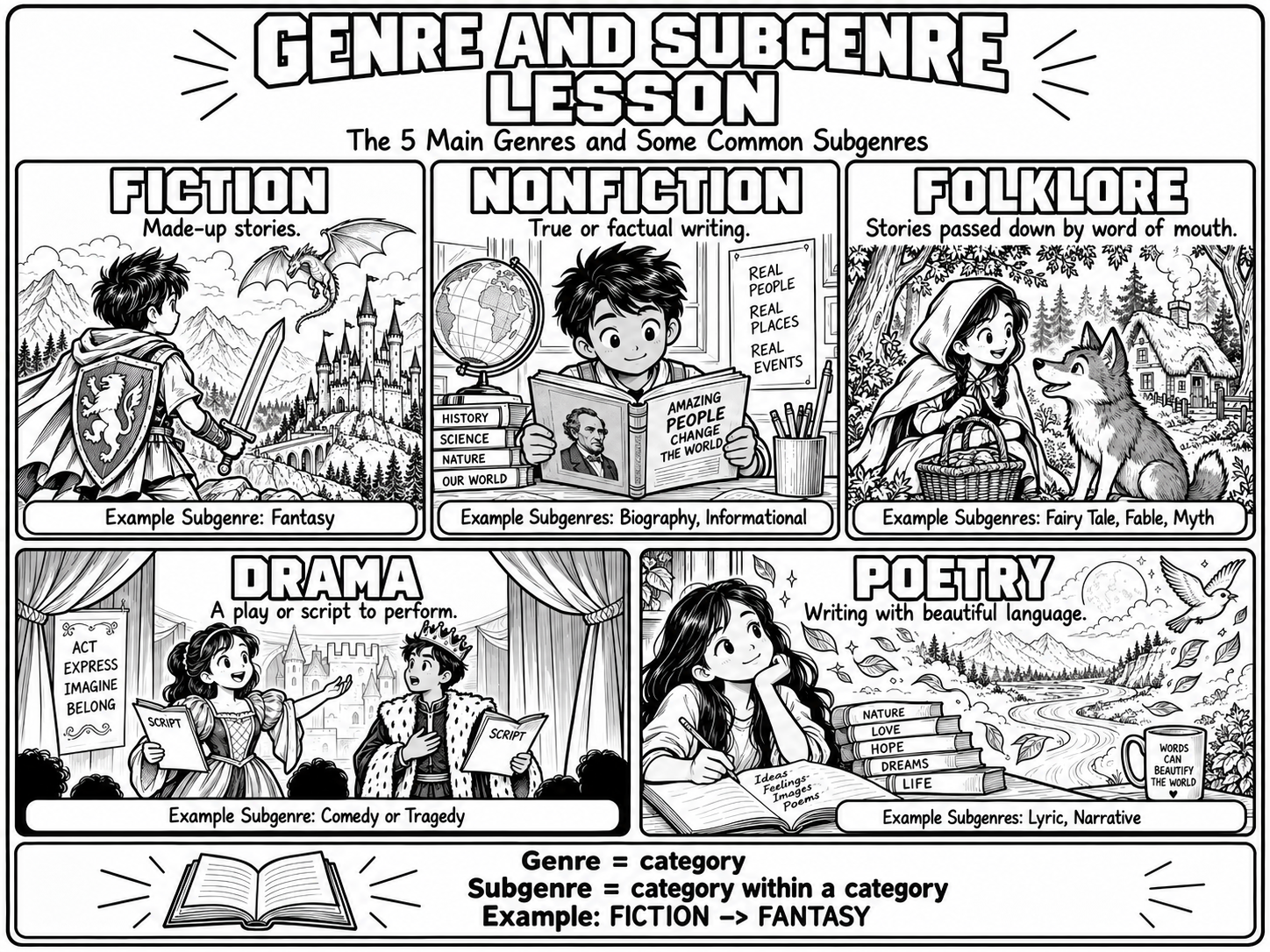
Genre = Category
  • Subgenre
  • Subgenre = Category within a category
  • Example
  • A BANANA → is a FOOD → is a FRUIT.
  • Harry Potter → is FICTION → is FANTASY.
Genre Overview
The 5 Main Genres
  • Fiction - Creative or imaginative writing; made up.
  • Nonfiction - Writing that is true or factual.
  • Folklore - Stories passed down orally (by word of mouth).
  • Drama - A play or script.
  • Poetry - Writing that is concerned with the beauty of language.
  • Let's look at each of these more closely...
Subgenres of Fiction
An Overview
  • Realistic Fiction
  • Historical Fiction
  • Science Fiction
  • Fantasy
  • Let's look at each of these a little closer.
Realistic Fiction
Stories that could be true but aren't.
  • Key Clues
  • Everyday settings, relatable problems, no magic/aliens/historical anchors.
  • Examples
  • The Captain’s Choice by Marcus Reed
  • Jordan has a tough choice to make. Will he help his best friend during basketball tryouts or stay quiet to secure the final spot on the team himself?
  • The Project Partner by Amara Wells
  • A girl gets paired with a goofball partner for a science project. Now she has to decide whether to do all the work herself or speak up before the deadline.
Historical Fiction
A made-up story set around a real event or person from history
  • Key Clues
  • Specific dates or eras and real wars or events from the past.
  • Examples
  • Seeds to Dreams by Emma Holmes
  • In 1942, a young girl named Lily helps her mother plant a "Victory Garden." She and her mother help feed hungry neighbors while waiting for her father to return home from the war.
  • To Go Alone by Sally Parks
  • Sarah moves to a new school in 1960. This new school is guarded by troops. They are integrating the school by force. Sarah has to face this challenge while also dealing with pressure from her neighbors.
Science Fiction
Has aliens, advanced technology, or is set in outer space or the future
  • Key Clues
  • Futuristic dates, space travel, alien species, and advanced technology
  • Examples
  • The Blinking Star by Ravi Anand
  • In the year 2275, a girl named Kira lives on a space station. One night her robot dog picks up a strange signal from a star that no one has explored. Kira wants to find out what is sending the signal.
  • Shadow Over Titan by Elise Park
  • When a storm cuts power at a research base on Titan, Lena discovers the repair drones are obeying commands from somewhere deep under the ice.
Fantasy
Has monsters, magic, or characters with superpowers
  • Key Clues
  • Spells, dragons, monsters, or magical realms
  • Examples
  • The Jar of Winds by Sophie Callahan
  • Ten-year-old Mateo finds a glass jar in his attic. When he opens it, a tiny storm flies out. His grandmother says there are more jars hidden in the house, and each jar holds a different kind of magic.
  • Shadows of Eldoria by Meryl Vance
  • A young apprentice discovers he has the rare ability to control shadows with his mind. He must master his new powers to protect his hidden city from an army of rock monsters.
Subgenres of Nonfiction
An Overview
  • Informational Writing
  • Persuasive Writing
  • Autobiography
  • Biography
  • Let's look at each of these a little more closely.
Informational Writing
Gives facts, explains, teaches
  • Key Clues
  • Textbooks, cookbooks, how-to guides, reference materials; may have an objective tone; explains, describes, or teaches something
  • Examples
  • All About Tides by Dr. Howard Brown
  • This book explains what tides are. It teaches readers why the ocean moves in and out every day. It also describes how the moon helps pull the water.
  • How to Grill by Ron Sanders
  • This text teaches the proper way to grill steaks, hamburgers, veggies, and more. You too can learn to never burn another burger again.
Persuasive Writing
Tries to influence or convince the reader
  • Key Clues
  • Argues, tries to convince, uses words like "should" or "must," asks readers to take action
  • Examples
  • Drop the Dress Code by Isaiah Monroe
  • Isaiah argues that his school's strict dress code doesn't improve learning. He thinks that the dress code punishes students for expressing themselves. He urges readers to attend the next school board meeting and speak up.
  • Let Us Sleep by Tanya Oaks
  • Tanya argues that school should start later because tired students make more mistakes, feel worse, and learn less. She closes her essay by asking readers to sign her petition.
Autobiography
One's life story written by oneself
  • Root Words
  • AUTO = self | BIO = life | GRAPHY = writing
  • Examples
  • My Hands in the Soil by Elena Ruiz
  • Elena Ruiz tells the true story of growing up on her family’s small farm during a long drought. In her own words, she describes the work, the worry, and the pride of not giving up.
  • The Story of My Life by Helen Keller
  • Helen tells her own true story about becoming deaf and blind as a baby and learning to read and write with the help of her teacher, Anne Sullivan. Helen shares stories of some of her happy times and greatest challenges.
Biography
A person’s life story written by someone else
  • Root Words
  • BIO = life | GRAPHY = writing
  • Examples
  • The Boy Who Asked Why by Renee Caldwell
  • Caldwell tells the true story of Albert Einstein. As a kid, he was quiet and curious. He loved to ask questions about how the world worked. He grew up to become one of the most famous scientists ever.
  • Freedom's Lantern: The Story of Harriet Tubman by Samuel Oakley
  • This book, written by Samuel Oakley, is about the real life of Harriet Tubman. She escaped slavery and then went back to help others escape too. She never gave up, even when the journey was dangerous.
Folklore
Stories passed down by telling and retelling
  • Part of the oral tradition
  • Usually teach a lesson or explain something
  • "RETOLD BY," "ADAPTED BY," and "UNKNOWN"
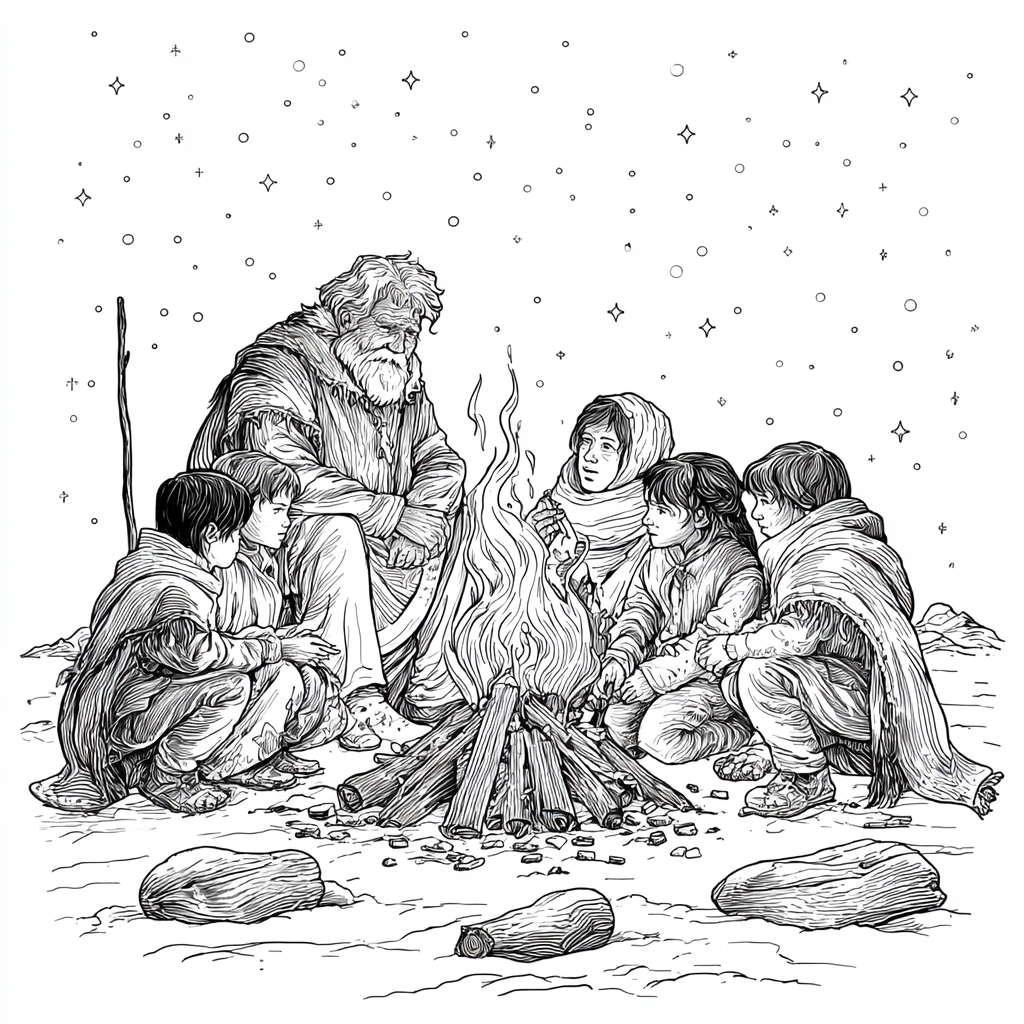
A family clan huddled by a campfire under starry skies, grandfather recounting a tale to grandchildren and relatives, dramatic shadows from flames highlighting intent faces and woven blankets.
Subgenres of Folklore
An Overview
  • Fable
  • Fairy Tale
  • Tall Tale
  • Legend
  • Myth
  • Let's look at each of these a little more closely.
Fable
Very short story with talking animals and a clearly stated moral
  • Key Clues
  • Very short; animals act and speak like humans; ends with a clearly stated lesson
  • Examples
  • The Tortoise and the Hare retold by Nina Solis
  • A boastful Hare mocks a Tortoise for being the slowest creature in the meadow. Then he challenges the Tortoise to a race to prove it. The Hare sprints ahead with ease and, confident the race is already won, lies down to take a nap. The Tortoise plods forward slowly, but without stopping, and he eventually crosses the finish line while the Hare is still sleeping. Slow and steady wins the race.
  • The Ant and the Grasshopper retold by Marcus Adler
  • While an Ant spends the long summer hauling grain back to his colony, a Grasshopper lounges nearby, singing and teasing the Ant for working so hard. When winter arrives and the fields are bare, the Grasshopper comes begging for food. The Ant just asks him what he did all summer. Prepare today for the needs of tomorrow.
Fairy Tale
Has magic, monsters, and/or talking animals
  • Key Clues
  • “Once upon a time,” human main character, magic and monsters
  • Examples
  • Goldilocks and the Three Bears retold by Catherine Marsh
  • Once upon a time, a girl named Goldilocks wanders into a cottage deep in the forest. She decides to help herself to the belongings of its three bear residents. She eats their porridge, breaks a chair, and falls asleep in the smallest bed. When the bear family returns home, they discover the intruder. Goldilocks wakes in a panic and flees through the window, never to return.
  • Cinderella adapted by Rosa Vidal
  • Once upon a time, a girl named Cinderella was living with her mean stepmother and her wicked stepsisters. They made Cinderella do all the cleaning and chores and never let her have any fun. One night, Cinderella's fairy godmother uses magic to give Cinderella a beautiful dress and glass slippers. She even gives Cinderella an enchanted pumpkin carriage! Cinderella goes to the prince's ball and has a grand time. But at midnight, the magic wears off and Cinderella must return home. The love-smitten prince finds the glass slipper that she left behind and searches for her. He uses this slipper as a clue to find her, and in the end they live happily ever after.
Tall Tale
Funny stories set in the Wild West where the main character's size or skill is greatly exaggerated
  • Key Clues
  • American frontier setting and humorous exaggeration
  • Examples
  • Paul Bunyan and the Great Lakes retold by Gerald Hawkins
  • Paul Bunyan was the biggest, strongest lumberjack who ever lived. Paul was so tall that he could use pine trees as toothpicks. He was so strong he could pull a river straight. Paul logged entire forests in a single afternoon. In fact, the Great Lakes are nothing but Paul's footprints from the time he hiked from Maine to Minnesota in a weekend.
  • Pecos Bill and the Tornado retold by Donna Whitfield
  • Pecos Bill was the toughest cowboy in the whole Wild West. He could lasso a lightning bolt and wrestle a grizzly bear before breakfast. Raised by coyotes on the open plains, he became the greatest cowboy the frontier ever saw. When a monstrous tornado ripped across west Texas, Bill didn't run. He lassoed it around the neck, climbed on top, and rode it like a wild mustang across three states.
Legend
A story based on a real person or place that might be true but is exaggerated
  • Key Clues
  • Based on a real figure, facts stretched beyond nonfiction, tone is serious
  • Examples
  • 300 retold by Anton Christou
  • King Leonidas of Sparta led a force of just 300 warriors to hold the narrow pass at Thermopylae. The Persian army numbered in the hundreds of thousands. For three days, the Spartans refused to retreat, fighting in shifts and using the tight terrain to neutralize the enemy's overwhelming numbers. The size of the Persian army meant nothing in this narrow pass. Leonidas and his men defeated tens of thousands of Persians. This small but brave fighting force saved Sparta.
  • Robin Hood and the Silver Arrow adapted by Margaret Ashford
  • An outlaw named Robin Hood hid in the ancient depths of Sherwood Forest and waged a one-man war against the corrupt Sheriff of Nottingham. With a band of loyal followers, Robin robbed wealthy nobles and returned the money to the poor. He became a hero to the common people. He was said to be such a skilled archer that he once split his opponent's arrow straight down the center to win a tournament. No one knows for sure if Robin Hood was a real person, but the forest is real.
Myth
Has gods and goddesses; may explain the creation of something
  • Key Clues
  • Gods/goddesses, origin/creation explanations, ancient cultures
  • Examples
  • Persephone and the Seasons adapted by Daniel Okoro
  • According to the ancient Greeks, Demeter, the goddess of the harvest, loved her daughter Persephone more than anything. One day, Persephone was abducted and taken to the underworld by the god Hades. Demeter was so sad that she made all the plants stop growing and the mortals began to starve. Zeus made a deal with the other gods. Persephone was allowed to come home for part of the year. While she is home, Demeter is happy and plants grow. When she leaves, winter comes. That is how the Greeks explained the seasons.
  • Ra and the First Morning retold by Farah Sayed
  • The ancient Egyptians believed that the universe began as an endless expanse of dark, churning water called Nun. From this nothingness, the sun god Ra willed himself into existence. He rose above the surface and was so bright that light filled the sky for the first time. Then Ra spoke the names of things and they became real. He said "earth," and there was earth. He said "sky," and there was sky. That is how the ancient Egyptians believed the world began.
Drama
Stories written in script form; meant to be performed
  • Key Clues
  • Looks like a script: character names followed by lines.
  • Examples
  • Juliet: O Romeo, Romeo! wherefore art thou Romeo?
  • Hamlet: To be, or not to be: that is the question
Subgenres of Drama
Comedies and Tragedies
  • Comedies
  • Things go poorly for most of the story but it ends happily.
  • Tragedies
  • Things go well for most of the story but it ends terribly.
  • Comedies = Weddings | Tragedies = Funerals
Poetry
Writing that is concerned with the beauty of language
  • There are many subgenres of poetry.
  • Forms: haikus or sonnets
  • Techniques: rhyming or rhythm
  • Poetry is a main literary genre.
Commonly Confused Subgenres
Some Tips and Tricks
  • Fairy tale and Fantasy
  • Fable and Fairy Tale - Look at the ending
  • Tall Tale and Legend - Consider the tone
  • Legend and Historical Fiction - Look at the author
  • Biography and Autobiography - Look at the author
  • Science Fiction and Fantasy - Look at the setting
In Review
  • There are 5 main genres.
  • Identify the main genre first, then look for clues to identify the subgenre.
  • Look at the author credit line!

Review

Shown after slides, one question at a time

Review
The Science of Stink: Why Things Smell and Other Gross Mysteries by Dr. Barnaby P. Sniff
In this hilarious but entirely factual science book, Dr. Barnaby P. Sniff explains the biology behind the world's grossest smells. Readers will learn how bacteria eat sweat to create body odor. The book also uses charts to show readers how scent molecules travel through the air.
  • Science Fiction
  • Biography
  • Informational Writing
  • Realistic Fiction
  • Tragedy
Learn Why (shown after incorrect answer)
This text provides factual information to readers.
Optional Follow-up
How do you know? Explain your answer.
Review
The Backyard Rule by Deshawn Carter
Owen's grandfather has a rule: every answer is in the backyard. Stuck on homework? Go outside and think. Bored? Build something with sticks. Owen has always thought his grandfather was the smartest person alive. The man can fix a truck engine by ear, build a fence without measuring, and name every bird in the county. But staying at Grandpa's farmhouse this summer, Owen starts noticing things that don't add up. Grandpa won't read the newspaper, orders "the usual" at every restaurant, and hands Owen the mail with an excuse about shaky hands. Then Owen finds a drawer full of unopened envelopes, some marked URGENT. Owen realizes his grandfather has been hiding something for a very long time. Should Owen say something, or would that embarrass the toughest person he knows?
  • Historical Fiction
  • Realistic Fiction
  • Persuasive Writing
  • Science Fiction
  • Informational Writing
Learn Why (shown after incorrect answer)
This is a made-up story but it could happen in real life.
Optional Follow-up
How do you know? Explain your answer.
Review
The Lion and the Donkey retold by Brant Miller
One day, a Lion strolled proudly down a forest path while the other animals respectfully stepped aside. Suddenly, a Donkey brayed a rude and insulting remark at the Lion as he passed by. The Lion felt a sudden flash of hot anger and spun around, ready to strike. But when he saw exactly who had spoken, his anger faded into pity, and he walked quietly on. He realized he would not honor such a fool with even a single swipe of his claws. The moral of the story is that you should not resent the remarks of a fool, but simply ignore them.
  • Tall Tale
  • Myth
  • Legend
  • Fable
  • Fairy Tale
Learn Why (shown after incorrect answer)
This is a very short story that is part of the folkloric tradition and has a clearly stated moral.
Optional Follow-up
How do you know? Explain your answer.
Review
Beyond the Cafeteria Doors by Kylie Barnes
In this essay, Kylie argues that the school administration should allow students to eat lunch off campus. She points out that leaving the building gives students a much-needed mental break. She thinks this will help them focus better in their afternoon classes. She also argues that managing their own time and money teaches responsibility. She ends her essay by urging students and parents to sign her petition. She believes off-campus lunch will be better for all.
  • Informational Writing
  • Autobiography
  • Persuasive Writing
  • Biography
  • Science Fiction
Learn Why (shown after incorrect answer)
This text attempts to convince the reader to support off-campus lunch.
Optional Follow-up
How do you know? Explain your answer.
Review
Calamity Jake and the River That Wouldn't Stop retold by Wanda Pike
Out on the frontier, Calamity Jake was famous for doing impossible jobs with a grin. When a flood rushed toward town and the river refused to go back where it belonged, Jake said, "Fine. I'll handle it." He bent down and drank so much water the riverbed showed again. Then, just to be helpful, he spit the extra water into a faraway canyon to make a brand-new lake. Folks say he burped so loud it scared away the rainclouds!
  • Tall Tale
  • Myth
  • Legend
  • Fable
  • Fairy Tale
Learn Why (shown after incorrect answer)
This story has been retold many times, it features humorous exaggeration, and it is set in the American frontier.
Optional Follow-up
How do you know? Explain your answer.
Review
The Library of Locked Doors by James R. Allen
Jada thinks the school library is the quietest place in the building-until she discovers a special key in a dusty book. When she turns it, a hidden door appears between the shelves. It opens to a corridor lined with floating candles and books that breathe like animals. A shadowy librarian warns her to return the key, but something tells Jada not to trust this figure. Each door Jada unlocks reveals another secret: a room of storms, a cage of tiny dragons, a mirror that shows the past. Can Jada learn to control the key before she gets locked away?
  • Historical Fiction
  • Realistic Fiction
  • Fairy Tale
  • Science Fiction
  • Fantasy
Learn Why (shown after incorrect answer)
This is a story with magic and monsters and it is NOT part of the oral tradition.
Optional Follow-up
How do you know? Explain your answer.
Review
Mic Check: My Year in the Sound Booth by Jalen Rivers
In this true story, I—Jalen Rivers—tell what happened when I joined my school's podcast team. I liked writing more than talking, so recording my voice felt scary at first. I describe my first embarrassing episode, the mistakes I made while editing, and the day we had a guest speaker and I almost froze. But I kept showing up, and little by little, my confidence grew. By the end, I wasn't just "helping"—I was leading.
  • Biography
  • Comedy
  • Tragedy
  • Autobiography
  • Persuasive Writing
Learn Why (shown after incorrect answer)
The author tells their own true life story from first-person perspective ("I," "my").
Optional Follow-up
How do you know? Explain your answer.
Review
The Importance of Being Earnest by Oscar Wilde
This hilarious play follows two friends, Jack and Algernon. Both men pretend their name is "Ernest" to win the hearts of two different women. Their lies get completely out of control. However, after many misunderstandings and awkward arguments, the truth comes out. The play finishes with a happy ending where the lies are forgiven and both couples get to be together.
  • Comedy
  • Tragedy
  • Fairy Tale
  • Realistic Fiction
  • Fable
Learn Why (shown after incorrect answer)
This is a play with a happy ending.
Optional Follow-up
How do you know? Explain your answer.
Review
The Sign My Father Carried by Angela Ford
It is February 1968 in Memphis, Tennessee. Twelve-year-old Marcus watches his father leave for work on the back of a garbage truck every morning. One day, two workers are killed when their truck breaks down. Marcus's father and others refuse to go back to work until things change. They march through the streets carrying signs that read "I Am a Man." Marcus wants to help, but his mother says it's too dangerous. Marcus must decide what he is willing to risk to stand beside his father.
  • Informational Writing
  • Realistic Fiction
  • Persuasive Writing
  • Historical Fiction
  • Science Fiction
Learn Why (shown after incorrect answer)
This is a made-up story based around a major historical event.
Optional Follow-up
How do you know? Explain your answer.
Review
Why the Sea Tastes of Salt adapted by Rena Malu
Long ago, the ocean was as fresh and sweet as river water. The Sea Goddess Talua filtered every drop through her coral throne. Her brother, Mako, the God of Storms, grew jealous of how the fishermen praised Talua while fearing him. He churned the seas without warning, sinking boats and scattering fish. Talua tried bargaining, threatening, and even hiding the tides, but nothing stopped him. Finally, Talua wept into the deep. Her divine tears carried a bitterness that no current could wash away. The ocean turned salty that day, and it has never been fresh again. And that is why the sea tastes of salt.
  • Tall Tale
  • Myth
  • Legend
  • Fable
  • Fairy Tale
Learn Why (shown after incorrect answer)
This is a story that is part of the folkloric tradition, has gods and goddesses, and accounts for the creation of something.
Optional Follow-up
How do you know? Explain your answer.