

What are Character Types?
Labels that explain how a character works
- Every story has characters.
- Not every character does the same job.
- Character types = role, depth, change
- Let's learn the words for each kind.
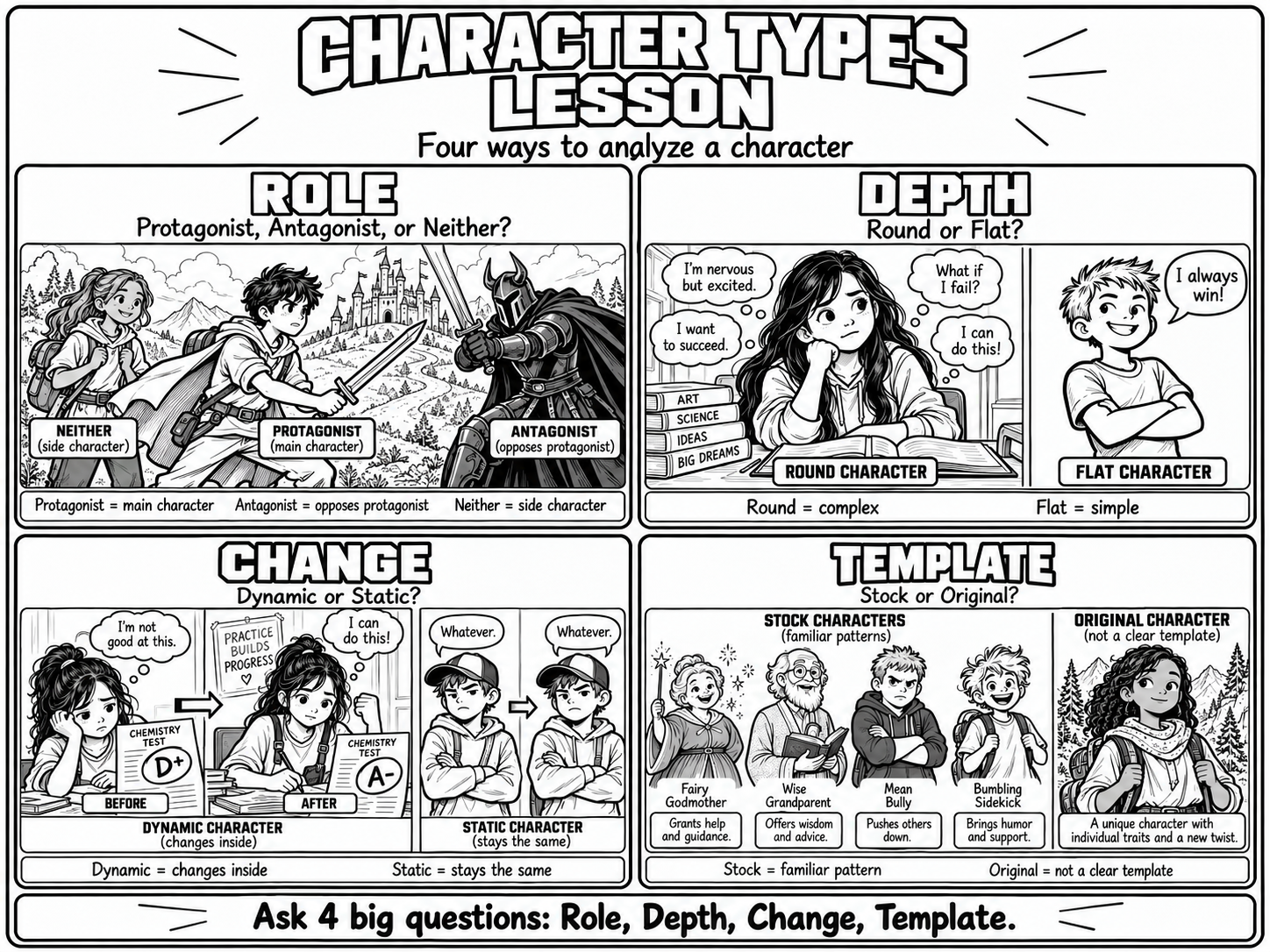
Skill: Character Types
Learn how to analyze the characters in a story. You will learn to classify a character three ways: by their role (protagonist, antagonist, or neither), their depth (round or flat), and their change over time (dynamic or static), plus a bonus label for characters who match a familiar template (stock). Available at three reading levels for grades 3 to 12.
Students flip between this passage and the review questions
Anders loved a good prank. He loved the moment right before it worked, when no one saw it coming. A rubber snake in Theo's backpack. A fake spider on the bus. A whoopee cushion on the substitute's chair. If there was a way to make someone jump, Anders had already tried it.
His best friend Theo was used to it. When the rubber snake fell out of his bag, Theo just sighed and picked it up. "Nice one," he said, like he always did. Theo never got mad. He figured that was just Anders.
Everyone figured that was just Anders. Last month he told the whole bus that Mr. Delgado's house was haunted. For a week, three kids would not walk past it. His big sister Greta did not believe a word he said anymore. When he yelled that there was a spider on her shoe, she did not even look up. "Sure there is," she said, and kept scrolling on her phone.
That was the problem. Anders joked so much that no one could tell when he was serious. There was no serious. There was just Anders, grinning, waiting for you to fall for it.
One night, their dad was cooking dinner. A pan sat on the hot stove. Dad went into the other room to answer the phone. Anders walked in for a snack. That is when he saw it. A dish towel had fallen against the hot burner. A small flame was climbing up the towel toward the cabinets.
"Fire!" Anders shouted. "There is a real fire in the kitchen!"
Greta did not turn around. "Nice try, Anders."
"I am not joking! Dad! Come quick!"
"You are always not joking," Greta said.
The flame was getting bigger. Anders felt something cold drop in his stomach. This was not a prank. He ran to the other room and pulled his dad's arm. "It is real. I promise. Please come."
Something in his face made his dad move. Dad ran to the kitchen. He saw the burning towel. He turned off the burner and dropped a lid over the flame. In a few seconds, the fire was out. There was a black mark on the wall. The room smelled like smoke. But no one was hurt.
Greta came to the door. Her face was pale. She had almost not believed him, and it had been real.
"Good thing you got me so quickly," Dad said.
Anders nodded. But he kept thinking about the scary part. It was not the fire. It was the moment before anyone moved. When he yelled "Fire!" it meant nothing, because he was the boy who joked. His pranks were funny. But now, even when something was real, no one could trust him.
Anders did not want to stop being funny. Being funny was who he was. But he saw that there had to be a difference between joking around and really meaning it. That way, the next time something was real, someone would move right away.
A few days later, Anders told Greta there was a llama in the backyard. Greta did not look up. "Fake," she said.
"Yeah, that one is fake," Anders said, smiling. Then his voice got calm and clear. "But the stove is still on. For real."
Greta looked at him hard. Something was different this time. She got up and checked. The stove was on. She turned it off. She still did not fully trust his jokes, and she never would. But this time, when it was real, she could tell.
Shown after slides, one question at a time