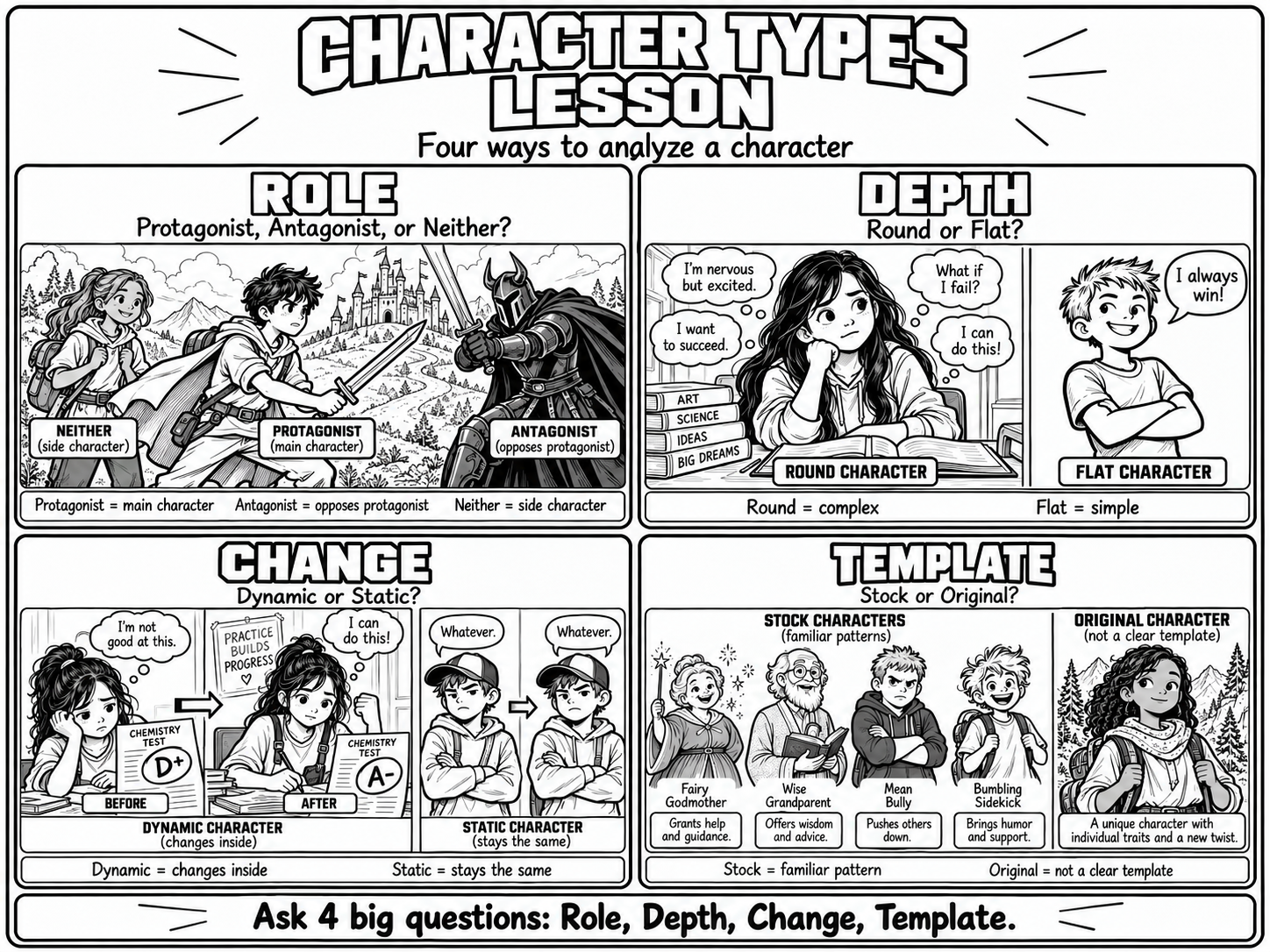
A coloring book style image of various character types: protagonist vs. antagonist, round vs. flat character, dynamic vs. static etc.
Lesson Preview · Grades 9-12

Character Types Lesson

Skill: Character Types

Learn how to analyze the characters in a story. You will learn to classify a character three ways: by their role (protagonist, antagonist, or neither), their depth (round or flat), and their change over time (dynamic or static), plus a bonus label for characters who match a familiar template (stock). Available at three reading levels for grades 3 to 12.

Ad 728x90
What are Character Types?
Analytical labels for how characters function
  • Every story has characters.
  • Not every character does the same job.
  • Character types = role, depth, change
  • Let's learn the vocabulary.
Four Big Questions
Ask these questions about a character...
  • 1. Role: Is this the main character, or do they push against the main character?
  • 2. Depth: Is this character complex or simple?
  • 3. Change: Does this character change inside, or stay the same?
  • 4. Template: Does this character match a familiar type?
  • Let's learn each one, starting with role.
Role: The Conflict Lens
Protagonist, Antagonist, or Neither?
  • Protagonist = the central character.
  • Antagonist = the character, group, or force that opposes the protagonist.
  • Neither = a supporting or minor character who is not central to the conflict.
  • Role is structural, not moral.
Depth of the Character: How Much Do They Develop?
Are they simple or complex?
  • Round = deep character with mixed feelings and complex motivations.
  • Flat = simple character with one side and little depth.
  • Flat Does NOT Mean Bad
Change: Does the Character Grow?
Does the character change inside?
  • Dynamic character = learns an important lesson and has a clear inner shift.
  • Static character = stays basically the same through the story.
  • Static characters can still act, struggle, fail, or succeed.
Template: Stock Character or Original?
Is the character recognizable from other stories?
  • Stock character = a familiar character pattern
  • Examples
  • The fairy godmother, the corrupt sheriff or official, the mean bully, the wise grandparent, the bumbling sidekick
  • Original character = does NOT clearly fit a familiar template.
  • Most characters are not labeled stock unless the template is obvious.
Don't Get Tricked!
  • Mix-Up 1: Round and dynamic measure different things.
  • Round = depth at any moment. Dynamic = change over time. A character can be round AND static, or flat AND dynamic.
  • Mix-Up 2: An antagonist is NOT always a villain.
  • A loving parent blocking a risky dream is an antagonist. They just need to oppose the protagonist.
  • Mix-Up 3: Static does NOT mean flat.
  • Static = does not change. Flat = lacks depth. A round character can also be static.
Putting It All Together
  • Dara had wanted to be a doctor since she was seven. But this year her chemistry grade fell apart, and she started to wonder if she was fooling herself. Her older brother told her she was just scared. Dara knew he was right. She also knew she could walk away and no one would blame her. Instead, she signed up for tutoring. By the end of the semester she had pulled the grade up to a solid B, and she had decided something else: she did not want to be a doctor because other people expected it. She wanted it because she did.
  • Role: Dara is the protagonist.
  • Depth: Dara is round.
  • Change: Dara is dynamic.
  • Template: Dara is an original character.

Reading Passage

Students flip between this passage and the review questions

"For Real This Time"

Anders lived for the half second before a prank landed, that breath of time when the trap was set and no one knew it yet. A rubber snake coiled in Theo's backpack. A plastic spider dangling over a bus seat. A whoopee cushion tucked under the substitute's chair. If there was a way to make a person jump, Anders knew it well, had run the experiment in the past, and could report the results from memory.

Theo had long since stopped reacting. When the snake tumbled out of his bag, he only exhaled and set it on the desk. "Nice one, Anders," he said, exactly as he always said it. Theo did not get angry. He figured that was just Anders and pranks were just something that happened around Anders and always would.

Everyone had filed him under the same heading. Weeks earlier he had informed the entire bus that Mr. Delgado's house at the end of the block was haunted, and for days afterward a handful of younger kids took the long way around it. His older sister Greta had quietly retired every ounce of trust she had once extended him. When he burst into the kitchen swearing a spider was crawling up her shoe, she did not lift her eyes from her phone. "Sure it is," she said, in the flat voice of someone who had been fooled one too many times and had made a policy of disregarding Anders entirely.

That was the trouble with Anders, though he would not have called it trouble yet: he joked so constantly that the signal had worn out. There was no register left for sincerity. There was only Anders, grinning, waiting for the world to take the bait.

One evening his father was cooking, caramelizing onions in a pan working on the stove, when the phone rang and he stepped into the next room. Anders drifted into the kitchen, hunting for a snack, and saw it before he understood it. A dish towel had sagged against the live burner and a slim tongue of flame was working its way up the cloth toward the cabinets.

"Fire," he said with a bit of reservation, and then louder, "there is a fire, an actual fire, in the kitchen, right now."

Greta did not so much as turn her head. "Nice try, Anders."

"I am not messing around. Dad. Dad, get in here!"

"You are never messing around," Greta said, unbothered, as this moment of tension and disbelief haunted Anders worse than any specter sighted near Mr. Delgado's house.

The flame climbed. Anders felt a cold, dropping weight in his gut, the precise opposite of the thrill he chased when setting up a prank. He crossed the room in three steps, seized his father's arm, and pulled. "It is real. I am begging you, Dad. Come now!"

Perhaps it was his face or perhaps some older instinct read what his reputation had buried, but his father moved toward the kitchen, and when he got there, Dad took the burning towel, and acted without wasted motion. He killed the burner, dropped a lid over the flame, and smothered it in seconds, a puff of black smoke rolled across the ceiling. A dark streak of soot marked the wall above the stove. The air was heavy with smoke but no one was hurt.

Greta reached the doorway and stopped, the color gone out of her face. She had come within a few careless seconds of suffering through a burning kitchen.

His father breathed out slowly. "Good thing you came and got me, Anders," he said.

Anders nodded, but his mind had snagged on something worse than the fire. It was not the flame that frightened him. It was the silence before anyone moved, the seconds in which the word "fire" left his mouth and simply died there, weightless, because it came from the boy who joked. The pranks had been funny and he did not regret the laughter. What unsettled him was the discovery that he had bought that laughter by selling the trust that others had placed in him. These pranks had come at a great cost and now nobody who knew Anders could afford to believe him.

He did not resolve to stop being funny. Being funny was part of who he was and he had no intention of amputating that part from himself. What he resolved was subtler. There had to be a line, audible to the people around him, between Anders at play and Anders in earnest, so that the next time the stakes were real, no one would lose a second deciding whether to believe him. Comedy was cheap. Credibility, he now saw, was the thing you spent it on, and he had nearly gone bankrupt.

A few days later he told Greta there was a llama loose in the backyard. She did not glance up. "Fake."

"That one is fake," he agreed, grinning. Then the grin fell away and his voice went level and plain. "The stove is still on, though. For real this time."

She looked at him a long moment, reading him, and found something in his tone she had not bothered to look for in years. She got up, checked, switched it off, and jabbed a finger at him on her way back. "Do not make me regret this."

She was the same Greta she had always been, still built to call his bluff on reflex. The difference was on Anders' side of it. This time, when it counted, he had made certain she could tell.

Review

Shown after slides, one question at a time

Review
Which character is best described as the protagonist?
  • Greta
  • Anders
  • Mr. Delgado
  • Theo
  • Dad
Learn Why (shown after incorrect answer)
Anders is best described as the protagonist. The reason for this is that the story follows his experience, and he is the character who faces the central conflict: his constant joking nearly costs his family when a real emergency hits.
Optional Follow-up
Why do you believe this? Explain your answer.
Review
Which best describes the antagonist?
  • Greta, who refuses to believe Anders
  • Dad, who is busy on the phone
  • Theo, who has grown used to Anders' pranks
  • The fire on the stove, which threatens the kitchen
  • Anders's own reputation as the boy who is always joking
Learn Why (shown after incorrect answer)
Anders spent his own credibility tricking people for laughs, so the force opposing Anders here is that no one believes him. The fire is the crisis that forces the issue, not the thing he struggles against. Anders struggle is to be believed.
Optional Follow-up
Why do you believe this? Refer to the text in your answer.
Review
Is Anders a static or a dynamic character?
  • Static character
  • Dynamic character
Learn Why (shown after incorrect answer)
Anders is a dynamic character because he has a real inner shift. He learns that he traded trust for laughs and resolves to draw a clear line between joking and meaning it.
Optional Follow-up
How do you know? Explain your answer by referring to the text.
Review
Is Anders a flat or a round character?
  • Flat character
  • Round character
Learn Why (shown after incorrect answer)
Anders is a round character with multiple sides. First, he is the gleeful trickster. Then he feels genuine fear and readers see him become a reflective person who grasps what his joking cost.
Optional Follow-up
How do you know? Explain your answer by referring to the text.
Review
Is Greta best described as a protagonist, an antagonist, or neither?
  • Protagonist
  • Antagonist
  • Neither
Learn Why (shown after incorrect answer)
Greta is not an antagonist or a protagonist. She is neither. Although she is Anders loudest skeptic, she is not driving the conflict or trying to oppose him. She is merely a character who has been affected by Anders' behavior.
Optional Follow-up
Why do you believe this? Explain your answer.
Review
Is Greta a static or a dynamic character?
  • Static character
  • Dynamic character
Learn Why (shown after incorrect answer)
Greta remains static throughout the text. She is the same skeptic at the start and the end, and the text says it outright: "She was still the same Greta." At the end of the text, she begins to believe Anders, but only due to the fact that he changed how he signals sincerity. This means that the change belongs to Anders, not Greta
Optional Follow-up
Why do you believe this? Refer to the text in your answer.
Review
Is Theo a flat or a round character?
  • Flat character
  • Round character
Learn Why (shown after incorrect answer)
Theo is a flat character. He has just one trait. He is the kind friend. He plays a short and steady small role.
Optional Follow-up
How do you know? Explain your answer.
Review
Is Dad best described as a protagonist, an antagonist, or neither?
  • Protagonist
  • Antagonist
  • Neither
Learn Why (shown after incorrect answer)
Dad is not an antagonist or a protagonist. His role in the story is neither. He's a helper who ends the crisis but the conflict isn't his and he doesn't oppose Anders.
Optional Follow-up
Why do you believe this? Explain your answer.
Review
Is Dad a flat or a round character?
  • Flat character
  • Round character
Learn Why (shown after incorrect answer)
Dad is a flat character. He really only presents a single dimension: supportive parental figure, occasionally preoccupied with phone calls.
Optional Follow-up
Why do you believe this? Explain your answer.
Review
Is Mr. Delgado a static or dynamic character?
  • Static character
  • Dynamic character
Learn Why (shown after incorrect answer)
Mr. Delgado is a static character who never actually appears in the story and is only mentioned as a past prank target of the "haunted" house.
Optional Follow-up
Why do you believe this? Explain your answer.