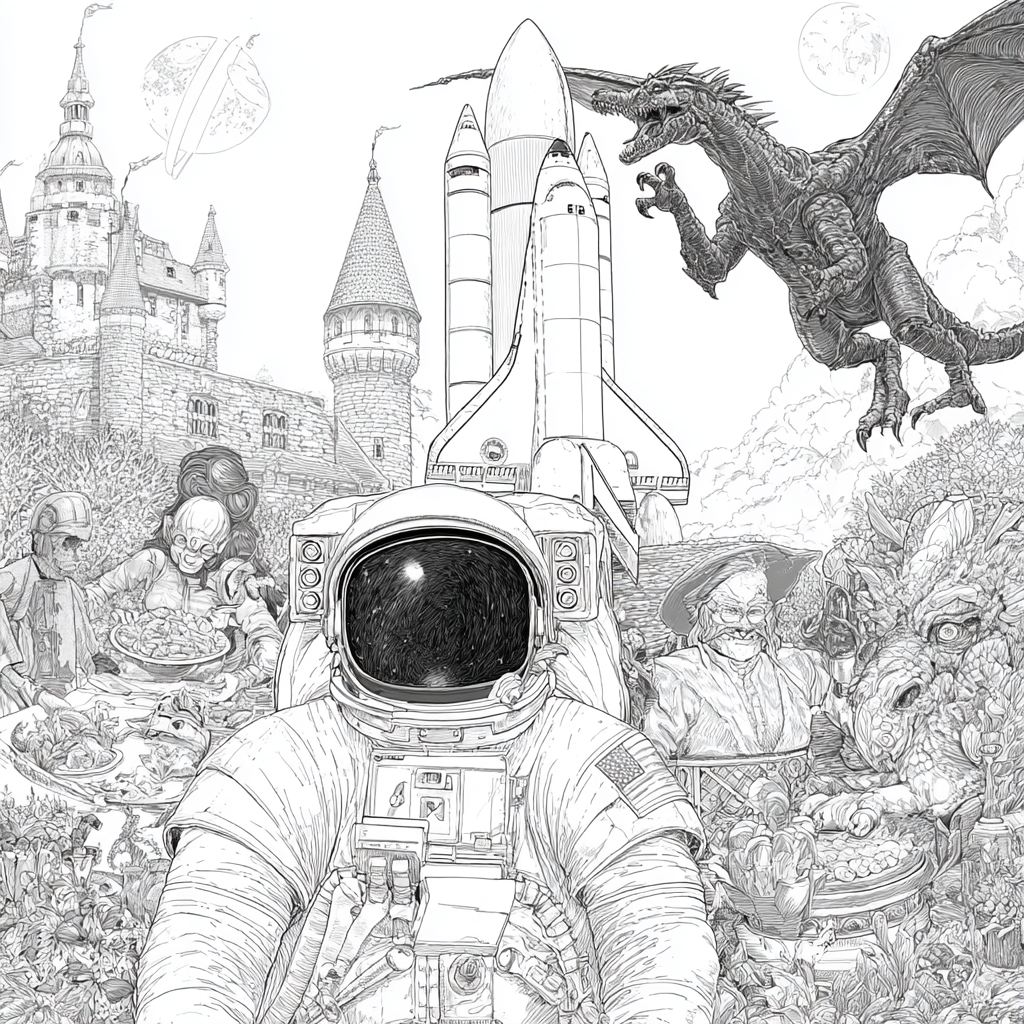
A vibrant collage of fiction genres: astronaut in spaceship for sci-fi, knight in castle for historical, family dinner for realistic, wizard battling dragon for fantasy
Lesson Preview · Grades 9-12

Genre and Subgenre Lesson

Skill: Genre and Subgenre

This lesson explains the five major literary genres — fiction, nonfiction, folklore, drama, and poetry — and then dives into some of the subgenres. Students learn to identify and distinguish subgenres like science fiction, mystery, historical fiction, biography, autobiography, informational text, fable, fairy tale, myth, legend, and tall tale. After the lesson, students practice classifying a variety of texts by genre and subgenre. Available at three reading levels for grades 3–12.

Ad 728x90
Genre
Genre = Category
  • Subgenre
  • Subgenre = Category within a category
  • Example
  • A BANANA → is a FOOD → is a FRUIT.
  • Harry Potter → is FICTION → is FANTASY.
Genre Overview
The 5 Main Genres
  • Fiction - Creative or imaginative writing; made up.
  • Nonfiction - Writing that is true or factual.
  • Folklore - Stories once passed down orally (by word of mouth).
  • Drama - A play or script.
  • Poetry - Writing that is concerned with the beauty of language.
  • Let's look at each of these more closely...
Subgenres of Fiction
An Overview
  • Realistic Fiction
  • Historical Fiction
  • Science Fiction
  • Fantasy
  • Let's look at each of these a little closer.
Realistic Fiction
Stories that could be true but aren't.
  • Key Clues
  • Everyday settings, relatable problems, no magic/aliens/historical anchors.
  • Examples
  • The Weight of the Name by Sarah Jenkins
  • Clara is offered a controversial internship. Now she is struggling to balance her family’s high expectations for her future against her own plans and desires.
  • Exit Interview by Tom Kessler
  • A student newspaper editor discovers a story that could expose favoritism in the scholarship process. This is a big deal, but publishing it may mean burning a bridge with her favorite teacher.
Historical Fiction
A made-up story set around a real event or person from history
  • Key Clues
  • Specific dates or eras and real wars or events from the past.
  • Examples
  • My Family Name by Kenji Sugiyama
  • In 1944, many Japanese-Americans were deprived of their property and put in internment camps. This is the story of a teenager struggling to maintain his family's honor while living in one of these camps.
  • To Toss the Cap by Amara Howard
  • A young Black woman enrolls in a newly integrated university in 1962. She deals with hostile classmates and harassment. She wonders whether earning her degree is worth enduring what it costs her every day to walk through those doors.
Science Fiction
Has aliens, advanced technology, or is set in outer space or the future
  • Key Clues
  • Futuristic dates, space travel, alien species, and advanced technology
  • Examples
  • The Seventy-Year Drift by Catalina Voss
  • Seventeen-year-old Wren finds herself aboard a generation ship bound for a distant planet. Her world changes when she uncovers evidence that the ship's navigation AI has been making decisions it was never authorized to make.
  • Meridian Upload by Joss Tanaka
  • Schools have replaced books with brain downloads. A new machine beams lessons into students' brains. But 8th grade student Dex Parker discovers something shocking. The latest update is quietly rewriting the way that some students think.
Fantasy
Has monsters, magic, or characters with superpowers
  • Key Clues
  • Spells, dragons, monsters, or magical realms
  • Examples
  • Thornspell by Gina Harris
  • After accidentally unlocking a dark magic sealed in his grandmother's garden, fourteen-year-old Callum discovers he can speak to animals. But every word he says drains the magic keeping an ancient forest alive.
  • Ink and Bone by Tariq Hollis
  • Renna discovers she can pull objects out of books just by tracing the illustrations with her finger — a sword from an adventure novel, a key from a mystery. But every object she removes changes the story it came from, and those changes are starting to leak into the real world.
Subgenres of Nonfiction
An Overview
  • Informational Writing
  • Persuasive Writing
  • Autobiography
  • Biography
  • Let's look at each of these a little more closely.
Informational Writing
Gives facts, explains, teaches
  • Key Clues
  • Textbooks, cookbooks, how-to guides, reference materials; may have an objective tone; explains, describes, or teaches something
  • Examples
  • All About Sharks by Dr. Raymond Finnegan
  • This book teaches you all about oceanic sharks. You will learn what they eat, their preferred habitats, and how they swim so fast.
  • Sauces Made Easy by Ruby Sanders
  • This text teaches readers how to make dozens of simple, delectable sauces to serve with any meal. Includes step-by-step directions to simmer your way to satisfaction.
Persuasive Writing
Tries to influence or convince the reader
  • Key Clues
  • Argues, tries to convince, uses words like "should" or "must," asks readers to take action
  • Examples
  • Why Homework Should Include Choice by Leah Sandler
  • Leah argues that schools should replace one-size-fits-all homework with student-selected options. She thinks this will build independence and improve engagement. She presents arguments supporting her opinion. Then she asks teachers to support a pilot program.
  • Screen-Free Saturdays: A Case for Unplugging by Derek Montoya
  • In this essay, the author argues that families should commit to one screen-free day per week. He presents research on how constant device use affects focus and sleep. Then he encourages readers to challenge themselves to try it for a month.
Autobiography
One's life story written by oneself
  • Root Words
  • AUTO = self | BIO = life | GRAPHY = writing
  • Examples
  • Running Toward Morning by Elena Cruz
  • In this true memoir, Elena recounts how distance running carried her through family loss and public failure. Readers will find her honest voice both moving and inspiring.
  • Night by Elie Wiesel
  • Elie Wiesel tells the true story of his own life as a young boy during World War II. He tells how the Nazis took him and his family to horrific prison camps like Auschwitz, where many people suffered and died. Elie wrote this book to share his sad memories and teach us never to forget the Holocaust.
Biography
A person’s life story written by someone else
  • Root Words
  • BIO = life | GRAPHY = writing
  • Examples
  • A Mind Like No Other: The Story of Leonardo da Vinci by Paul Sutton
  • Sutton's book is about the life of Leonardo da Vinci, who was a painter, an inventor, and a scientist all at the same time. Leonardo da Vinci filled notebooks with drawings of flying machines and the human body and was one of the most creative people who ever lived.
  • The Queen of the Nile: Cleopatra's Story by Diana Frost
  • Diana Frost tells the true story of Cleopatra, the famous queen of ancient Egypt. Cleopatra was smart and spoke many languages. She led her country during a very difficult time and made alliances with some of the most powerful leaders in the ancient world.
Folklore
Stories passed down by telling and retelling
  • Part of the oral tradition
  • Usually teach a lesson or explain something
  • "RETOLD BY," "ADAPTED BY," and "UNKNOWN"
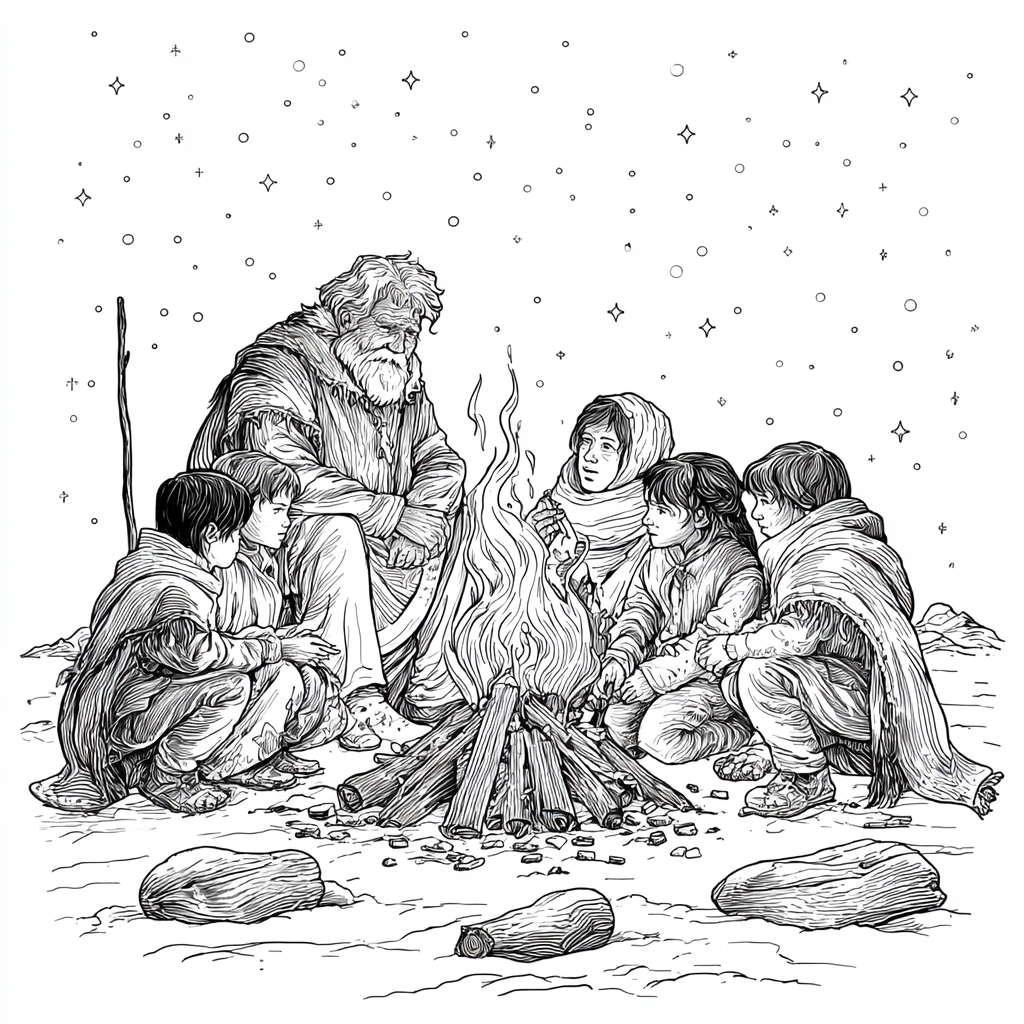
A family clan huddled by a campfire under starry skies, grandfather recounting a tale to grandchildren and relatives, dramatic shadows from flames highlighting intent faces and woven blankets.
Subgenres of Folklore
An Overview
  • Fable
  • Fairy Tale
  • Tall Tale
  • Legend
  • Myth
  • Let's look at each of these a little more closely.
Fable
Very short story with talking animals and a clearly stated moral
  • Key Clues
  • Very short; animals act and speak like humans; ends with a clearly stated lesson
  • Examples
  • The Tortoise and the Hare retold by Nina Solis
  • A Hare mocks a Tortoise and suggests that they compete in a race. The Hare speeds ahead, and, thinking he doesn’t need to try hard to beat the Tortoise, lies down under a tree to nap. The Tortoise, not bothered by the crowd’s laughter, keeps going at his steady speed. Eventually, he crosses the finish line before the Hare even wakes up. Slow and steady wins the race.
  • The Ant and the Grasshopper retold by Marcus Adler
  • During the warm summer, an Ant works hard every day, saving food for the future, while a Grasshopper laughs at him and spends all his time playing and singing. When winter comes and there is little food, the Grasshopper, now in trouble, begs the Ant for help. He learns that counting on others to help is not as good as planning ahead. Prepare today for the needs of tomorrow.
Fairy Tale
Has magic, monsters, and/or talking animals
  • Key Clues
  • “Once upon a time,” human main character, magic and monsters
  • Examples
  • Goldilocks and the Three Bears retold by Catherine Marsh
  • Once upon a time, a girl named Goldilocks enters a cottage in the forest and proceeds to eat, break, and sleep her way through the possessions of its three bear inhabitants. Eventually the bears return home. Understandably, they are upset and Goldilocks is forced to confront the consequences of her actions, which in this case means she must flee to safety through a window.
  • Cinderella adapted by Rosa Vidal
  • Once upon a time, a young maiden named Cinderella was living with her cruel stepmother and her malevolent stepsisters. They forced Cinderella to toil endlessly and never enjoy herself for a moment. One night, Cinderella's fairy godmother transforms Cinderella, giving her a beautiful dress, glass slippers, and an enchanted pumpkin carriage! Cinderella goes to the prince's ball and has a grand time. But at midnight, the magic wears off and Cinderella must flee precipitously. The love-smitten prince finds the glass slipper that she left behind and conducts a search for her. He uses this slipper as a clue to find her, and in the end they live happily ever after.
Tall Tale
Funny stories set in the Wild West where the main character's size or skill is greatly exaggerated
  • Key Clues
  • American frontier setting and humorous exaggeration
  • Examples
  • Paul Bunyan and the Great Lakes retold by Gerald Hawkins
  • Paul Bunyan was the biggest, strongest lumberjack who ever lived. Paul stood so tall that birds nested in his beard. Paul could fell a thousand trees with a single swing of his mighty axe. And Paul was strong enough to straighten a crooked river. The Great Lakes themselves were nothing more than Paul's bootprints from a particularly long walk that later filled with rain.
  • Pecos Bill and the Tornado retold by Donna Whitfield
  • Pecos Bill could lasso a lightning bolt and wrestle a grizzly bear before breakfast. Raised by coyotes on the open plains, he became the greatest cowboy the frontier ever saw. His most celebrated feat, however, was riding a tornado. When a cyclone the size of three counties came tearing across the Texas panhandle, Bill roped it, mounted it bareback, and held on for a ride that crossed four state lines.
Legend
A story based on a real person or place that might be true but is exaggerated
  • Key Clues
  • Based on a real figure, facts stretched beyond nonfiction, tone is serious
  • Examples
  • 300 retold by Anton Christou
  • King Leonidas of Sparta, commanding a rear guard of roughly 300 Spartans and a smaller contingent of allied Greeks, held the coastal pass against the full might of a Persian invasion force for three days in 480 BCE. They fought in a narrow pass at Thermopylae. The Persian army numbered in the hundreds of thousands. Some say there were over a million Persian troops. For three days, the Spartans refused to retreat, fighting in shifts and using the tight terrain to neutralize the enemy's overwhelming numbers. The size of the Persian army meant nothing in this narrow pass. Leonidas and his small force held off hundreds of thousands of Persians and saved Sparta.
  • Robin Hood and the Silver Arrow adapted by Margaret Ashford
  • An outlaw named Robin Hood hid in the ancient depths of Sherwood Forest during the medieval period and waged a one-man war against the corrupt Sheriff of Nottingham. With a band of loyal followers, Robin robbed wealthy nobles and returned the money to the poor. He became a hero to the common people. Robin's legendary marksmanship, his ability to evade capture despite a substantial bounty, and exploits such as splitting an opponent's arrow at tournament have been told and retold for centuries. No one knows for sure if Robin Hood was a real person, but the forest is real.
Myth
Has gods and goddesses; may explain the creation of something
  • Key Clues
  • Gods/goddesses, origin/creation explanations, ancient cultures
  • Examples
  • Persephone and the Seasons adapted by Daniel Okoro
  • According to the ancient Greeks, Demeter, the goddess of the harvest, plunged the world into endless winter after her daughter Persephone was taken to the underworld by the god Hades. No crops grew and the mortals began to starve. Zeus brokered a compromise: Persephone would spend half the year above ground with her mother and half below with Hades. This is how the Greeks explained why the earth blooms in spring and dies back in winter.
  • Ra and the First Morning retold by Farah Sayed
  • According to the ancient Egyptians, the universe began as an endless expanse of dark, churning water called Nun. From this nothingness, the sun god Ra willed himself into existence. He rose above the surface, bringing light to the void for the first time. Then Ra spoke the names of all things — the sky, the earth, the rivers, and every living creature. Each came into being at the sound of his voice. The ancient Egyptians believed that Ra continued to sail across the sky each day and through the underworld each night, endlessly repeating the journey that began with creation.
Drama
Stories written in script form; meant to be performed
  • Key Clues
  • Looks like a script: character names followed by lines.
  • Examples
  • Juliet: O Romeo, Romeo! wherefore art thou Romeo?
  • Hamlet: To be, or not to be: that is the question
Subgenres of Drama
Comedies and Tragedies
  • Comedies
  • Things go poorly for most of the story but it ends happily.
  • Tragedies
  • Things go well for most of the story but it ends terribly.
  • Comedies = Weddings | Tragedies = Funerals
Poetry
Writing that is concerned with the beauty of language
  • There are many subgenres of poetry.
  • Forms: haikus or sonnets
  • Techniques: rhyming or rhythm
  • Poetry is a main literary genre.
Commonly Confused Subgenres
Some Tips and Tricks
  • Fairy tale and Fantasy
  • Fable and Fairy Tale - Look at the ending
  • Tall Tale and Legend - Consider the tone
  • Legend and Historical Fiction - Look at the author
  • Biography and Autobiography - Look at the author
  • Science Fiction and Fantasy - Look at the setting